 Quran
Quran
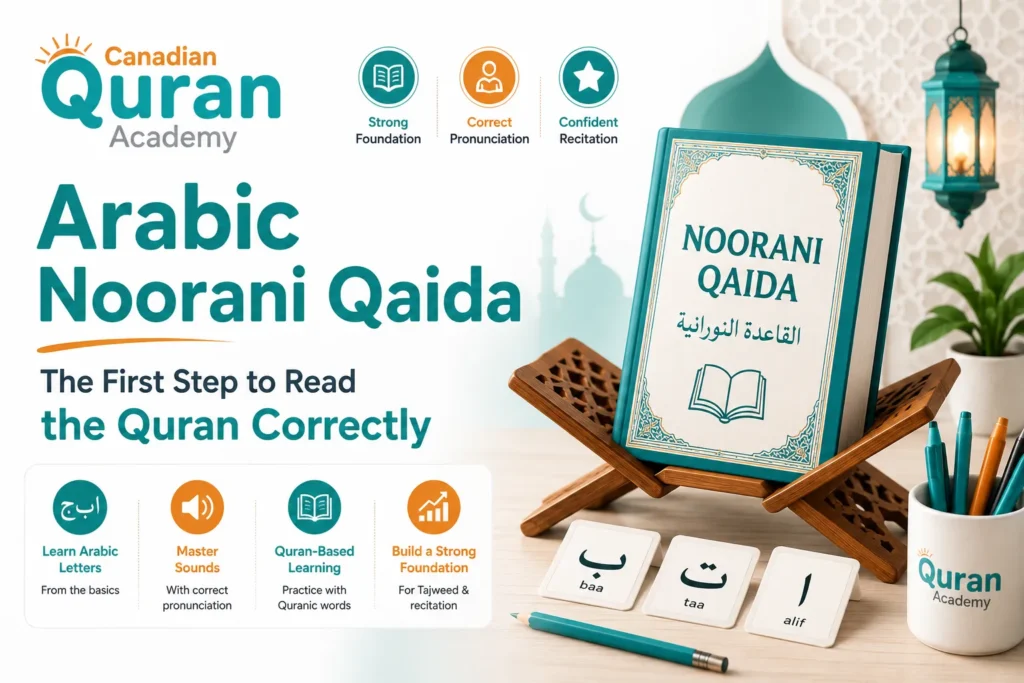
If you’ve ever watched a child stumble over Quranic verses, guessing at letters instead of reading them, you already understand why the Arabic Noorani Qaida exists. It’s the small booklet that turns guesswork into genuine reading — the first structured step between “I don’t know Arabic” and “I can recite the Quran correctly.”
This guide explains what Noorani Qaida is, where it came from, why it matters, who it’s designed for, and how a Noorani Qaida lesson is actually taught — whether you’re a parent teaching at home or a teacher planning a classroom.
What you’ll learn in this article
- What the Arabic Noorani Qaida actually teaches and how it’s structured
- Where Noorani Qaida came from and why it’s still used worldwide
- Why skipping it causes pronunciation problems that are hard to undo later
- Who should start it, and at what age
- How a typical Noorani Qaida lesson plan is built, chapter by chapter
- Practical, step-by-step methods for teaching it to a child or adult beginner
What is Noorani Qaida?
Noorani Qaida is a short foundational booklet — typically 30 to 40 pages — that teaches the Arabic alphabet noorani qaida method: letter shapes, letter sounds, vowel marks, and the rules for joining letters into words, using Quranic text as the practice material from day one.
Unlike a general Arabic-language primer, every example in Noorani Qaida is pulled from Quranic vocabulary. You’re not learning random Arabic words — you’re training your eyes, mouth, and ear on the exact sounds you’ll need to recite the Quran accurately.
The book covers the 28 Arabic letters in their different written forms, short vowels (fatha, kasra, damma), long vowels, tanween, sukoon, tashdeed, and introductory tajweed rules such as qalqalah and the rules of noon sakinah. By the final pages, a student is reading short Quranic verses with correct pronunciation.
How Noorani Qaida differs from other Qaida methods?
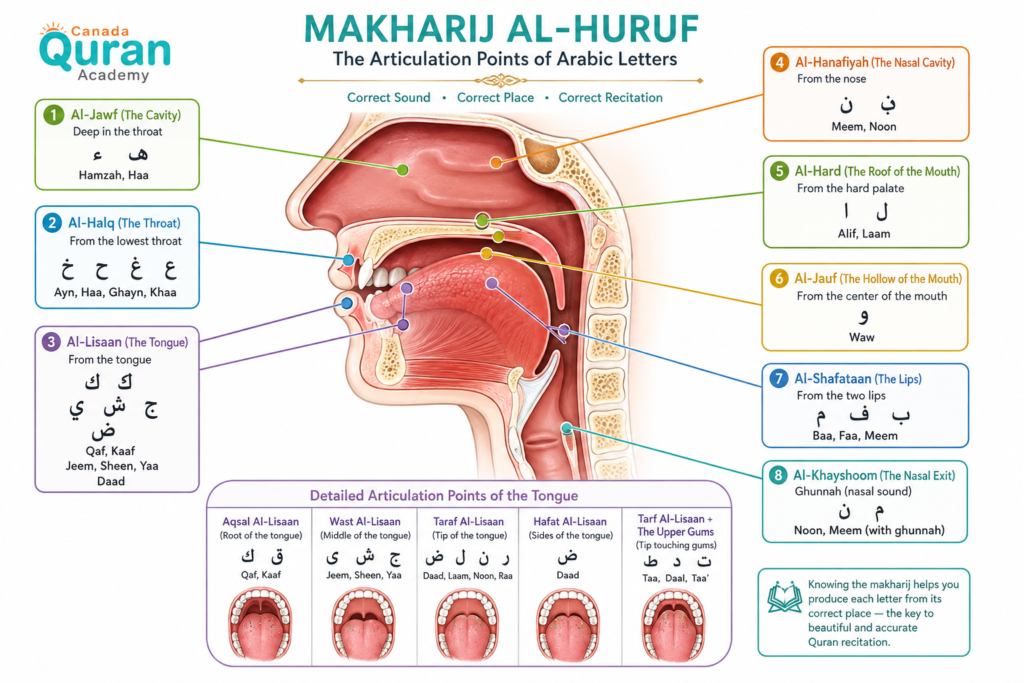
You may also come across Madani Qaida, Baghdadi Qaida, or Noor-ul-Bayan. All of them teach the same basic skill — reading Arabic script for Quran recitation — but Noorani Qaida places heavier emphasis on makharij, the exact articulation points in the mouth and throat where each letter sound originates.
That focus on precise articulation is why it’s remained the most widely used method across Islamic schools for over a century.
The origin of Noorani Qaida
Noorani Qaida was compiled roughly 150 years ago by Sheikh Noor Muhammad Haqqani, an Islamic scholar from India, who noticed that non-Arab Muslims were making pronunciation errors serious enough to change the meaning of Quranic words.
He built a step-by-step method — starting from isolated letter shapes and progressing to full verses with tajweed — that broke Arabic phonetics into small, teachable stages.
The book was named Al-Qaida an-Nooraniyah, “the luminous foundation,” reflecting its purpose: illuminating the path to correct Quran reading.
That structure worked well enough that it’s now taught in madrasas and Quran academies across Pakistan, India, Bangladesh, the Middle East, and increasingly in North America, wherever families are raising children — or entering Islam as adults — without a background in Arabic.
Canadian Quran Academy’s own Noorani Qaida curriculum follows this same time-tested sequence, adapted for online, one-on-one teaching.
Read also: The Most Used Arabic Words In The Quran – With Meaning And Frequency
Why Noorani Qaida Matters For Correct Quran Reading?
Arabic pronunciation carries meaning in ways English doesn’t, which is exactly why the Arabic Noorani Qaida places so much weight on sound before speed.
A single letter swapped for a similar-sounding one can change a word entirely — the classic example is قَلْب (qalb, “heart”) versus كَلْب (kalb, “dog”). Reciting the Quran with that kind of substitution is a real risk for anyone who skips foundational training.
This is the core importance of Noorani Qaida: it trains the tongue and throat to produce correct sounds before a student ever touches a full page of Quranic text, so bad habits never form in the first place.
Skipping this stage doesn’t actually save time — it just moves the cost later. Students who jump straight into Quran reading without it tend to read slowly, mispronounce frequently, and need far more correction from a teacher down the road.
Students who invest three to six months in Noorani Qaida first generally move through Quran reading and tajweed noticeably faster once they get there.
Read Also: How To Learn Arabic For Quran In Canada?
Live Class in Action
Watch how our instructors interact with students in real-time, focusing on interactive methods.
Start Your Quranic Journey in Canada
Join our vibrant community and learn with expert tutors through our flexible online platform.
Claim Your Free TrialThe Goals Of Noorani Qaida
Every stage of Noorani Qaida is built toward a specific, measurable goal rather than vague “Arabic exposure.” The core goals are:
- Accurate letter recognition in all written positions — isolated, beginning, middle, and end of a word, since Arabic letters change shape depending on where they sit.
- Correct short and long vowel pronunciation, so a student can tell فَ, فِ, and فُ apart instantly, by sound, not just by sight.
- Fluent letter-joining, where individual sounds blend into real words at a natural reading pace, rather than being sounded out letter by letter.
- Early tajweed awareness — qalqalah, madd, and the noon sakinah rules — introduced gradually so a student isn’t overwhelmed the moment they open a Mushaf.
- A trained ear, not just trained eyes: distinguishing between similar-sounding letters like ص and س, or ط and ت, which is where most non-Arabic speakers actually struggle.
Read also: 8 Quran Verses About Daughters In Arabic And English With Meanings
Who Is Noorani Qaida For? Understanding The Targeted Segment
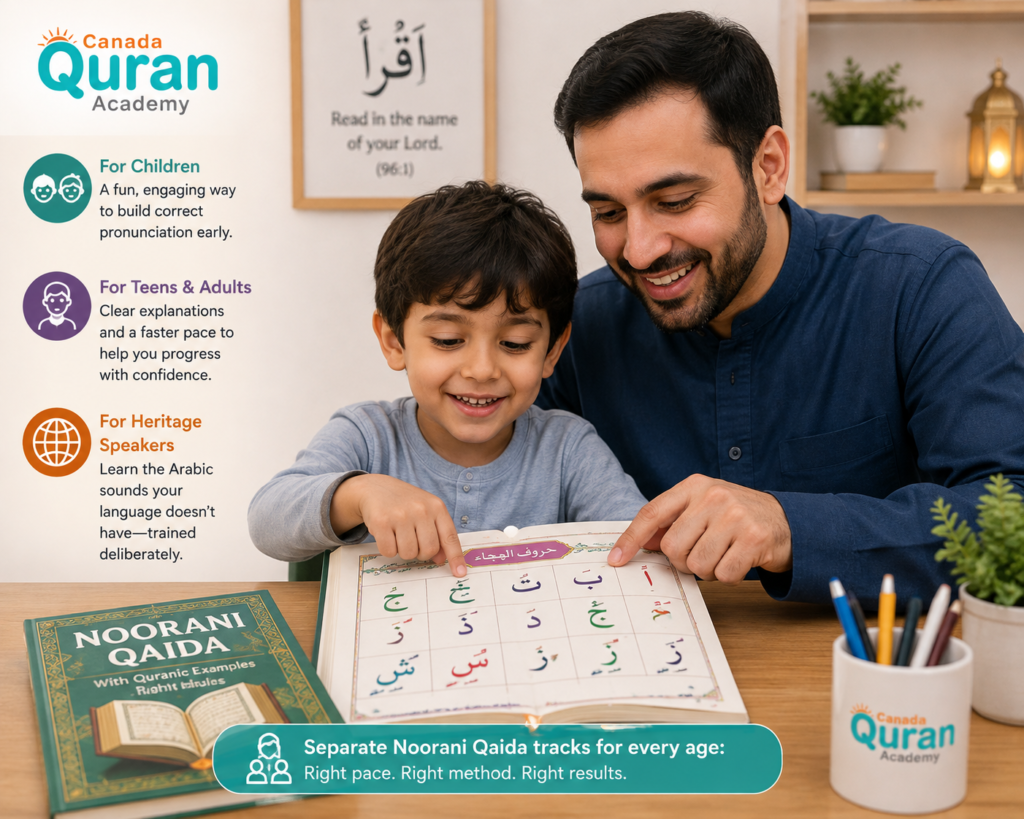
Noorani Qaida was designed with non-Arabic speakers in mind, which makes its targeted segment broader than “just kids.” Three groups benefit most.
Children aged 4 to 7 pick up pronunciation patterns naturally at this stage, and starting early prevents mispronunciation habits from setting in before they’re noticed.
Teenagers and adults with no Arabic background, including converts to Islam, can and do complete Noorani Qaida successfully — age has far less impact on progress than consistency does.
Heritage speakers of other languages — English, Urdu, Bengali, Turkish, Malay — often need Noorani Qaida specifically because their native language doesn’t contain the same throat and mouth sounds Arabic requires, so those sounds have to be trained deliberately rather than absorbed.
Canadian Quran Academy runs separate Noorani Qaida tracks for these groups: a lighter, game-based pace for young children, and a faster, explanation-driven pace for teens and adults.
If you’re enrolling a child specifically, the Noorani Qaida Course for Kids is built around exactly this age group’s attention span.
Read also: Arabic Punctuation In The Quran – The Complete Guide
How Noorani Qaida Lessons Are Structured?
A Noorani Qaida course is broken into roughly 17 chapters, organized into three learning phases that build directly on each other. Skipping ahead in this sequence is the single most common reason students stall out later.
Phase 1 — the foundation
Covers the 28 letters in isolation, the short vowels (harakat), and the first attempts at joining two letters into a word. This phase alone typically takes several weeks of steady practice.
Phase 2 — essential rules
Introduces sukoon, tashdeed, the rules of noon and meem sakinah, qalqalah, and madd (vowel elongation). This is where most of the “hidden” tajweed foundation gets built, chapter by chapter.
Phase 3 — applied reading
Moves students from isolated practice words into actual Quranic words, then short verses, then longer passages — by the final chapters, a student is reading real Quran text with the rules from Phase 2 applied automatically.
Read also: 8 Quran Verses About Daughters In Arabic And English With Meanings
A Realistic Noorani Qaida Lesson Plan By Age
Lesson length and pace should track a child’s attention span, not a fixed curriculum calendar.
| Age of child | New letters per lesson | Lesson length |
| 4–5 years | 2–3 letters | 10–15 minutes |
| 6–7 years | 3–5 letters | 15–20 minutes |
| 8+ years | 4–5 letters | 20 minutes |
A student should only move to the next chapter once they can read the current one without help — not on a fixed schedule. Most children complete the full Noorani Qaida in three to six months of consistent daily practice; adults with strong focus sometimes finish faster, others take longer, and both are normal.
Start Your Quranic Journey in Canada
Join our vibrant community and learn with expert tutors through our flexible online platform.
Claim Your Free TrialHow To Teach Noorani Qaida Step By Step?
Teaching Arabic Noorani Qaida well comes down to a handful of habits, repeated consistently, rather than any single clever trick.
Canadian Quran Academy’s instructors build every lesson around what we call the 3R Method — Repeat, Read aloud, Random-check — a simple structure that catches the two biggest failure points in self-taught reading: mumbled sounds and memorized-but-not-read patterns.
1. Repeat The Sound Before The Name
Show your child exactly how your mouth and throat move for each letter, and have them copy the sound — not just the letter’s name — before moving forward. Correct a wrong sound immediately; waiting until “later” lets the error settle in.
2. Read Aloud, Never Silently
Silent reading hides mistakes from both of you. Have your child read each line out loud, stop gently on an error, and have them repeat the correct version three times before moving on.
3. Track Every Letter With A Finger
Children’s eyes jump ahead of their comprehension constantly. A finger moving under each letter, in sync with the sound being read, keeps focus locked to one letter at a time and stops silent skipping.
4. Revise Before Advancing
Spend five to seven minutes reviewing yesterday’s lesson before starting anything new. This is what actually makes new lessons easier — not more time on new material, but stronger recall of the old material.
5. Random-Check, Don’t Just Read Top To Bottom
Once a page feels “mastered,” point to a word in the middle of a line instead of starting from the top. If a child hesitates, they were following the pattern of the page, not genuinely reading it — a distinction that matters enormously once they reach unfamiliar Quranic pages.
6. Keep It Short And Daily, Not Long And Occasional
A focused 15-minute daily lesson consistently outperforms an hour-long weekly session, because Noorani Qaida is cumulative — missing several days means re-teaching material that was nearly solid.
A common mistake we see even from well-meaning parents: correcting a mispronunciation once, then moving on immediately. One correction rarely fixes a motor habit — it typically takes three to five repetitions of the correct sound in the same sitting before it sticks.
If you’re not fully confident distinguishing your own pronunciation of similar letters, that’s precisely where a trained teacher earns their place — not to replace home practice, but to catch the errors a parent’s ear may not.
Read Also: The Importance of Arabic Language in the Quran
Experience Our Classrooms
Don’t just take our word for it—take a look inside! Watch the videos below to experience our engaging teaching methods and vibrant online classrooms firsthand.
Start Your Quranic Journey in Canada
Join our vibrant community and learn with expert tutors through our flexible online platform.
Claim Your Free TrialGive Your Child A Strong Start In Noorani Qaida Today
Every week without correct guidance is a week of habits that get harder to unlearn. Canadian Quran Academy’s certified instructors teach the full Noorani Qaida curriculum online, one-on-one, catching pronunciation mistakes in real time — not after they’ve become permanent.

Your child learns at their own pace, with a patient teacher who never rushes past a sound until it’s right.
Our Quran Courses:
- Quran Recitation Classes
- Quran Reading Classes
- Noorani Qaida Course
- Noorani Qaida Course for Kids
- Online Quran Classes for Kids
- Quran Classes for Adults
- Quran Classes for Female
- Learn Quran Course for Beginners
- Quran Memorization (Hifz) Course
- Hifz Classes for Adults
- Quran Memorization and Hifz Course for Kids
- Quran Hifz Course for Ladies
- Quran Ijazah Program
- Quran Qirat Learning Course
- Quran Tafsir Course

Start Your Quranic Journey in Canada
Join our vibrant community and learn with expert tutors through our flexible online platform.
Claim Your Free TrialConclusion
The Arabic Noorani Qaida isn’t a formality before “real” Quran study — it is the real foundation. It’s where correct letter sounds, vowel accuracy, and early tajweed habits get built, before mistakes have a chance to set in.
Whether you’re teaching a young child at home or enrolling in a structured Noorani Qaida course, the same principle holds: short, daily, sound-first lessons beat long, irregular ones every time.
Canadian Quran Academy built its Noorani Qaida program around exactly that principle, so every student — child or adult — starts their Quran reading journey on solid ground.
Frequently Asked Questions
Here are direct answers to the questions parents and adult beginners most often ask us about learning Noorani Qaida.
1. How long does it take to complete Noorani Qaida?
Most children complete Noorani Qaida in three to six months with consistent daily practice; adults often finish within a similar window, sometimes faster with focused one-on-one lessons. Pace depends more on consistency than on age.
2. Can non-Arabic speakers learn Noorani Qaida?
Yes — Noorani Qaida was specifically designed for non-Arabic speakers. It teaches Arabic sounds through phonics and direct articulation practice, so no prior Arabic knowledge is needed to start.
3. Should tajweed be taught at the same time as Noorani Qaida?
Basic tajweed rules like qalqalah and madd are introduced gradually within Noorani Qaida itself, once letters and vowels are comfortable. Full tajweed study typically follows after Noorani Qaida is complete.
4. What if my child keeps forgetting letters?
Forgetting is normal and usually means revision time was too short. Increase daily review to five to seven minutes, use flashcards for the weakest letters, and avoid moving to new material until old letters are automatic.
5. Is Noorani Qaida only for children?
No. Teenagers, adults, and converts to Islam learn Noorani Qaida just as effectively — many adult students complete it successfully with no prior Arabic background at all.
6. Can Noorani Qaida be learned effectively online?
Yes, provided the instructor gives real-time pronunciation correction rather than pre-recorded lessons alone. Live correction is what catches subtle sound errors before they become habits — which is the basis of Canadian Quran Academy’s teaching approach.






Leave a Reply