 Quran

For most dedicated students, the answer to the question that shapes every plan you make: how long does it take to become a Hafiz? is two to seven years.
That range is driven by daily commitment level, teaching quality, review consistency, and Arabic reading proficiency at the start of the journey.
For Canadian Muslims balancing school, work, prayer schedules, and family life alongside memorization goals, understanding these factors is the difference between a plan that works and a cycle of frustrating restarts.
What You Will Learn In This Article:
- What realistic Hafiz timelines look like at different commitment levels.
- Which personal factors determine your individual memorization speed.
- Why review sessions matter more than new memorization sessions.
- How the Three-Phase Hafiz Model helps you plan without feeling overwhelmed.
- What Canadian Muslim students specifically need to structure this journey around real life.

How Long Does It Actually Take To Become A Hafiz In Canada?
Many students approach this question expecting a single definitive number. In reality, the answer depends on a combination of daily choices and personal circumstances that vary meaningfully from one student to the next.
1. What Is The Quran’s Structure And Why Does It Matter For Your Memorization Plan?
The Quran contains 604 pages across 114 surahs, divided into 30 Juz. Each Juz is split into two Hizbs of ten pages. These built-in divisions become the practical building blocks of any realistic daily memorization schedule.
A student memorizing one full page daily would theoretically complete the Quran in approximately twenty months. Memorizing half a page daily extends that estimate to around forty months at the same pace.
Both calculations assume no forgetting and zero missed days. Accounting for review, revision cycles, and normal life interruptions is essential for arriving at a realistic personal estimate.
2. Why Does Review Time Determine Your Actual Hafiz Completion Date?
For every hour spent memorizing new verses, an effective Hafiz student spends four to five hours reviewing what was previously learned. This ratio is the most consistently underestimated part of every Hifz plan.
After memorizing two hundred pages, a significant portion of each daily session must go toward maintaining those pages. Add new memorization on top, and the total daily workload grows steadily throughout the journey.
Students who plan only for new page counts consistently find their timelines extending further than expected. Building review time into the schedule from session one produces far more accurate completion estimates.
Live Class in Action
Watch how our instructors interact with students in real-time, focusing on interactive methods.
Start Your Quranic Journey in Canada
Join our vibrant community and learn with expert tutors through our flexible online platform.
Claim Your Free TrialThe Personal Factors That Determine How Long Your Hafiz Journey Will Take
The timeline is not fixed, and it is not random. A set of identifiable, personal factors shapes every student’s memorization speed. Understanding them makes honest, accurate planning genuinely possible.
1. Your Age Affects Quran Memorization Speed And Retention
Children between seven and twelve years old typically memorize faster because their brains are in a peak neuroplasticity window, forming new memory patterns more efficiently than at any later stage of life.
Teenagers combine relatively fast memorization speed with growing Arabic comprehension, which helps them connect sound to meaning. Their typical Hafiz timelines run from two to five years with structured, consistent daily practice.
Adult learners in Canada often progress at a slightly slower pace for new material, but bring stronger self-discipline, clearer spiritual motivation, and the ability to organize sessions around professional and family life effectively.
2. Your Prior Arabic Reading Foundation Level Changes Your Memorization Timeline
A student who already reads Arabic fluently and understands basic Tajweed rules can focus entirely on memorization from day one. A student still building reading accuracy must address both skills simultaneously, naturally extending the overall timeline.
Non-Arabic speakers who invest in a structured Arabic reading program before or alongside Hifz make significantly faster overall progress. Pronunciation errors embedded during early memorization are far harder to correct than to prevent from the start.
For students building their recitation foundation, a resource like the Arabic Noorani Qaida provides the phonetic accuracy that makes every subsequent memorization session more efficient and durable over time.
Read also: How Long Does It Take To Learn The Quran In Canada? A Complete Guide
3. A Certified Teacher Shortens Your Path To Becoming A Hafiz
A certified Hafiz teacher catches pronunciation errors before they are memorized permanently. One wrongly articulated letter, repeated through hundreds of practice repetitions, is far more difficult to correct later than to learn correctly from the start.
Regular teacher sessions also identify memorization gaps that students cannot detect in their own recitation. Many self-directed attempts stall for months before one qualified feedback session pinpoints the actual underlying problem.
For Canadian students, online programs now connect learners with ijazah-certified teachers from any city or suburb, removing the geographic barrier that once required proximity to a major Islamic center or madrasah.
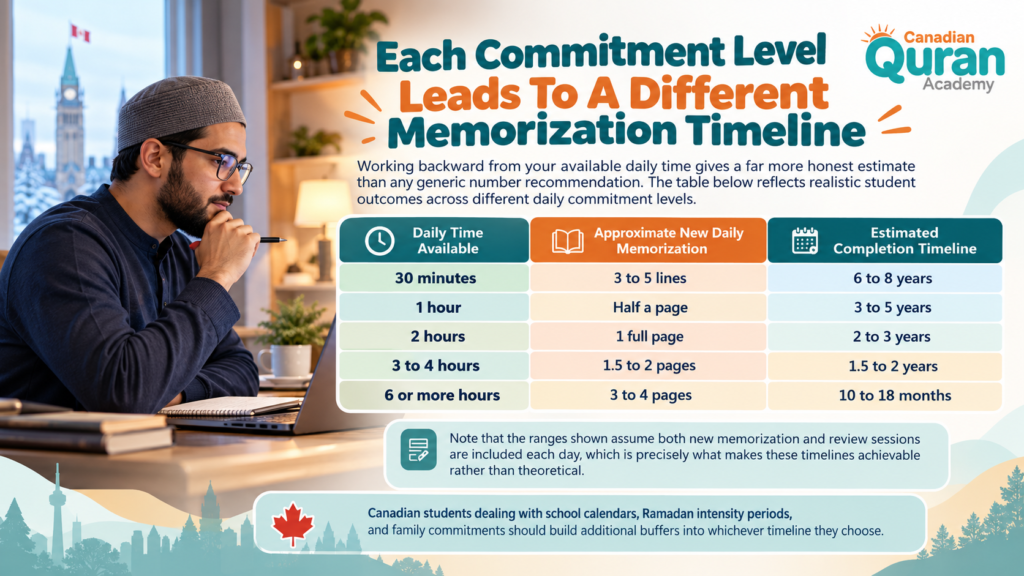
Each Commitment Level Leads To A Different Memorization Timeline
Working backward from your available daily time gives a far more honest estimate than any generic number recommendation. The table below reflects realistic student outcomes across different daily commitment levels.
Note that the ranges shown assume both new memorization and review sessions are included each day, which is precisely what makes these timelines achievable rather than theoretical.
| Daily Time Available | Approximate New Daily Memorization | Estimated Completion Timeline |
| 30 minutes | 3 to 5 lines | 6 to 8 years |
| 1 hour | Half a page | 3 to 5 years |
| 2 hours | 1 full page | 2 to 3 years |
| 3 to 4 hours | 1.5 to 2 pages | 1.5 to 2 years |
| 6 or more hours | 3 to 4 pages | 10 to 18 months |
Canadian students dealing with school calendars, Ramadan intensity periods, and family commitments should build additional buffers into whichever timeline they choose.
Why Do Most Hafiz Students Struggle And What Can Help Them Finish?
The most common reason students abandon their Hafiz journey is not insufficient ability or time. It is a problem that can be named “retention debt,” the silent accumulation of unreviewed memorization until the load becomes psychologically unmanageable.
When pages are added daily without a consistent review structure, earlier Juz begin fading before later ones are fully secured. After several months, a student finds themselves unable to confidently recite sections completed weeks before. The practical solution is consistent: review before new memorization, every single session.
Allocating sixty percent of each session to reviewing existing material and forty percent to new pages consistently produces stronger long-term Hifz than any other single habit adjustment.
For students building their foundational approach from the beginning, exploring how to learn Quran in Canada provides a practical starting framework that prevents retention debt from developing in the first place.
Discover Why Canadian Students Choose The Canadian Quran Academy for Quran Memorization Training?

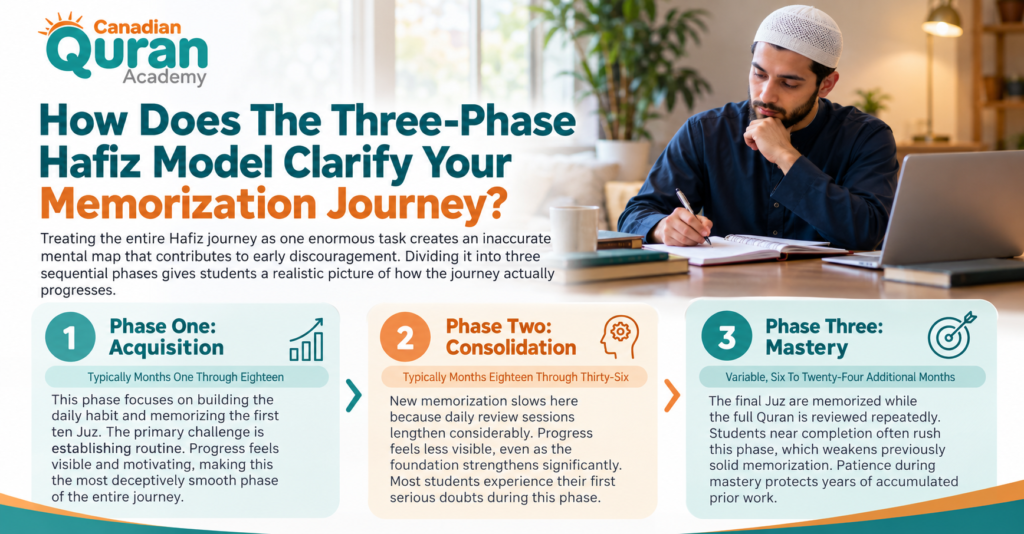
How Does The Three-Phase Hafiz Model Clarify Your Memorization Journey?
Treating the entire Hafiz journey as one enormous task creates an inaccurate mental map that contributes to early discouragement. Dividing it into three sequential phases gives students a realistic picture of how the journey actually progresses.
Phase One: Acquisition (Typically Months One Through Eighteen)
This phase focuses on building the daily habit and memorizing the first ten Juz. The primary challenge is establishing routine. Progress feels visible and motivating, making this the most deceptively smooth phase of the entire journey.
Phase Two: Consolidation (Typically Months Eighteen Through Thirty-Six)
New memorization slows here because daily review sessions lengthen considerably. Progress feels less visible, even as the foundation strengthens significantly. Most students experience their first serious doubts during this phase.
Phase Three: Mastery (Variable, Six To Twenty-Four Additional Months)
The final Juz are memorized while the full Quran is reviewed repeatedly. Students near completion often rush this phase, which weakens previously solid memorization. Patience during mastery protects years of accumulated prior work.
How Can Canadian Muslims Structure Their Hafiz Journey Around Real Life?
Canadian Muslim students operate in a specific context that most Hafiz guides fail to address directly. Recognizing that context allows for planning that is honest about actual daily constraints and cultural pressures.
Weekend Islamic schools, after-school Quran circles, and summer Hifz intensives are available across Toronto, Mississauga, Ottawa, Calgary, and Vancouver.
For children balancing Canadian school curricula alongside memorization goals, consistent thirty to sixty minute daily sessions produce steady progress without academic compromise. Families seeking practical guidance on supporting younger children specifically will find useful direction through how to learn Quran for kids in Canada.
Adult learners benefit from online programs that allow sessions before Fajr or after Isha, the two time windows most supported by Islamic tradition and most free from competing demands in a typical Canadian daily schedule.
On the days when the middle of the journey feels relentless and motivation fades, returning to Quran verses about patience reconnects students to the deeper purpose that carries them through the consolidation phase.
Start Your Adult Quran Reading Journey Anywhere in Canada

What Role Does Sincere Intention Play In How Long It Takes To Become A Hafiz?
The Quran itself carries a direct assurance about this path: “And We have certainly made the Quran easy for remembrance, so is there any who will remember?” (Surah Al-Qamar, 54:17). This verse appears four times in the same surah, a repetition that is not incidental. It is a divine promise tied specifically to sincere intention combined with honest daily effort.
Students who memorize for the right reason consistently report stronger retention than those treating Hifz as a purely academic goal.
That sincerity also provides the motivation to persist through Phase Two, when visible progress slows and the finish line feels distant. Students grounded in genuine spiritual purpose hold on during those months in ways that externally motivated students often cannot.
When that intention needs renewal, reflecting on Quranic verses on trust in Allah regrounds the entire memorization journey in its original and lasting spiritual purpose.
Experience Our Classrooms
Don’t just take our word for it—take a look inside! Watch the videos below to experience our engaging teaching methods and vibrant online classrooms firsthand.
Start Your Quranic Journey in Canada
Join our vibrant community and learn with expert tutors through our flexible online platform.
Claim Your Free TrialAre You Ready To Begin Your Hafiz Journey With Canadian Quran Academy?
Canadian Quran Academy connects Muslim students across Canada with certified, ijazah-holding Quran teachers through flexible online classes designed around real Canadian schedules and life commitments.
Whether you are a child beginning memorization for the first time, a teenager working toward Hafiz alongside high school, or an adult taking this lifelong step, expert guidance from the beginning shortens your timeline and protects the quality of your Hifz.
Check our top courses:
- Quran Online Academy
- Learn Quran Course for Beginners
- Quran Memorization and Hifz Course for Kids
- Quran Hifz Course for Ladies
- Al-Azhar Quran Course
- Online Tajweed Classes

Start Your Quranic Journey in Canada
Join our vibrant community and learn with expert tutors through our flexible online platform.
Claim Your Free TrialConclusion
Becoming a Hafiz takes between one and a half and seven years for most dedicated students. That range reflects real variation driven by daily commitment, teaching quality, review discipline, and Arabic reading proficiency at the start of the journey.
The students who complete this path are consistently the most consistent ones, not the fastest. They protect their review sessions as carefully as their new memorization sessions, seek qualified instruction early, and treat the middle phases with the same commitment they brought to the beginning.
For Muslims across Canada, the infrastructure to make this achievable now exists in every major city and through every reliable online platform. The question of how long does it take to become a Hafiz has a personal answer, and finding that answer begins with a single consistent session.
For those moments when the journey feels long, Quran verses about not giving up remind every aspiring Hafiz that each sincere step forward carries its own reward.
Frequently Asked Questions
Can A Canadian Adult With A Full-Time Job Become A Hafiz?
Yes. Many working adults complete Hifz with thirty to sixty minutes of consistent daily practice. Timelines of four to seven years are completely valid and produce strong, lasting memorization when review is prioritized alongside new pages each session.
Is A Teacher Required To Become A Hafiz?
A teacher is not technically required, but self-directed Hifz is significantly harder and slower. Teachers correct Tajweed errors before they become permanent, manage review schedules, and provide the long-term accountability that sustains effort over years.
What Is The Strongest Time Of Day To Memorize Quran?
The period after Fajr prayer is widely considered the most effective memorization window. The mind is fully rested, external distractions are minimal, and early morning quiet creates the focused environment that deep, lasting memorization requires.
How Many Pages Per Day Should A Child Memorize?
Children aged seven to ten typically begin with half a page daily. As routine and confidence develop, one full page or more becomes realistic. Starting conservatively prevents burnout during the critical first three to six months of habit formation.
What Happens When A Student Forgets Previously Memorized Sections?
Forgetting is normal and expected at every stage of Hifz. It signals that a review session is overdue, not that the student has failed. A structured daily review plan prevents forgetting from compounding into a full memorization crisis over time.
Does Understanding Arabic Make Hafiz Memorization Faster?
Significantly. Students who understand what they are memorizing form stronger memory associations. Even foundational Arabic comprehension reduces forgetting rates and makes each review session more productive and retentive over time.







Leave a Reply