 Quran
Muslim families in Canada face a challenge parents in Muslim-majority countries rarely encounter: raising children connected to the Quran in a society where the school system, social environment, and daily rhythm all work against it.
The most effective way of how to learn Quran for kids in Canada is through consistent, structured online classes with a certified teacher, combined with a daily home routine.
That routine built around the Canadian school calendar and age-appropriate learning methods that keep children engaged long after the novelty wears off.
The good news is that none of these obstacles are permanent. Thousands of Muslim children across Toronto, Vancouver, Calgary, and Montreal are learning Quran correctly today, because their parents stopped waiting for perfect conditions.
The nine steps below form a complete system. Each one builds on the previous, giving your child a clear path from recognizing Arabic letters for the first time all the way to confident, correct recitation.
Enroll Your Child in Online Quran Classes Across Canada Today

1. Master the Foundations Before Memorization Begins
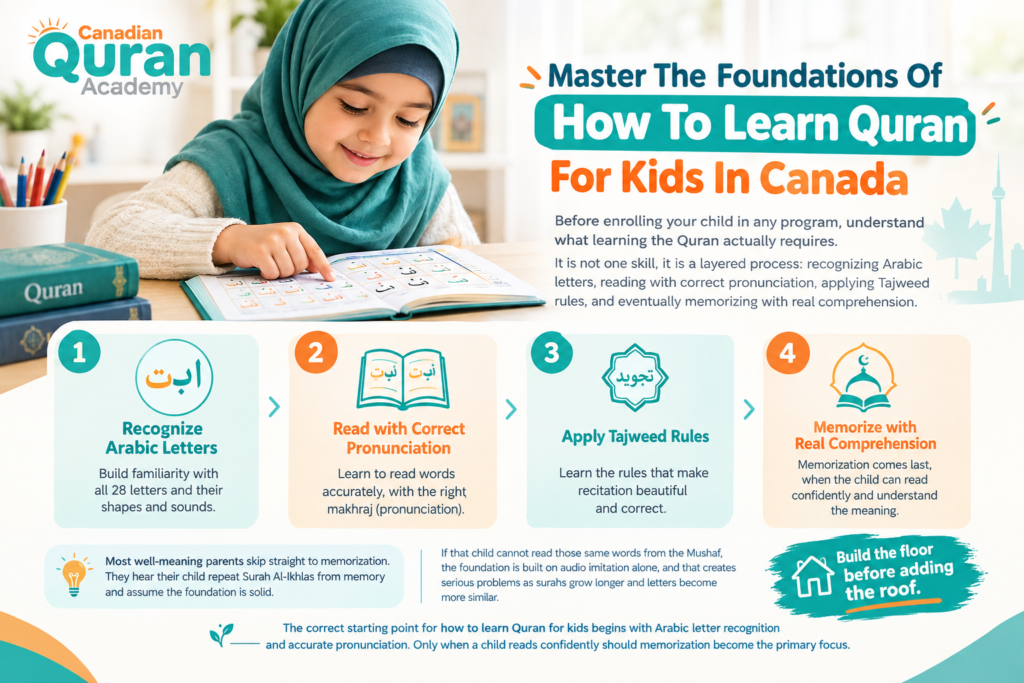
Before enrolling your child in any program, understand what learning the Quran actually requires.
It is not one skill, it is a layered process: recognizing Arabic letters, reading with correct pronunciation, applying Tajweed rules, and eventually memorizing with real comprehension.
Most well-meaning parents skip straight to memorization. They hear their child repeat Surah Al-Ikhlas from memory and assume the foundation is solid.
If that child cannot read those same words from the Mushaf, the foundation is built on audio imitation alone, and that creates serious problems as surahs grow longer and letters become more similar.
The correct starting point for how to learn Quran for kids begins with Arabic letter recognition and accurate pronunciation. Only when a child reads confidently should memorization become the primary focus. Build the floor before adding the roof.
2. Build A Consistent Daily Routine That Fits Canadian Family Life
Consistency matters more than duration. A ten-minute daily session beats a sixty-minute session that happens three times a month because that is how memory consolidation actually works, not how it feels in the moment.
Canadian school life is uniquely demanding: report cards every semester, PA days, winter break, spring break, and the exhaustion of short, dark November and February days.
The Quran routine you build must survive all of it, not just function during a relaxed summer or the heightened motivation of Ramadan.
Before the specific strategies below, understand one principle: every variable in the routine, timing, duration, and seasonal flexibility, should be decided in advance, not improvised week to week.
A. Match Session Length To Your Child’s Age
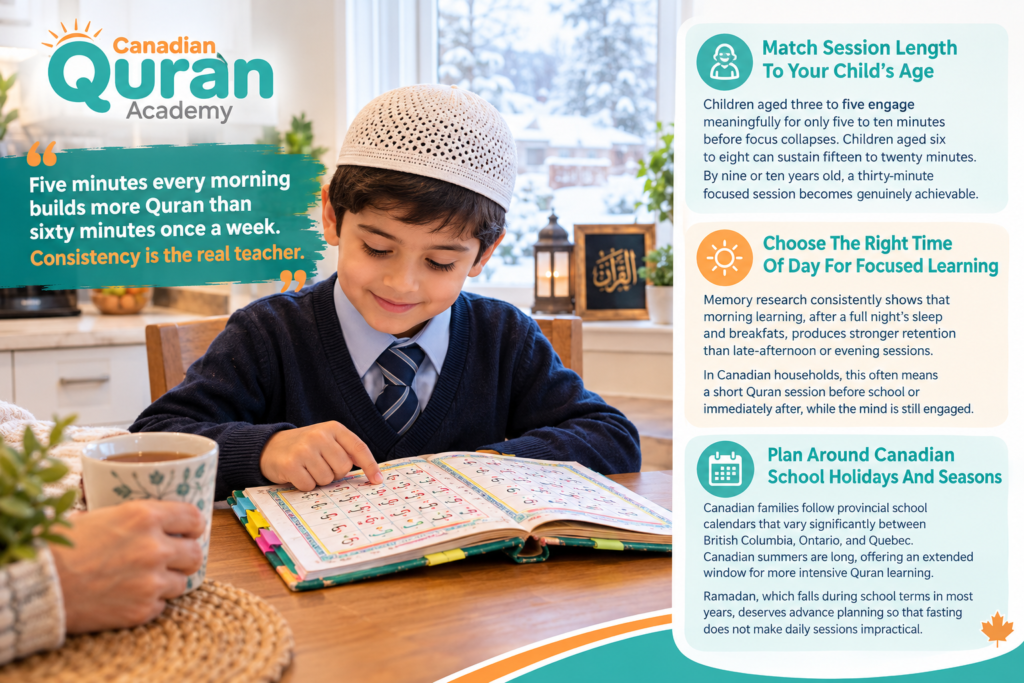
Children aged three to five engage meaningfully for only five to ten minutes before focus collapses. Children aged six to eight can sustain fifteen to twenty minutes. By nine or ten years old, a thirty-minute focused session becomes genuinely achievable.
Developmental readiness determines session length, not parental ambition or comparisons with other children at the mosque. A child pushed beyond their attentional capacity begins associating Quran time with frustration rather than reward.
B. Choose The Right Time Of Day For Focused Learning
Memory research consistently shows that morning learning, after a full night’s sleep and breakfast, produces stronger retention than late-afternoon or evening sessions.
In Canadian households, this often means a short Quran session before school or immediately after, while the mind is still engaged.
Avoid scheduling sessions directly after a long school day or within an hour of bedtime. A mentally depleted or sleepy child retains far less, and begins linking the Quran with exhaustion, the opposite of what you are building toward.
Read also: How To Learn Quran In English In Canada?

C. Plan Around Canadian School Holidays And Seasons
Canadian families follow provincial school calendars that vary significantly between British Columbia, Ontario, and Quebec. Canadian summers are long, offering an extended window for more intensive Quran learning.
Ramadan, which falls during school terms in most years, deserves advance planning so that fasting does not make daily sessions impractical.
Open your child’s school calendar beside a blank Quran schedule. Mark the light periods and the heavy ones. Adjust the daily target, not the daily habit, according to the season.
Live Class in Action
Watch how our instructors interact with students in real-time, focusing on interactive methods.
Start Your Quranic Journey in Canada
Join our vibrant community and learn with expert tutors through our flexible online platform.
Claim Your Free Trial3. Enroll In Structured Online Classes From Certified Quran Teachers
The most reliable solution for Canadian Muslim families is structured, one-on-one online Quran instruction with a teacher trained specifically to work with children.
Local mosque programs serve an important community role, but they rarely offer the consistent pacing or individual correction that younger learners need to progress properly. Online classes eliminate the logistical problems unique to Canada: the forty-minute winter commute through icy roads.
In addition to the incompatible scheduling between a family in Halifax and a teacher elsewhere, and the scarcity of qualified instructors in smaller cities like Kelowna, Saskatoon, or Fredericton.
Canadian Quran Academy connects families across every province to certified Quran teachers who schedule sessions around the Canadian school timetable, not the other way around. The teacher adapts to your child’s life; your child does not need to adapt to an institutional schedule.
4. Choose A Teacher Trained Specifically To Work With Children
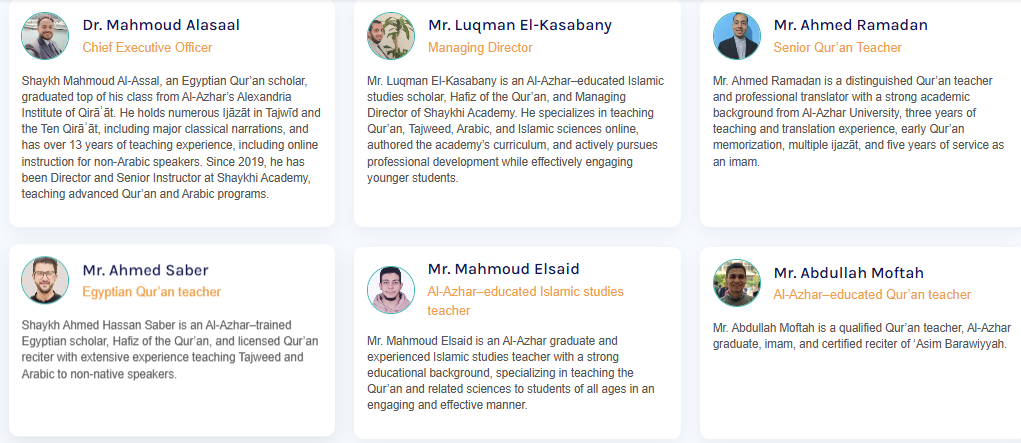
Not every Quran teacher who holds an Ijazah is equipped to teach a six-year-old in Canada. Adult Quran instruction and children’s Quran instruction require entirely different pedagogical skills and confusing the two is one of the most common mistakes Canadian parents make when selecting a teacher.
Academic qualification is the floor, not the ceiling. The ceiling is the teacher’s ability to engage, correct, and motivate a young learner across a screen, consistently, and without resorting to shame or excessive pressure. Two things help you assess this before you commit:
A. What Credentials Should A Children’s Quran Teacher Hold?
At minimum, the teacher should hold an Ijazah in Hafs an Asim recitation — the most widely used transmission worldwide. This guarantees that the Tajweed they teach is accurate and traceable to its authenticated source.
Beyond the Ijazah, look for documented experience with children under twelve, familiarity with the Noorani Qaida methodology, and ideally some understanding of how English-dominant children approach Arabic phonetics.
A teacher trained primarily on adult Arabic speakers will need significant recalibration to teach an eight-year-old in Ottawa effectively.
Parents who want to understand the role Arabic plays in this journey can explore how to learn Arabic for the Quran in Canada as a parallel path worth considering.
B. How To Evaluate A Teacher In The Trial Session?
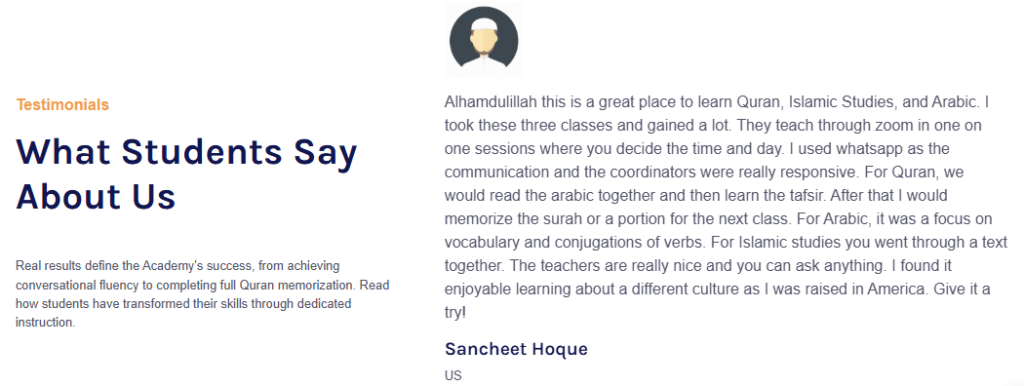
Use the trial class as a real assessment, not a pleasant introduction. Watch specifically how the teacher responds to a mistake. Does the child freeze, or correct naturally and continue?
Notice whether the teacher adapts the pace mid-session or delivers a fixed script regardless of how the child is responding.
A strong children’s Quran teacher asks questions, offers genuine encouragement after each correct attempt, and ends the session with the child feeling capable, not corrected.
If your child says “I liked that teacher” after the trial, you have your clearest possible signal.
5. Apply Spaced Repetition To Lock In What Kids Memorize
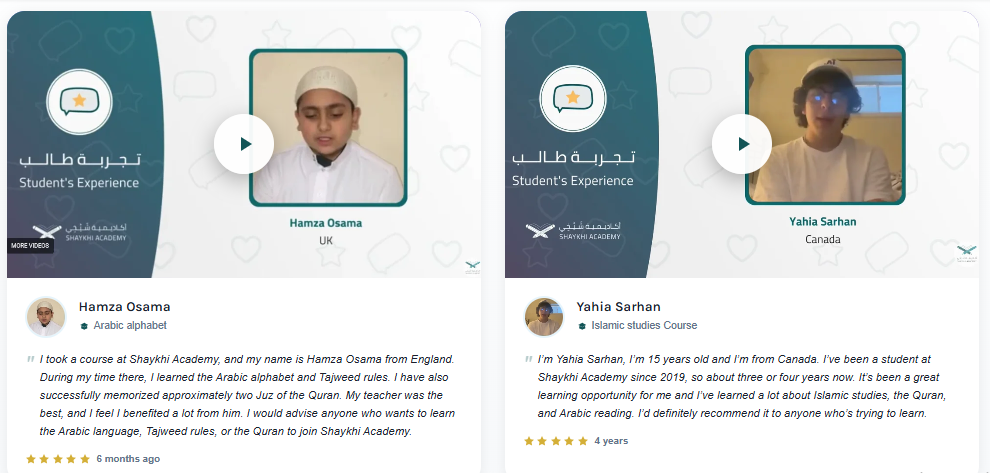
Repetition is the engine of Quran memorization, but the method of repetition determines whether children absorb it or resist it. Spaced repetition, which means reviewing material at increasing intervals over time, produces significantly stronger long-term retention than massed repetition, which is repeating the same ayah thirty times in a single sitting.
In practice, for how to learn Quran for kids: introduce one to three new ayaat per session. Review them the following day, again three days later, and once more after one week.
This interval structure fights the forgetting curve that frustrates both parents and children when memorized material disappears within days.
The single non-negotiable rule: never link memorization to punishment. Children who associate Quran recitation with fear or shame carry that association into adulthood. Correction is necessary, pressure and punishment are not.
6. Connect Every Surah To Its Meaning Through Simple Stories
One of the most overlooked tools in Quran education for children is meaning. Teachers and parents who teach sound without context produce children who recite correctly but feel very little. Those children who feel nothing rarely continue on their own once the external pressure is removed.
Even a four-year-old understands a simplified meaning of Surah Al-Fil: “Allah sent birds to protect the Kaaba from an army that came with elephants.” That one sentence transforms an audio pattern into a story with real stakes.
Stories stay in memory far longer than sounds alone. The Quranic verses on education that speak directly about learning and knowledge are especially powerful anchors for children who are themselves in school every day.
Make it a practice to share one simple meaning after every new surah your child begins. Link it to something in their daily world.
A child in Canada who learns that the Quran teaches care for all living things will see that teaching confirmed on a nature walk, and that lived connection reinforces the ayah more reliably than repetition alone.
Start Building Quranic Interpretive Skills Today

7. Use Digital Tools To Reinforce Learning Between Sessions
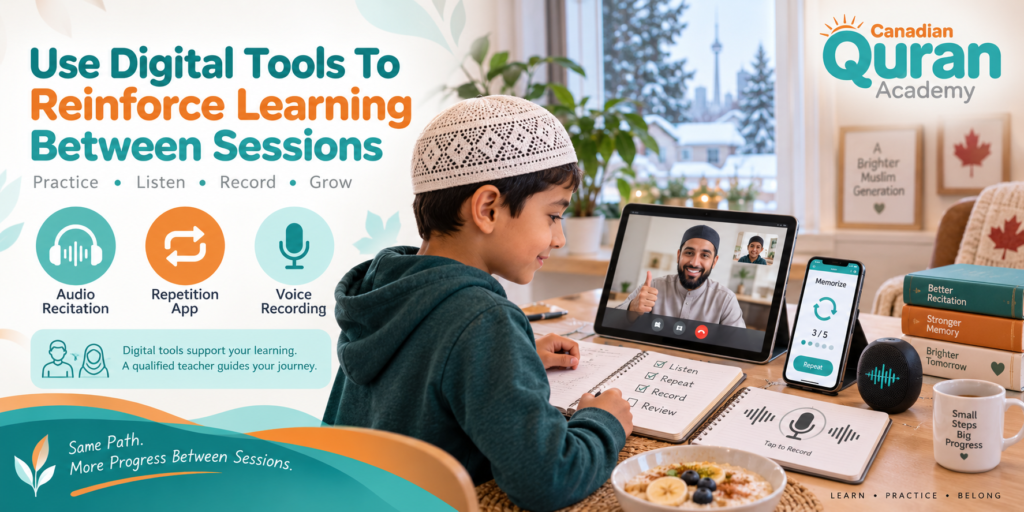
Between Quran sessions, digital tools fill the gap in meaningful ways. The key word is reinforce — apps and audio recordings are supplements to the teacher, not replacements for one.
A child who learns from audio alone, without real-time correction, accumulates errors that become harder to unlearn with each passing month.
Effective digital reinforcement for children includes: high-quality recitation recordings of the surah currently being memorized, played during breakfast or morning car rides.
The repetition-feature apps built specifically for Quran memorization; and simple voice-recording tools where children hear their own recitation and begin noticing their own errors before the next session.
Children who build their foundation through the Arabic Noorani Qaida respond especially well to digital reinforcement — because the structured phonetic base makes supplementary content accessible rather than confusing.
8. Explore Free English Quran Resources With Clear Eyes
A growing number of Canadian parents ask a direct question: can my child learn the Quran in English for free? The direct answer is yes, partially. Free YouTube channels, community mosque sessions, and Quran apps all offer genuine value as introductory or supplementary tools, and there is real benefit in using them as a first exposure.
The limitation becomes clear when free resources are asked to carry the full weight of a child’s Quran education. No YouTube channel corrects your child’s makhraj in real time.
No free app notices that your child mispronounces a recurring letter every single session. Many free community classes serve twenty children with one volunteer teacher, which is a valuable community, but limited individual instruction.
In practice, many children who spend months on free platforms arrive at Canadian Quran Academy with ingrained pronunciation habits that require extra time to correct.
A structured, affordable program with a certified teacher is, in most cases, less expensive than the remediation required after years of uncorrected learning.
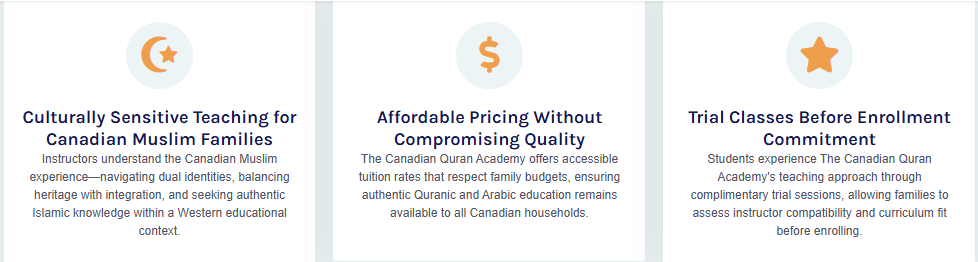
Canadian Quran Academy offers affordable monthly plans with certified teachers, schedule your child’s free assessment today.
9. Track Your Child’s Progress And Celebrate Every Milestone They Reach
Progress without acknowledgment is invisible to a child. A child who memorizes Surah An-Nas correctly for the first time needs that moment marked not because external validation drives long-term learning, but because named milestones create clear targets for the next achievement.
Create a visible progress board in your home. List the surahs your child has completed, with the date of completion beside each one.
When they reach a meaningful threshold, ten surahs memorized, or the full Juz Amma, celebrate it as a genuine family event: a special meal, a small gift, or a call to a grandparent to hear the recitation live.
Children who see their own progress accumulating are children who begin setting their own Quran goals without being prompted. That self-directed motivation is the long-term result every Muslim parent in Canada is building toward.
Experience Our Classrooms
Don’t just take our word for it—take a look inside! Watch the videos below to experience our engaging teaching methods and vibrant online classrooms firsthand.
Start Your Quranic Journey in Canada
Join our vibrant community and learn with expert tutors through our flexible online platform.
Claim Your Free TrialEnroll Your Child At Canadian Quran Academy Today
Your child does not need a mosque next door, a bilingual household, or a perfect schedule to learn the Quran in Canada.
They need a certified teacher who shows up consistently, a method matched to their developmental stage, and a parent who marks every milestone along the way.
Canadian Quran Academy provides all three. Our certified instructors teach children across every province, from British Columbia to Nova Scotia, with schedules built around Canadian school terms, provincial time zones, and real family life.
Every child begins with a free placement assessment so the teacher knows exactly where to start. The first session is free. Your child’s Quran journey starts here.
Our Quran Courses:
- Quran Online Academy
- Learn Quran Course for Beginners
- Quran Memorization and Hifz Course for Kids
- Noorani Qaida Course for Kids
- Al-Azhar Quran Course
- Tajweed Course for Kids
Book Your Child’s Free Trial Class Now

Conclusion
Teaching your child the Quran in Canada is not a single decision, it is a sequence of consistent, deliberate steps. Begin with the correct foundation before memorization.
Build a routine that fits the Canadian school year, not an idealized version of one. Enroll in structured classes with a certified children’s Quran teacher. Apply spaced repetition instead of pressure.
Connect every surah to its meaning through simple, memorable stories. Reinforce with digital tools between sessions.
Assess free resources honestly, and choose a structured program when your child needs real correction. Track every milestone and celebrate it.
Every surah memorized correctly in childhood carries forward into adulthood. How to learn Quran for kids in Canada has a simple core answer: one step at a time, with the right guide, and a consistent parent behind them. Canadian Quran Academy is ready to be that guide starting with a free first class, today.
Frequently Asked Questions
What Is The Best Age To Start Quran Classes For A Child In Canada?
Children can begin letter recognition and audio exposure as early as age three. Structured Quran reading classes are most effective from age five to seven, when phonetic readiness for Arabic script is strongest.
Starting earlier is entirely appropriate for short surah listening and repetition, formal reading instruction produces better results once a child already reads in one language.
How Long Should A Daily Quran Session Be For A Young Child?
For children aged five to seven, sessions of fifteen to twenty minutes are most effective. For children aged eight to twelve, thirty minutes is achievable with a clear structure and a patient teacher.
Short daily sessions produce stronger results than long sessions that happen infrequently, consistency is the variable that matters most.
Can A Child In Canada Learn Quran Without Speaking Arabic?
Yes. Quranic Arabic reading is a distinct skill from spoken Arabic conversation. Children in English-dominant Canadian households learn through phonetic training.
They learn to produce Arabic sounds correctly before understanding every word fully. Comprehension develops gradually alongside recitation fluency over time.
What Is The Noorani Qaida And Does My Child Need It?
The Noorani Qaida is a structured phonetic primer for learning to read Quran from the ground up.
It is the most effective starting tool for children with no prior Arabic knowledge, and most certified children’s Quran programs use it as the first stage before moving into actual Quran text.
How Do I Know If A Quran Teacher Is Truly Qualified To Teach My Child?
Ask directly about the teacher’s Ijazah, the age groups they have taught, and their specific experience with non-Arabic-speaking children.
Then use the trial session as an assessment: a qualified children’s teacher adapts the pace to the individual child, corrects warmly and constructively, and ends the session with the child feeling capable rather than overwhelmed.





Leave a Reply