 Quran

Imagine finishing your first month of memorization already holding a page from all thirty parts of the Quran, instead of one single juz.
That is exactly what happens in the Ottoman hifz method, a centuries-old Turkish system still taught today in Türkiye, Bosnia, and parts of Malaysia.
Most students in North America learn hifz through the familiar Sabaq, Sabqi, and Manzil routine: new lesson, recent revision, older revision.
The Ottoman approach rearranges that entirely. Instead of moving forward page by page, you climb through the mushaf in layers, and revision happens automatically inside the daily lesson.
This guide covers what the method is, how the stacking rounds work, the seven training stages used in Turkish schools, and how well it fits a working adult or a school-age child in Canada.
Takeaway — What You Will Learn
- What the Ottoman (Usmania) hifz method is and where it is still taught
- How the stacking system works, page by page, round by round
- The seven traditional stages, from Khatm to Has
- Why revision is built into the method instead of scheduled separately
- Who this method suits, and how to adapt it part-time
What Is the Ottoman Hifz Method?
The Ottoman hifz method — also called the Usmania method, the Turkish method, or the stacking system — is a memorization framework in which you learn one page from each of the thirty ajza before returning for the next layer.
Rather than completing Juz 1 and then starting Juz 2, you work across all thirty parts at once. Each pass through the mushaf is called a round, and each round adds one page to every juz.
It rests on two principles: structured repetition, so pages return to your tongue on a predictable schedule, and daily consistency, because the layered design collapses if you skip days.
It is normally taught with the 15-line mushaf, where each juz holds exactly twenty pages. That neat arithmetic is what makes the stacking work — twenty pages per juz means twenty rounds, and twenty rounds means the whole Quran.
Students arriving from a Sabaq–Sabqi–Manzil background often find the switch disorienting. Our teachers in the Quran memorization classes walk a student through one full round before deciding whether to continue.
Read Also: Mauritania Hifz Method
How the Stacking System Works, Page by Page
Think of building with Lego. You lay the foundation blocks first, then add layer after layer. The Ottoman method treats the mushaf the same way, except the foundation is the last page of each juz.
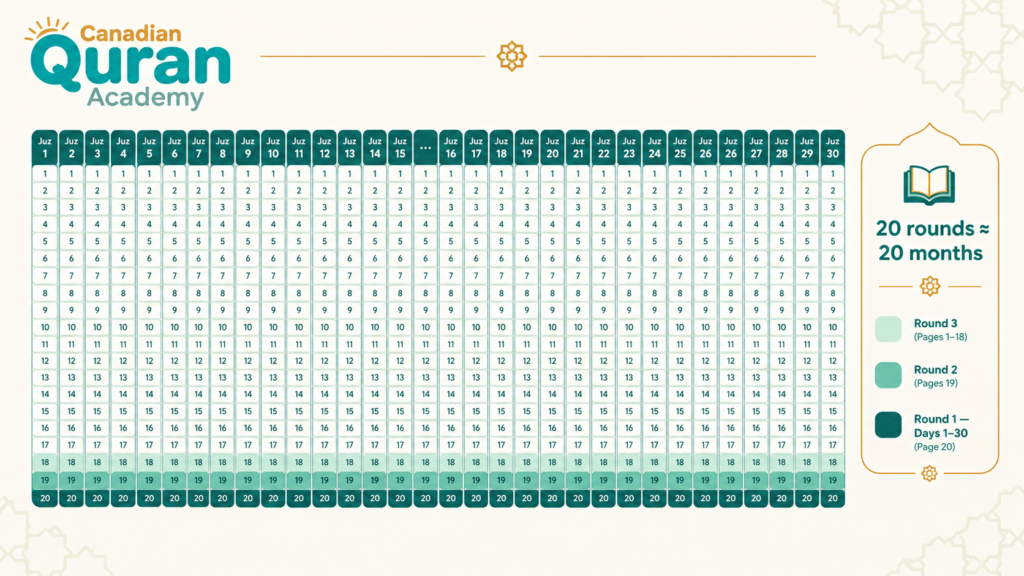
Day one, you memorize the final page of Juz 1. Day two, the final page of Juz 2. You continue until day thirty, when you finish the final page of Juz 30. That is round one — thirty pages, one per juz.
Round two begins with the nineteenth page of Juz 1, then the nineteenth page of Juz 2, and so on. Round three takes the eighteenth pages. Each round moves you one page higher up the stack.
Counted another way, the pages in a single round sit twenty pages apart in the mushaf. Start at page 20 of Surah Al-Baqarah, count twenty pages, memorize page 40, and continue to the end.
Some schools reverse the direction and begin round one from Juz 30. Others have the student memorize all of Juz 30 first, since it covers nearly every Tajweed rule.
Read Also: Psychological Barriers In Memorization – How Stress Affects Quran Memorization
How Long the Rounds Take
A round normally lasts thirty to forty days, depending on the student’s pace and the school’s rest days.
Twenty rounds at that pace puts the full Quran at roughly twenty months of full-time study. Intensive programs compress this to about a year and a half; part-time students need considerably longer.
There is a satisfying midpoint. Once you finish round ten, you hold the tenth page of every juz — half the Quran, evenly distributed across the mushaf.
The Seven Stages of Ottoman Hifz Training
Turkish institutes do not simply hand a beginner the stacking schedule. The method sits inside a seven-stage program, and each stage must be cleared before the next opens. Two names borrow from the kitchen: pişmiş means “cooked,” in the sense of being brought to full readiness.
- Khatm: Complete at least ten full readings of the Quran with correct Tajweed. Fluency is the gatekeeper: the student must recite a page in about two minutes.
- Chi: New memorization. In a residential school, this means long days, commonly cited at nine hours, six days a week.
- Zor Pişmiş: Concentrated drilling of the difficult passages, the ones that keep slipping.
- Kolay Pişmiş: Repetition of passages that have already become easy, so they stay easy.
- Tekrar: General repetition of everything held in memory.
- Tekrar Hepsi Sayfa: Systematic revision of every page of every juz, from the first page onward.
- Has: The final examination: reciting the entire Quran, or ten ajza a day, from memory.
Notice how much of the program is revision rather than new material. That balance is the real lesson of the Ottoman system, whichever method you follow.
The Khatm stage is also where most aspiring students stall. Reciting a page in two minutes with sound Tajweed is a serious standard, which is why structured Tajweed classes belong before a hifz plan, not after it.
Why Revision Is Built Into the Method
In most hifz systems, revision is a separate appointment: your new lesson, then your Manzil — the older portion you must protect. Two commitments, two blocks of time.
The Ottoman method folds them together. On day thirty-one you memorize a new page, and because it sits directly above a page learned last month, reciting it pulls the earlier page along with it.
By day sixty you are reciting sixty pages in accumulation; by day ninety, ninety pages. Eventually the daily recitation approaches the whole Quran — which is the point, not a side effect.
This is also why the method is unforgiving. Miss a stretch of days, and you hold disconnected pages scattered across thirty ajza, with no continuous passage to fall back on.
Read Also: Learn Quran By Heart In Canada
Who the Ottoman Method Suits and Who Should Avoid It
The system was designed for a particular student: one who recites quickly, memorizes quickly, and can commit full-time hours.
It suits residential and intensive programs well. Run part-time at the same page-per-day rhythm, it tends to break down because the accumulating recitation load grows faster than a part-time schedule can absorb.
Scholars are not unanimous about it. Some senior teachers in Istanbul consider it the finest system in existence; others prefer sequential methods because a lapse is easier to recover from.
The honest assessment: if you are naturally consistent and can protect your daily slot, the Ottoman method produces exceptionally firm memorization. If your schedule is unpredictable, a sequential plan serves you better.
Adapting the Method for Part-Time Students
A modified version can still work. Some students batch a smaller set — five pages across five ajza on a given day — and stretch each round accordingly.
Others borrow only the principle, choosing revision pages twenty pages apart so every session touches the whole mushaf rather than one corner of it.
This is an adjustment a teacher should make with you, not for you. Our instructors assess reading speed and available hours during the first session of our Quran recitation classes before recommending any structure.
Using the Ottoman Method to Strengthen Existing Hifz
The stacking system has a second, less discussed use. If you have completed the Quran and your memorization has weakened, the method works well as a repair tool: batching pages across several ajza each day surfaces weak spots early and evenly.
Understanding the words accelerates that repair considerably. Studying Quranic Arabic alongside revision turns unfamiliar page beginnings into meaningful sentences that are far harder to forget.
Live Class in Action
Watch how our instructors interact with students in real-time, focusing on interactive methods.
Start Your Quranic Journey in Canada
Join our vibrant community and learn with expert tutors through our flexible online platform.
Claim Your Free TrialStart Your Hifz Journey With a Free Trial Class Today
Memorizing the Quran is not about finding a secret technique. It takes a qualified teacher, a plan matched to your real schedule, and a Tajweed foundation strong enough to build on.
Canadian Quran Academy offers one-to-one online Tajweed, Quran recitation, and Arabic classes with certified Al-Azhar teachers, on a timetable that fits families in Toronto, Calgary, Vancouver, and Montreal.
With a qualified teacher listening to you live, you can identify mistakes you may not notice. Whether you are a beginner or already recite the Quran, your teacher will guide you and tell you honestly whether the Ottoman hifz method, or a gentler sequential plan, is the right starting point for you or your child.
Our Quran Courses
- Quran Online Academy
- Quran Recitation Classes
- Quran Reading Classes
- Online Quran Classes for Kids
- Quran Classes for Adults
- Quran Classes for Female
- Learn Quran Course for Beginners
- Quran Memorization (Hifz) Course
- Hifz Classes for Adults
- Quran Memorization and Hifz Course for Kids
- Quran Hifz Course for Ladies
- Quran Ijazah Program
- Quran Qirat Learning Course
- Quran Tafsir Course
- Noorani Qaida Course
- Noorani Qaida Course for Kids
- Weekend Quran Classes
- Intensive Quran Course
- Al-Azhar Quran Course
- Online Tajweed Classes
- Tajweed Course for Kids
- Tajweed Course for Adults
- Tajweed Course for Ladies

Conclusion
The Ottoman hifz method is a layered, revision-first approach built on the 15-line mushaf and a stacking sequence that adds one page to every juz per round. Twenty rounds complete the book, typically in eighteen to twenty months of dedicated study.
Its greatest strength is that revision is not an extra task — it is the task. Its greatest weakness is fragility: the design rewards consistency generously and punishes interruption sharply.
The take-away message is to study the method for its principle rather than copying its schedule blindly. Distribute revision across the whole mushaf, secure your Tajweed first, and choose the system that matches the life you actually live.
FAQs
How long does the Ottoman hifz method take?
Full-time students generally complete the Quran in about twenty months, since each of the twenty rounds takes thirty to forty days. Intensive programs can shorten this to around eighteen months, while part-time study takes significantly longer.
Is the Ottoman method suitable for beginners?
Not as a first step. A student needs fluent reading, sound Tajweed, and the ability to recite a page in about two minutes before the stacking rounds make sense. Complete beginners should start with Noorani Qaida and Tajweed instruction.
How is the Ottoman method different from Sabaq, Sabqi, and Manzil?
Sabaq–Sabqi–Manzil moves through the Quran sequentially and treats new memorization and revision as separate daily tasks. The Ottoman method works across all thirty ajza at once and merges revision into the new lesson itself.
Why is a 15-line mushaf used for the Ottoman method?
In the 15-line mushaf, each juz contains exactly twenty pages. That uniformity allows one page per juz per round, twenty rounds in total, with pages sitting a predictable twenty pages apart.
Can I use the Ottoman method to revise Quran I already memorized?
Yes, and this is one of its most practical uses. Batching pages from several ajza each day exposes weak passages across the whole mushaf rather than one section at a time.





Leave a Reply