 Quran

Have you ever studied the same Quranic verse several times, felt that you knew it perfectly, and then suddenly struggled to recall it during recitation? Psychological barriers in memorization can sometimes explain why memorizing feels much harder during periods of stress, worry, pressure, or emotional exhaustion.
For children and adults learning the Quran in Canada, memorization is influenced by more than repetition alone. Stress level, sleep, attention, emotions, learning environment, motivation, Arabic reading ability, Tajweed accuracy, and the quality of revision can all affect how well new verses are learned and recalled.
This article explains how stress affects memory psychology, the difference between acute stress and chronic stress and memory, the role of emotion and attention, and practical ways to support Quran memorization when stress is making learning difficult.

Takeaway: What You Will Learn
- How psychological barriers can interfere with Quran memorization.
- How stress affects memory, psychology, attention, learning, and recall.
- The difference between acute stress and chronic stress and memory.
- How emotion, attention, the hippocampus, and amygdala interact during learning.
- Practical strategies that can support memory and Quran revision.
Psychological Barriers in Memorization
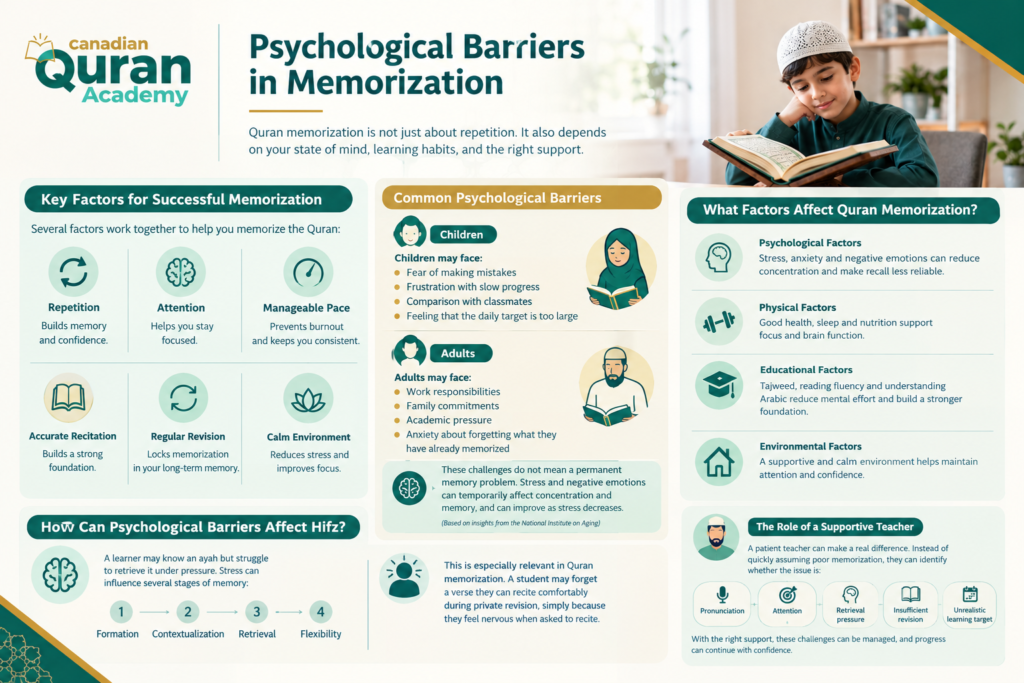
Successful Quran memorization depends on several factors working together. Repetition is important, but learners also need enough attention, a manageable learning pace, accurate recitation, regular revision, and a calm environment.
For children, psychological pressure may appear as fear of making mistakes, frustration, comparison with classmates, or feeling that the daily hifz target is too large. Adults may experience different barriers, including work responsibilities, family commitments, academic pressure, or anxiety about forgetting what they have already memorized.
These factors do not mean that a learner has a permanent memory problem. Stress and negative emotions can temporarily affect concentration and memory, and the National Institute on Aging notes that stress-related memory problems can improve as stress and emotions decrease.
What Factors Affect Quran Memorization?
The factors affecting Quran memorization can be divided into psychological, physical, educational, and environmental factors. Stress and anxiety can make Quran memorization more difficult by reducing concentration and making memory retrieval less reliable.
A calm and supportive learning environment can help children and adults maintain attention and confidence.
Besides, Beginners who are still struggling to recognize Arabic letters, vowel marks, or connected words may use much of their attention simply decoding the text. Learning correct Tajweed and developing fluent Quran reading skills can reduce this cognitive burden and create a stronger foundation for memorization.
The learner’s age, ability, daily responsibilities, motivation, and study environment can all affect Quran memorization. Children may need shorter sessions and more encouragement, while adults may require flexible schedules that fit around work and family commitments.
For this reason, a good Hifz program should consider the learner’s age, ability, pace, recitation accuracy, and current workload rather than focusing only on the number of verses memorized.
Read Also: The Ottoman Hifz Method
How Can Psychological Barriers Affect Hifz?
A learner may know an ayah but struggle to retrieve it under pressure. This is different from never having learned the ayah properly.
Stress can influence several stages of memory, including formation, contextualization, retrieval, and flexibility. Recent research describes stress as capable of producing different effects depending on its intensity, timing, and the individual response to the stressor.
This is particularly relevant to Quran memorization. A student who becomes nervous when asked to recite may suddenly forget a verse that they can recite comfortably during private revision.
A patient teacher can therefore make a meaningful difference. Instead of immediately interpreting every mistake as poor memorization, the teacher can identify whether the problem is pronunciation, attention, retrieval pressure, insufficient revision, or an unrealistic learning target.
Read Also: Mauritania Hifz Method
How Does Stress Affect Memory Psychology?
Stress can interfere with learning and memory, particularly when it is intense, prolonged, or occurs at an important stage of learning or retrieval. However, stress does not affect every type of memory in the same way.
Research shows that stress can sometimes strengthen certain emotionally significant memories while impairing other forms of learning and recall. The timing of the stressor is also important.
Does Stress Affect Memory Recall?
Yes. High stress can make memory retrieval more difficult, especially when someone is trying to recall information under pressure.
For a Quran learner, this might happen when a student is asked to recite a newly memorized Surah immediately in front of others. The learner may experience a temporary “blank” even though the material was successfully practiced earlier.
Stress-related retrieval difficulty should therefore not automatically be interpreted as evidence that the learner has lost the information permanently.
Acute Stress and Memory
Acute stress is a short-term stress response, such as feeling nervous before a test, presentation, competition, or Quran recitation assessment.
Its effect on memory can vary. Research indicates that acute stress may sometimes strengthen the consolidation of emotionally relevant information, while high stress around retrieval can impair performance.
For Quran learners, the practical goal is not to eliminate every moment of nervousness. Instead, teachers and parents can reduce unnecessary performance pressure and create repeated opportunities for calm, supportive recall.
Chronic Stress and Memory
Chronic stress is more persistent and may have broader effects on learning and cognition. Research has linked prolonged stress with changes in hippocampal function and with difficulties in hippocampus-dependent memory tasks.
For a child or adult learning Quran, ongoing stress may indirectly make memorization harder by reducing attention, disrupting sleep, increasing mental fatigue, or making study sessions feel overwhelming.
This is why a realistic Hifz schedule matters. A smaller amount of high-quality memorization followed by strong revision can be more sustainable than continually increasing the daily target.
Read Also: Learn Quran By Heart In Canada
Live Class in Action
Watch how our instructors interact with students in real-time, focusing on interactive methods.
Start Your Quranic Journey in Canada
Join our vibrant community and learn with expert tutors through our flexible online platform.
Claim Your Free TrialThe Impact of Emotion on Perception, Attention, Memory and Decision Making
Emotion can influence what we notice, what we focus on, what gets stored, and what we later retrieve. Under stress, the brain may prioritize information connected with the immediate threat or emotional situation. Research describes interactions between stress systems and brain regions involved in memory, including the hippocampus, amygdala, and prefrontal cortex.
This helps explain why a learner who is worried about making mistakes may focus more on the possibility of failure than on the words they are trying to memorize.
A supportive learning environment can therefore be educationally important. Encouragement, achievable goals, constructive correction, and consistent teacher feedback can help students remain focused on the learning task rather than becoming overwhelmed by performance anxiety.
For families looking for this type of structured support, Canadian Quran Academy’s online Quran programs provide live instruction for children and adults, including Quran reading, Tajweed, memorization, and Arabic learning.
How to Reverse Memory Loss From Stress?
Stress-related forgetfulness is often addressed by reducing the factors that interfere with learning rather than simply increasing repetition.
The National Institute on Aging explains that memory problems associated with stressful life events and negative emotions are often temporary and may improve as stress decreases.
It also recommends staying active, socially engaged, and involved in meaningful learning activities. For Quran learners, useful strategies include:
1. Reduce the Memorization Load
If a student is struggling, temporarily reducing the number of new verses can allow more cognitive resources to go toward accurate learning and retrieval. The objective should be strong memorization rather than fast memorization.
2. Prioritize Sleep and Recovery
Sleep plays an important role in memory consolidation. Research has consistently connected sleep with memory processing, while sleep loss can impair the ability to form and retain new memories.
For children especially, Quran memorization should not routinely come at the expense of adequate sleep.
3. Use Active Recall
Instead of repeatedly looking at the Mushaf, close it and attempt to recite the ayah from memory. Then check the Mushaf and immediately correct mistakes. This turns revision into a retrieval exercise rather than passive reading.
4. Use Structured Revision
A learner should regularly review previous material alongside new material. The Academy’s Hifz approach includes structured memorization and review rather than treating every new verse as an isolated task.
For learners in Canada balancing school, university, work, and family responsibilities, a realistic schedule is particularly important.
Strengthen Your Quran Memorization With Expert Guidance
A strong memorization routine becomes easier when learners have the right teacher, pace, and feedback. The Canadian Quran Academy offers structured online Quran education for Canadian children and adults, including Quran reading, Tajweed, Hifz, and Arabic programs.
Its instructors include teachers with Ijazah qualifications, and lessons can be scheduled around Canadian school, work, and family routines.
For beginners, building the Arabic reading foundation first can also reduce unnecessary cognitive load during Quran study. The Academy’s Noorani Qaida program progresses from Arabic letters and vowel marks to connected reading before students advance toward Quranic text.
Experience Our Classrooms
Don’t just take our word for it—take a look inside! Watch the videos below to experience our engaging teaching methods and vibrant online classrooms firsthand.
Start Your Quranic Journey in Canada
Join our vibrant community and learn with expert tutors through our flexible online platform.
Claim Your Free TrialBook a Free Quran Learning Trial and Build a Sustainable Routine
A personalized Quran lesson can help identify whether a learner’s difficulty comes from pronunciation, attention, revision habits, learning pace, or psychological pressure. With live instruction, students can receive immediate feedback instead of repeatedly practicing the same mistake alone.
Whether the goal is stronger Tajweed, Quran recitation, Hifz, or Arabic learning, a structured program can make the learning process more manageable for Canadian families.
If stress, lack of confidence, or an inconsistent routine is making Quran memorization difficult, the right teacher can help turn the learning process into a clear and manageable routine. Instead of struggling alone, students can receive personalized guidance, practical feedback, and a pace that matches their individual needs.
Our Quran Courses
- Quran Online Academy
- Quran Recitation Classes
- Quran Reading Classes
- Online Quran Classes for Kids
- Quran Classes for Adults
- Quran Classes for Female
- Learn Quran Course for Beginners
- Quran Memorization (Hifz) Course
- Hifz Classes for Adults
- Quran Memorization and Hifz Course for Kids
- Quran Hifz Course for Ladies
- Quran Ijazah Program
- Quran Qirat Learning Course
- Quran Tafsir Course
- Noorani Qaida Course
- Noorani Qaida Course for Kids
- Weekend Quran Classes
- Intensive Quran Course
- Al-Azhar Quran Course
- Online Tajweed Classes
- Tajweed Course for Kids
- Tajweed Course for Adults
- Tajweed Course for Ladies
Start with a Free Trial Quran Class today and take the first step toward a sustainable Quran learning routine.

Conclusion
Psychological barriers in memorization can make Quran learning feel more difficult, particularly when stress, anxiety, poor sleep, emotional pressure, or excessive study demands interfere with attention and retrieval.
The key message is that forgetting a verse does not automatically mean that a learner has poor memory. Stress can affect different stages of memory in different ways, and acute stress is not identical to chronic stress.
For Quran memorization, the strongest approach combines accurate Tajweed, active recall, consistent revision, realistic goals, adequate recovery, and supportive instruction. When psychological and educational factors are addressed together, children and adults can build a more sustainable relationship with the Quran.
FAQs
Does stress affect Quran memorization?
Yes. High or prolonged stress can interfere with attention, learning, and memory retrieval. Its effects vary depending on the intensity, duration, timing, and individual response to stress.
Can stress cause temporary memory problems?
Yes. Stressful life events and negative emotions can contribute to temporary forgetfulness. Such problems may improve as stress decreases, although persistent memory difficulties should be discussed with a healthcare professional.
Is acute stress worse for memory than chronic stress?
Neither can be described as universally “worse.” Acute stress can have different effects depending on when it occurs, while chronic stress is associated with longer-lasting changes that can interfere with some learning and memory processes.
What is the best way to memorize Quran when stressed?
Reduce the daily memorization load, prioritize accurate recitation, use active recall, maintain regular revision, protect sleep, and study in a supportive environment. If stress is persistent, addressing the underlying stress is also important.
Which part of the brain controls memory and emotion?
Memory and emotion involve interconnected brain systems rather than one single region. The hippocampus is important for several forms of memory, while the amygdala is strongly involved in emotional processing and can influence memory.
Can adults improve Quran memorization after experiencing stress?
Yes. Stress-related memory difficulties do not necessarily represent permanent memory loss. A structured learning routine, adequate recovery, regular retrieval practice, and individualized instruction can support learning.






Leave a Reply