 Quran

Have you ever stood in prayer, wanted to recite something longer than Surah Al-Ikhlas, and realized you simply did not have it in your memory yet?
That moment pushes thousands of families every year to look for a way to learn Quran by heart in Canada — parents in Mississauga searching for a hifz teacher for a seven-year-old, and adults in Calgary trying to fit memorization around shift work and commutes.
With roughly 1.8 million Muslims living in Canada according to the 2021 Census, the demand is real, but the local halaqah is not always within driving distance, and Canadian weekday schedules rarely match traditional class times.
This guide explains what the scholars actually say about memorization, how a realistic weekly plan looks, why tajweed has to come first, and how to stop forgetting what you have already memorized.

Takeaway — What You Will Learn
- The Islamic ruling on hifz: what is obligatory on every Muslim and what is a communal duty
- Why correct tajweed and recitation must be fixed before memorization starts
- A weekly hifz plan that fits Canadian work, school and time-zone realities
- A revision (murajaah) system that protects what you have already memorized
- Honest timelines for how long full memorization takes for kids and adults
How to Learn Quran by Heart in Canada: What the Journey Looks Like?
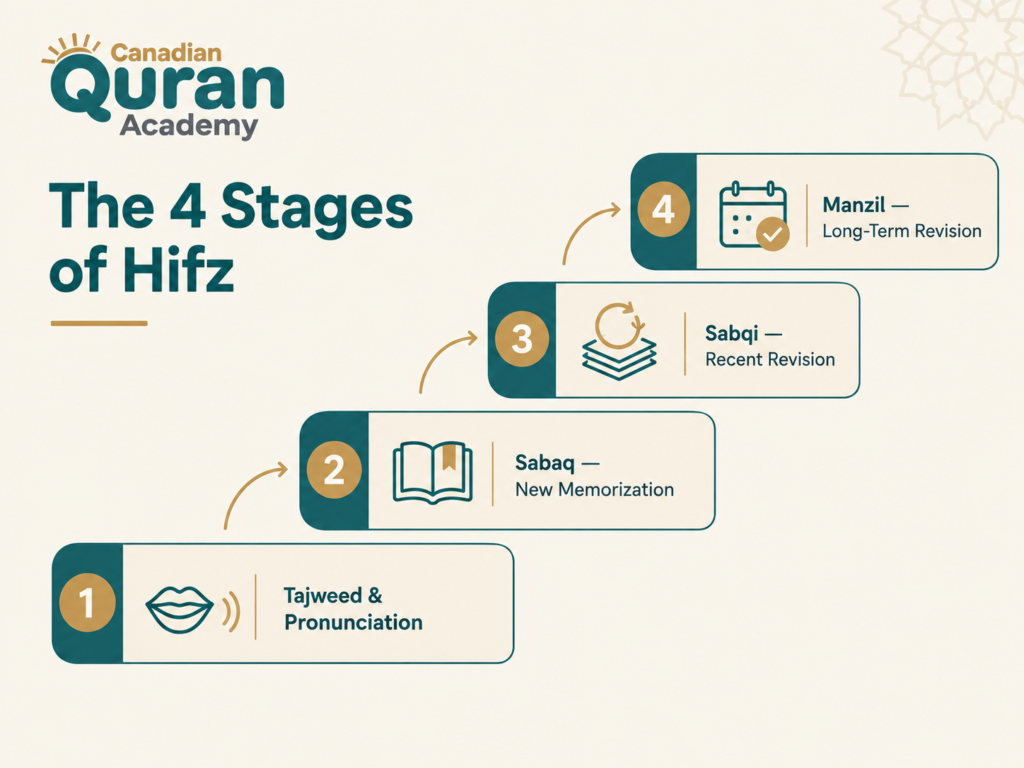
To learn Quran by heart in Canada, most students follow four stages: correcting pronunciation, building daily new memorization (sabaq), revising recent portions (sabqi), and cycling through old material (manzil).
The order matters more than the speed. A student who memorizes two pages a day with weak pronunciation ends up rebuilding everything later, which is slower than starting properly.
Distance is the second reality. Outside Toronto, Montreal, and Vancouver, many families have no daily halaqah nearby, so structured online sessions with a certified teacher have become the practical default.
Time zones are the third. A qualified Al-Azhar-trained instructor teaching from overseas can meet a student in Edmonton before school or after Isha, which is exactly the flexibility a five-day-a-week hifz routine needs.
Is Memorizing the Whole Quran Obligatory?
No. Memorizing the entire Quran is not an individual obligation on every Muslim. According to Egypt’s Dar al-Ifta, memorizing the Quran is fard kifayah (a communal obligation) for the people of each community, ensuring that the Quran remains preserved among them. However, memorizing what is necessary for one’s own prayer is an individual obligation.
What every Muslim must learn for prayer depends on the relevant fiqh details. Surah Al-Fatihah is required in prayer, while reciting an additional surah or verses after Al-Fatihah is considered Sunnah according to Dar al-Ifta.
So, you are not required to memorize the entire Quran. Beyond what is needed for valid worship, memorizing more of the Quran is a great virtue and an act of devotion—not a burden imposed on every Muslim.
Beyond that minimum, memorization is a virtue, not a burden. Allah says,
“And We have certainly made the Qur’an easy for remembrance, so is there any who will remember?” (Al-Qamar 54:17).
وَلَقَدْ يَسَّرْنَا ٱلْقُرْءَانَ لِلذِّكْرِ فَهَلْ مِن مُّدَّكِرٍۢ
That distinction removes a lot of guilt. You are not sinful for not being a hafiz — you are rewarded for every step you take toward it.
Read Also: Psychological Barriers In Memorization – How Stress Affects Quran Memorization
Why Tajweed Has to Come Before Hifz?
Memorizing a mispronounced verse means memorizing the mistake. Correcting it two years later takes far longer than learning it correctly the first week.
This is why serious programs begin with Noorani Qaida for beginners, then move to guided Quran recitation classes where a teacher listens and corrects letter by letter.
The rules themselves — makharij (articulation points), madd (elongation), ghunnah (nasalization), and the rules of noon sakinah — are not academic decorations. They are what keeps meaning intact.
Structured online tajweed classes at Canadian Quran Academy are built for exactly this stage, with separate tracks for kids, adults, and sisters so the pace matches the learner rather than the group.
A Weekly Hifz Plan That Fits a Canadian Schedule
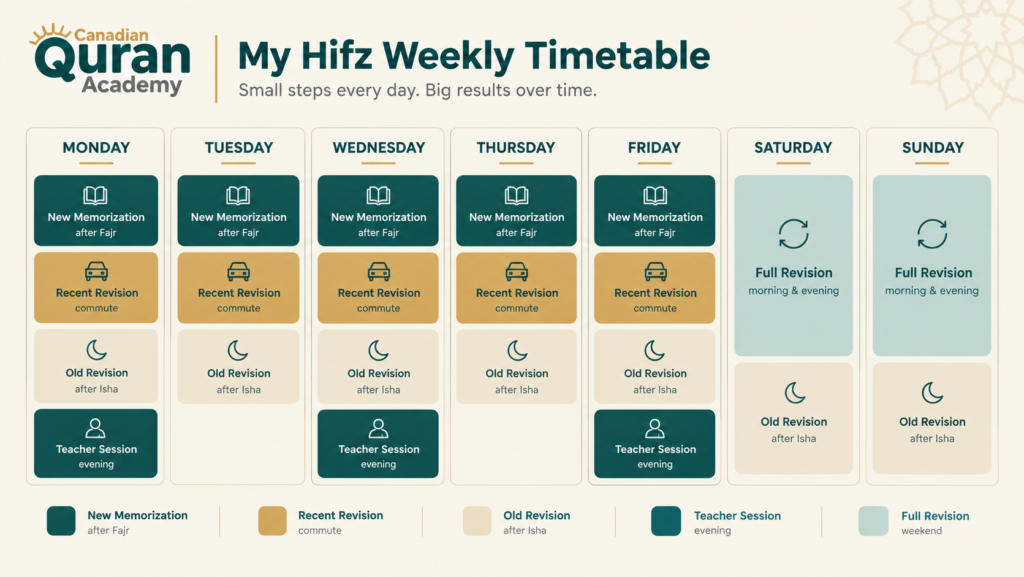
A workable plan is small, daily, and non-negotiable. Five days of memorization plus two days of pure revision beats seven inconsistent days every time.
A realistic adult routine:
- New memorization (20–30 min): three to five lines after Fajr, when the mind is clearest
- Recent revision (15 min): the last seven days of material, recited during your commute or lunch break
- Old revision (15 min): one page of previously completed material after Isha
- Teacher session (30–45 min): three to five times weekly, to recite and be corrected
Shaykh Ibn Baz advised choosing the times when the heart and tongue come together — after Fajr and during the night — rather than fitting Quran into leftover minutes.
Children usually do better with two shorter blocks: fifteen minutes before school and fifteen after dinner, ending while they still have energy rather than pushing to tears.
Read Also: The Ottoman Hifz Method
How to Stop Forgetting What You Have Memorized
Forgetting is normal, not failure. The Prophet (ﷺ) said, “Commit yourself to the Qur’an, for by Him in whose Hand is my soul, it is surely more prone to break away than a camel in its bind. (Sahih al-Bukhari 5033), which is why revision is a permanent part of hifz, not a temporary phase.
” تَعَاهَدُوا الْقُرْآنَ فَوَالَّذِي نَفْسِي بِيَدِهِ لَهُوَ أَشَدُّ تَفَصِّيًا مِنَ الإِبِلِ فِي عُقُلِهَا ”
The most effective revision tool is prayer itself. Reciting your memorized portions during voluntary prayers — especially night prayer — turns revision into worship.
A simple rule keeps things stable: never add new material on a day you have not revised. If your old memorization is slipping, pause the new pages for a week and rebuild the foundation.
Memorize With Understanding, Not Just Repetition
Memorization without comprehension is fragile. When a child repeats words with no meaning attached, the memory has nothing to anchor to, and motivation quietly disappears.
The Quran itself directs readers toward reflection: “Then do they not reflect upon the Qur’an, or are there locks upon their hearts?” (Muhammad 47:24).
أَفَلَا يَتَدَبَّرُونَ ٱلْقُرْءَانَ أَمْ عَلَىٰ قُلُوبٍ أَقْفَالُهَآ
Practically, this means reading a short tafsir of your daily portion, learning the vocabulary that repeats across the surah, and knowing why the passage was revealed.
Students who pair Quran memorization classes with basic Quranic Arabic almost always retain more, because they are storing meaning rather than sound.
Read Also: Mauritania Hifz Method
Should Children Start Hifz Early?
Yes — children between five and twelve absorb and retain Quran remarkably well, and early exposure builds pronunciation habits that are difficult to acquire later.
But the goal has to be explained. A child who knows why they are memorizing responds very differently from one who is only counting pages.
Keep sessions short, celebrate small completions, and let the child hear the meaning of what they memorize in English or their home language.
Dedicated hifz classes for kids use exactly this approach — short guided sessions, gentle correction, and progress reports for parents so nothing is guessed at.
How Long Does It Take to Memorize the Quran?
For a full-time student memorizing one page daily with consistent revision, complete memorization typically takes about two to three years. Part-time learners memorizing three to five lines a day usually need four to seven years.
Adults with full-time jobs often choose a staged goal instead: Juz Amma first, then Juz Tabarak, then the longer surahs. Finishing one juz well is far more valuable than starting ten.
Live Class in Action
Watch how our instructors interact with students in real-time, focusing on interactive methods.
Start Your Quranic Journey in Canada
Join our vibrant community and learn with expert tutors through our flexible online platform.
Claim Your Free TrialStart Your Quran Memorization Journey With a Free Trial Class
Stop planning your hifz and start it this week. Canadian Quran Academy pairs you with a certified, Ijazah-holding instructor who corrects your tajweed, sets a memorization pace that fits your actual schedule, and tracks your revision so nothing slips away.
Whether you are a parent enrolling a child, a sister looking for a female teacher, or an adult beginner starting with Surah Al-Fatihah, sessions run across all Canadian time zones — mornings, evenings, and weekends. Book your free trial class and recite for a teacher today.
Our Quran Courses
- Quran Online Academy
- Quran Recitation Classes
- Quran Reading Classes
- Online Quran Classes for Kids
- Quran Classes for Adults
- Quran Classes for Female
- Learn Quran Course for Beginners
- Quran Memorization (Hifz) Course
- Hifz Classes for Adults
- Quran Memorization and Hifz Course for Kids
- Quran Hifz Course for Ladies
- Quran Ijazah Program
- Quran Qirat Learning Course
- Quran Tafsir Course
- Noorani Qaida Course
- Noorani Qaida Course for Kids
- Weekend Quran Classes
- Intensive Quran Course
- Al-Azhar Quran Course
- Online Tajweed Classes
- Tajweed Course for Kids
- Tajweed Course for Adults
- Tajweed Course for Ladies
Conclusion
Choosing to learn Quran by heart in Canada is less about talent and more about structure. Complete memorization is a communal duty and a high virtue; what every Muslim personally owes is the portion that makes prayer valid.
The path that works is consistent: fix pronunciation through tajweed first, memorize a small daily portion at your sharpest hour, revise before you add, and attach meaning to every page you store.
Take-away message: small and daily beats large and occasional. Three correctly recited lines every morning, revised faithfully, will carry you further in a year than any burst of enthusiasm that collapses in month two.
FAQs
Can I memorize the Quran if I do not speak Arabic?
Yes. Thousands of non-Arabic speakers across Canada complete hifz every year. You begin with Noorani Qaida to master the letters and sounds, then memorize with a teacher while learning the meaning of your daily portion in translation.
Is it a sin to make mistakes while reciting from memory in prayer?
No. Islamweb’s scholars state there is no harm in reciting from memory to strengthen hifz even if mistakes occur, since reciters rarely avoid them entirely. Reciting in prayer actually carries additional reward.
What is the best age for a child to start memorizing the Quran?
Most teachers recommend starting between ages five and seven, after the child can recognize Arabic letters. Early years combine short memorization sessions with Noorani Qaida and pronunciation practice rather than heavy daily targets.
Are online Quran memorization classes as effective as in-person halaqah?
For most Canadian families, yes. One-to-one online sessions give more individual correction time than a crowded group class, remove travel time, and allow five short sessions a week instead of one long weekend class.
How much should I memorize each day?
Start with three lines a day and hold that pace for one month before increasing. Consistency and revision determine your progress far more than daily volume.
Do I need to memorize the whole Quran to be a good Muslim?
No. Memorizing Al-Fatihah and enough verses for prayer is the individual obligation. Anything beyond that is a voluntary virtue that brings great reward, and partial memorization is genuinely valuable in itself.






Leave a Reply