 Quran
How can a learner memorize large amounts of Quranic text and retain it for years? The Mauritania Hifz method offers one traditional answer: disciplined repetition, daily review, teacher correction, and gradual progression.
Known as the Mahadra tradition, Mauritania’s classical learning system has preserved knowledge through listening, memorization, oral repetition, and direct teacher-student transmission for centuries.
UNESCO describes the Mahadra as a community-based educational system sometimes called the “university of the desert,” where traditional knowledge is transmitted primarily through listening and memorization.
For Canadian families looking for practical Quran memorization methods, the value of this approach is not that every learner must copy the traditional system exactly. Rather, its emphasis on repetition and structured review offers useful principles that can be adapted to modern online Hifz programs for children and adults.
This guide explains how the Mauritanian Hifz method works, why repetition is central to it, how the traditional Mahadra environment supports memorization, and how Canadian Quran learners can apply its most useful principles today.

What You Will Learn
- How the traditional Mauritanian Mahadra supports Quran memorization.
- Why repeated recitation is the foundation of the Mauritanian Hifz method.
- How a four-day rolling review cycle can be adapted for modern learners.
- What Canadian children and adults can learn from this traditional approach.
- How teacher-guided Hifz can combine repetition with Tajweed and accurate recitation.
Mauritania Hifz method
The Mauritania Hifz method is a repetition-centered approach to Quran memorization associated with the traditional learning culture of Mauritania.
Its strongest feature is the idea that memorization should not depend on a single successful reading; the learner repeatedly reads, recites, reviews, and presents the material until it becomes firmly established.
The wider Mahadra tradition is much broader than Quran memorization. UNESCO describes it as a long-standing community education system involving religious sciences, language, literature, and oral transmission.
Lessons traditionally take place in settings adapted to local life, and students learn through listening, memorization, and repeated recitation.
What Is the Mauritanian Mahadra?
A Mahadra is a traditional Mauritanian learning environment in which students study under teachers through direct instruction and oral transmission. UNESCO inscribed the Mahadra community system on the Representative List of the Intangible Cultural Heritage of Humanity in 2023.
The traditional system is particularly interesting for Hifz learners because memorization is not isolated from the teacher. Students listen, repeat their lessons, and recite what they have learned to the teacher for correction.
That combination is important for Quran memorization today: repetition helps build retention, while a qualified teacher helps prevent the learner from repeatedly memorizing incorrect pronunciation or Tajweed.
The Wooden Tablet and Daily Lesson
One distinctive feature of traditional Mahadra education is the use of wooden writing tablets. UNESCO records that traditional lessons were written on wooden boards using ink made from local materials, including water, gum, and charcoal, and students repeated the lessons until they could recite them.
The tablet was therefore more than a writing surface. It supported a cycle of writing, reading, repeating, reciting, correcting, and moving to the next lesson. The historical practice does not need to be reproduced literally in a Canadian home.
The underlying learning principle can be transferred to a notebook, printed Mushaf, tablet, or digital Quran while maintaining the same focus on active recall and repeated recitation.
The Role of Warsh Recitation
Mauritania has a strong historical connection with the Warsh ʿan Nafiʿ tradition of Quranic recitation, which is widely associated with North and West African Quranic reading traditions.
Academic research describes Warsh as one of the recognized Quranic transmission traditions and notes its historical importance in the western Islamic world.
A learner should therefore avoid mixing recitation conventions without guidance. If a student is learning Hafs, Warsh, or another established riwayah, the best approach is to follow one qualified teacher consistently and learn the rules of that transmission accurately.
Read Also: Psychological Barriers In Memorization – How Stress Affects Quran Memorization
How Does the Mauritania Hifz Method Work?
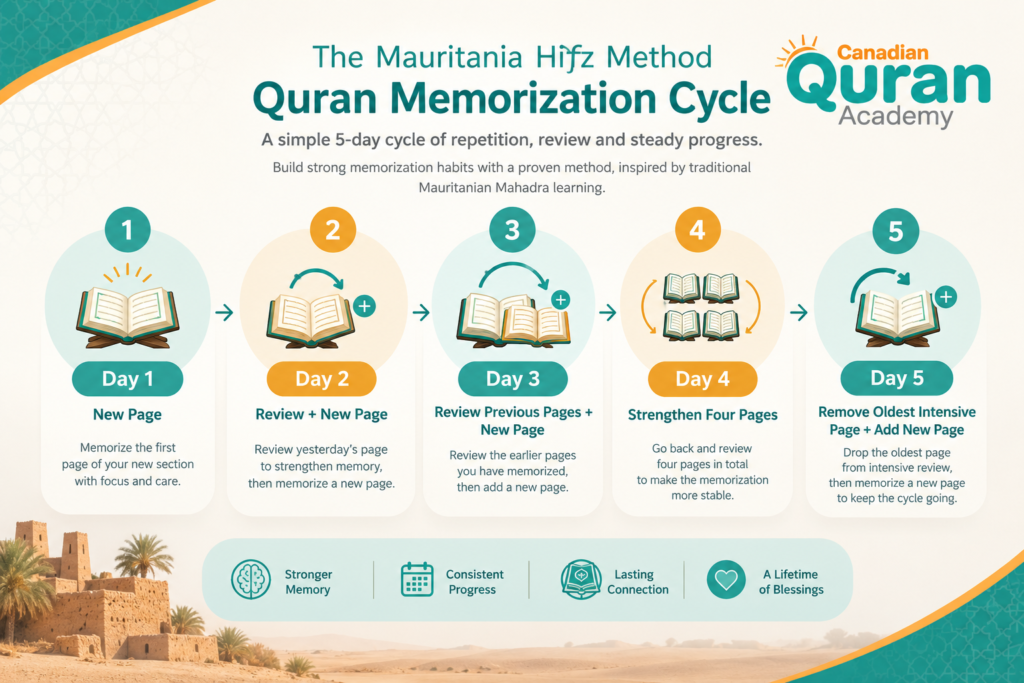
The practical idea can be summarized simply: learn a new portion, repeat it intensively, keep reviewing recent portions, and gradually replace the oldest material with new material while maintaining continuous revision.
One commonly described application uses several daily sessions and a rolling review cycle. The exact number of repetitions should not be treated as a fixed religious requirement; it is a memorization strategy that can be adjusted according to the learner’s age, ability, schedule, and retention.
Day One: Build the First Page
On the first day, the learner focuses on one page or a manageable portion of the Quran. The learner first listens to or reads the passage carefully, then repeats it many times while looking at the Mushaf.
As familiarity increases, the learner gradually attempts recitation from memory. Several short sessions throughout the day can be more manageable than trying to complete all repetition in one sitting.
Day Two: Review and Add New Material
On the second day, the learner reviews the previous page before beginning a new page. The older material receives fewer repetitions than it did on its first day, while the new material receives more intensive practice. This creates an important balance while new memorization continues without abandoning yesterday’s lesson.
Day Three: Connect Three Portions
On the third day, the learner reviews the first two portions and adds another new portion. The goal is not simply to memorize isolated pages but to connect them in sequence.
This linking stage is particularly important because some learners can recite individual verses correctly but struggle when moving from one verse or page to the next.
Day Four: Strengthen the Four-Day Cycle
By the fourth day, the learner reviews the previous three portions and adds a fourth. The oldest material has now received repeated exposure across several consecutive days.
This creates a simple principle that can be adapted for modern Hifz, where new material should enter the schedule gradually while recent material remains active through repeated recall.
Day Five and Beyond: Replace the Oldest Portion
From the fifth day, the oldest page can leave the intensive daily cycle while the learner continues reviewing the more recent pages and introduces a new one.
After that, the learner takes three recent portions and keeps them in the review cycle while adding one new portion.
The benefit is that every new page receives several days of focused attention before leaving the intensive cycle. For many learners, this can provide a stronger foundation than memorizing a large amount of Quran once and rarely reviewing it.
Read Also: The Ottoman Hifz Method
Why Repetition Matters in Quran Memorization
Repetition is one of the clearest lessons from the traditional Mahadra approach. However, more repetition is not automatically better. Repeating a mistake dozens of times can strengthen the mistake.
That is why a Quran memorization program should combine repetition with accurate listening, Tajweed instruction, and teacher correction. A learner should first establish correct pronunciation and then use repetition to strengthen the correct version.
1. Repetition Should Be Active
Simply looking at a page repeatedly is different from active memorization. A stronger practice is to read the verse, close or cover the Mushaf, recite it from memory, check the Mushaf, identify the mistake, and repeat the difficult section. This turns repetition into an active recall exercise rather than passive reading.
2. Repetition Should Include Review
The goal of Hifz is not only to acquire new verses. It is also to retain what has already been memorized. For children and adults in Canada, this is especially important because school, work, family commitments, and changing schedules can interrupt daily practice. A realistic review system can help learners continue progressing even when their available time changes.
How to Adapt the Mauritania Hifz Method in Canada
Canadian families do not need to recreate a traditional Mauritanian Mahadra to benefit from its principles. The most useful elements can be integrated into a modern, teacher-guided Hifz routine.
For children, the daily target should be small enough to maintain consistently. A child may benefit from memorizing a few verses or a short portion while spending additional time reviewing previous memorization.
Adults may prefer Shorter sessions centered around job, family, and prayer. Consistent repetition is still more beneficial than sporadic intensive memorization, according to conventional wisdom.
A live teacher can also make the process more effective by listening to the learner’s recitation and correcting Tajweed immediately. This is particularly valuable when the student is memorizing in a different riwayah or is still developing accurate Arabic pronunciation.
For Canadian families seeking this kind of structured support, Canadian Quran Academy offers Hifz programs for children and adults with systematic memorization, review, and Tajweed-focused recitation. Its Hifz programs emphasize structured cycles and teacher-guided retention rather than memorizing forward without sufficient revision.
Read Also: Learn Quran By Heart In Canada
Is the Mauritania Hifz Method Suitable for Children and Adults?
Yes, but the pace should be adapted to the learner. Children generally need shorter sessions, frequent encouragement, and achievable memorization targets. Starting with shorter Surahs can help them experience progress while developing correct Quran reading and Tajweed.
Adults can often handle longer sessions, but their biggest challenge may be consistency. A flexible schedule with clearly defined new memorization and review targets can make Hifz easier to maintain alongside work and family responsibilities.
The important lesson is not to copy a historical number of repetitions mechanically. Instead, use the Mauritanian principle of consistent repetition, teacher correction, continuous review, and adapt it to the learner.
If a student needs help with Arabic letters before beginning Hifz, a structured Noorani Qaida foundation can also be useful. Learn more about our academy’s beginner curriculum.

What Are the Advantages and Limitations of This Method?
The main advantage of the Mauritania Hifz method is its strong emphasis on retention rather than rapid accumulation.
Repeated exposure can help learners become increasingly familiar with the wording, sequence, pronunciation, and transitions between verses. It also encourages discipline and a predictable daily routine.
The limitation is that excessive repetition can become tiring, particularly for young children. It can also become ineffective if the learner repeatedly practices an incorrect pronunciation.
The best modern adaptation therefore combines traditional repetition with modern scheduling, individual pacing, teacher feedback, Tajweed correction, and meaningful breaks.
Live Class in Action
Watch how our instructors interact with students in real-time, focusing on interactive methods.
Start Your Quranic Journey in Canada
Join our vibrant community and learn with expert tutors through our flexible online platform.
Claim Your Free TrialStart Your Quran Hifz Journey With a Consistent Plan
A traditional memorization principle becomes more useful when it is adapted to the learner’s actual needs. For families in Canada, online lessons can also remove the need for commuting and make it easier to build Quran study around school, work, prayer, and family routines.
At Canadian Quran Academy, children and adults can receive individualized Quran instruction focused on memorization, Tajweed, recitation, and Arabic learning. Live instruction allows the teacher to listen to each learner rather than relying only on independent practice.
A free trial can help a learner identify an appropriate pace before committing to a longer Hifz schedule.
Our Quran Courses
- Quran Online Academy
- Quran Recitation Classes
- Quran Reading Classes
- Online Quran Classes for Kids
- Quran Classes for Adults
- Quran Classes for Female
- Learn Quran Course for Beginners
- Quran Memorization (Hifz) Course
- Hifz Classes for Adults
- Quran Memorization and Hifz Course for Kids
- Quran Hifz Course for Ladies
- Quran Ijazah Program
- Quran Qirat Learning Course
- Quran Tafsir Course
- Noorani Qaida Course
- Noorani Qaida Course for Kids
- Weekend Quran Classes
- Intensive Quran Course
- Al-Azhar Quran Course
- Online Tajweed Classes
- Tajweed Course for Kids
- Tajweed Course for Adults
- Tajweed Course for Ladies
Start your memorization journey and book your free trial

Conclusion
The Mauritania Hifz method offers a valuable lesson for anyone memorizing the Quran: consistent repetition must work together with review and accurate recitation.
For today’s Canadian learners, the goal is not to reproduce every historical practice. Instead, children and adults can take the strongest principles—small achievable portions, repeated practice, active recall, continuous review, and teacher correction—and integrate them into a sustainable Hifz routine.
Takeaway Message: The best memorization plan is not necessarily the fastest one. A sustainable routine that protects accuracy and retention can help a learner build a lasting relationship with the Quran.
FAQs
What is the Mauritania Hifz method?
The Mauritania Hifz method refers to a traditional repetition-centered approach associated with Mauritanian Quran and Mahadra learning. It emphasizes repeated recitation, teacher correction, gradual memorization, and continuous review.
How many times should I repeat a Quran verse when memorizing?
There is no single number that works for everyone. Repetition should continue until the learner can recite accurately without looking, while avoiding unnecessary repetition that causes fatigue.
What is the Mahadra in Mauritania?
The Mahadra is a traditional Mauritanian community-based learning system. UNESCO describes it as a centuries-old system in which knowledge is transmitted primarily through listening and memorization.
Does Mauritania use Warsh for Quran recitation?
Mauritania has a strong historical tradition of Warsh ʿan Nafiʿ recitation. Academic sources identify Warsh as an established Quranic transmission that has been particularly influential in the western Islamic world.
Is this Hifz method suitable for children?
Yes, its repetition and review principles can be adapted for children. However, young learners generally benefit from shorter sessions, manageable portions, encouragement, and direct teacher supervision.
Can adults use the Mauritania Hifz method?
Yes. Adults can adapt the same principles around their work and family schedules. Smaller daily targets with consistent review are often more sustainable than attempting large memorization sessions irregularly.





Leave a Reply