 Arabic
Anyone learning to read the Quran or speak Arabic eventually reaches a letter that stops them cold: the Arabic letter Ha (ح).
It has no equivalent in English, and mixing it up with its lookalike ه changes the meaning of the words you’re trying to say. This guide breaks down exactly how to pronounce it, write it, and use it correctly — the way we teach it at Canadian Quran Academy.
What Is The Arabic Letter Ha (ح)?
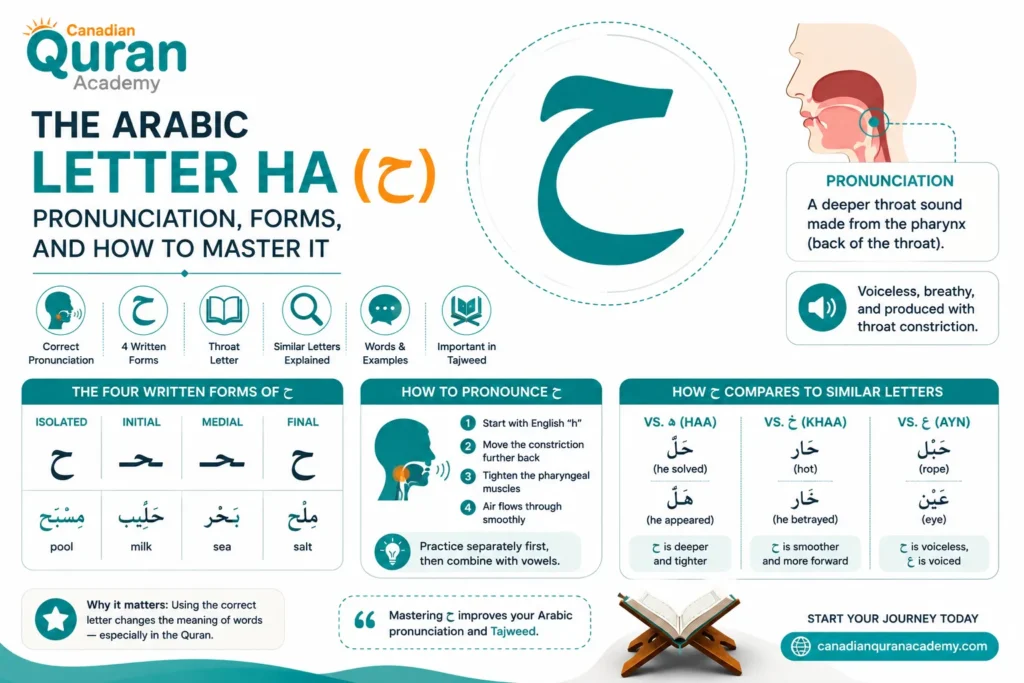
The Arabic letter Ha (ح) is the sixth letter of the Arabic alphabet, and it represents a voiceless pharyngeal fricative — a sound made by tightening the pharynx, the muscular area at the back of the throat, while pushing air through without engaging the vocal cords.
This sound simply doesn’t exist in English, French, or most European languages, which is exactly why it trips up so many new students. It’s also one of the ḥurūf al-ḥalq (throat letters) in the science of Tajweed, meaning its correct articulation matters directly for accurate Quranic recitation.
Unlike its close cousin ه, which is a soft, breathy sound like the English “h” in “hello,” ح is deeper, tighter, and produced further back. Confusing the two isn’t a minor accent issue — it can turn one word into a completely different one.
Before looking at how to physically produce the sound, it helps to understand why Arabic treats ح and ه as entirely separate letters rather than variations of the same “h.” In a language built on three-letter roots, swapping one throat letter for another changes the root itself, and therefore the meaning of the word.
How to Physically Produce the Ha Sound?
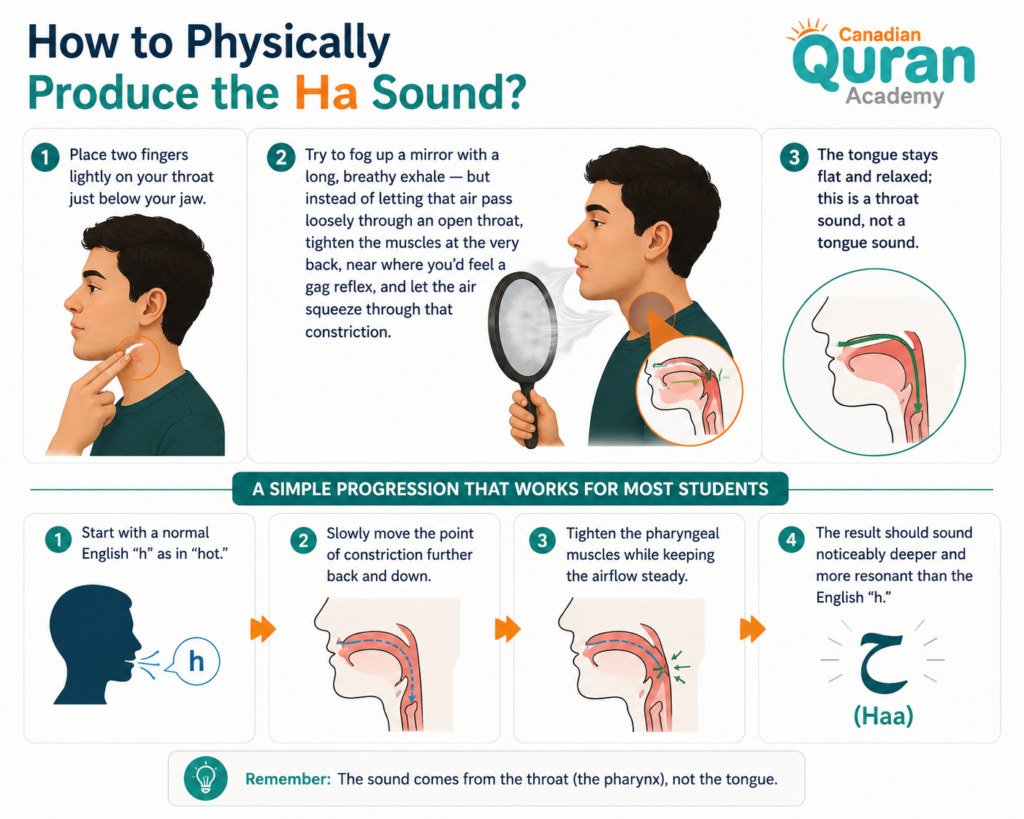
Place two fingers lightly on your throat just below your jaw. Then try to fog up a mirror with a long, breathy exhale — but instead of letting that air pass loosely through an open throat, tighten the muscles at the very back, near where you’d feel a gag reflex, and let the air squeeze through that constriction.
The tongue stays flat and relaxed; this is a throat sound, not a tongue sound. A rough progression that works well for most students:
- Start with a normal English “h” as in “hot.”
- Slowly move the point of constriction further back and down.
- Tighten the pharyngeal muscles while keeping the airflow steady.
- The result should sound noticeably deeper and more resonant than the English “h.”
At Canadian Quran Academy, instructors often have students practice this sound isolated for several days — separate from full words — before combining it with vowels, since trying to read whole words too early tends to reinforce the wrong articulation point.
The Four Written Forms Of ح
Like every letter in the Arabic alphabet, ح changes shape depending on where it sits in a word, even though the sound never changes. Recognizing these forms quickly is one of the biggest hurdles in early reading fluency, and it’s a step every learner of the ح – Arabic letter ha has to work through before reading picks up any real speed.
The good news is that ح belongs to a small, visually consistent family of letters — it shares its base shape with ج (jeem) and خ (khaa), and the only thing separating them is the presence and placement of a dot.
ح is the version with no dot at all.
- Isolated: ح — used when the letter stands alone, as in مسبح (pool)
- Initial: حـ — appears at the start of a word and connects forward, as in حليب (milk)
- Medial: ـحـ — connects on both sides, as in بحر (sea)
- Final: ـح — connects only from the right, as in ملح (salt)
Because ح is a “dual-joining” letter, it links smoothly to both the letter before and after it, which is part of what makes its medial form look more compact than its isolated form.
Read Also: The Letter Dadh In Arabic (ض) – How To Pronounce, Write, And Master It
How ح Compares To Similar-Sounding Letters?
This is where most learners get stuck, and where a good teacher makes the biggest difference. Three letters are routinely confused with ح, each for a different reason.
All three of these letters originate from roughly the same region of the mouth and throat, which is precisely why they blur together for beginners. Once you can isolate each one individually, the confusion tends to disappear within a few weeks of focused practice.
ح Versus ه (Haa)
ه is a simple glottal sound, essentially the English “h” in “hello,” produced with a relaxed, open throat.
ح requires real pharyngeal constriction. The pair حَلَّ (he solved) and هَلَّ (he appeared) are distinguished by nothing except this one difference — swap the letters and you’ve said a different word entirely.
ح Versus خ (Khaa)
خ is produced further back in the throat than ح and carries a raspy, guttural quality, similar to the German “ch” in “Bach” or the Scottish “ch” in “loch.” ح is smoother and sits slightly more forward. Compare حار (hot) with خار (he betrayed).
ح Versus ع (Ayn)
ع is produced in roughly the same pharyngeal location as ح, but it’s voiced — the vocal cords vibrate, giving it a distinctive “strangled” quality.
ح stays voiceless and breathy throughout.
One decision rule that helps students in live classes at Canadian Quran Academy: if your vocal cords are buzzing, you’re not saying ح. The moment you feel vibration in your throat rather than just friction, you’ve drifted into ع territory.
Everyday Words That Use The Letter Ha
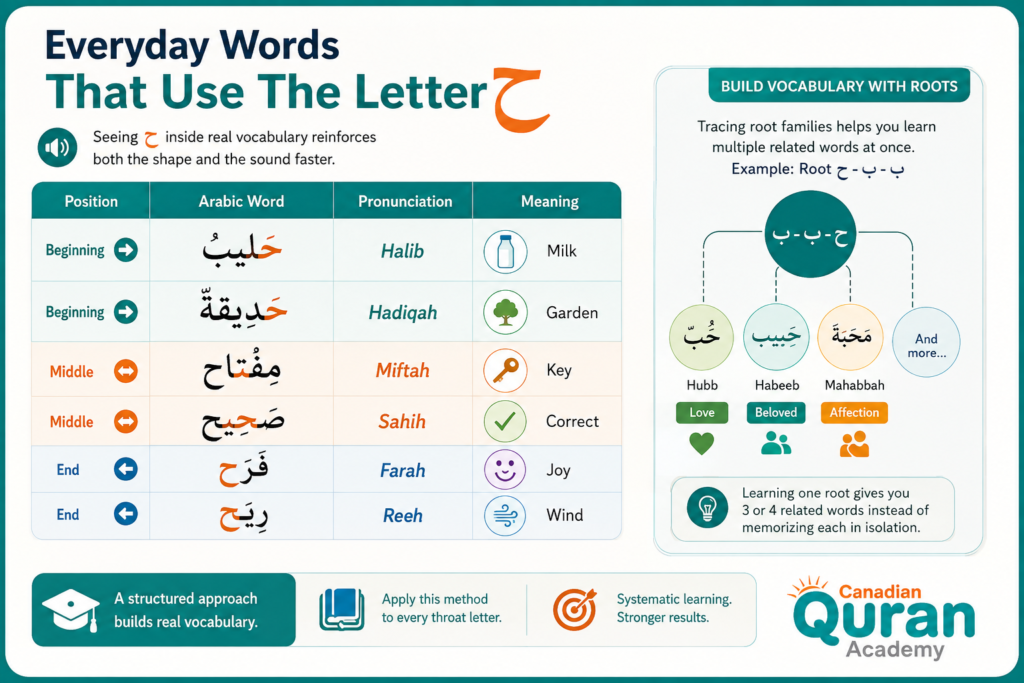
Seeing the Arabic letter Ha (ح) inside real vocabulary reinforces both the shape and the sound faster than drilling the letter alone.
| Position | Arabic Word | Pronunciation | Meaning |
| Beginning | حَليب | Halib | Milk |
| Beginning | حَديقة | Hadiqah | Garden |
| Middle | مِفْتاح | Miftah | Key |
| Middle | صَحيح | Sahih | Correct |
| End | فَرَح | Farah | Joy |
| End | رِيح | Reeh | Wind |
A useful vocabulary-building shortcut is tracing root families. The root ح-ب-ب, for example, produces حُبّ (love), حَبيب (beloved), and مَحَبّة (affection) — learning one root gives you three or four related words at once instead of memorizing each in isolation.
This is a technique worth applying across every throat letter, not just ح, and it’s part of how a structured Arabic Grammar Course builds vocabulary systematically rather than through random word lists.
Simple Sentences Using ح
Placing the letter inside full sentences shows how it behaves at natural speaking speed, where the throat constriction has to happen quickly between other sounds.
- الحياة جميلة (Al-hayah jameelah) — Life is beautiful
- هذا صحيح (Hadha saheeh) — This is correct
- أنا أحب القهوة (Ana uhibb al-qahwah) — I love coffee
Reading sentences like these aloud daily, rather than only isolated words, is what actually transfers the sound into fluent speech.
This kind of guided speaking practice is exactly what an Arabic Conversation / Speaking Course is built around — moving learners from recognizing letters to producing them naturally in conversation.
Read Also: How To Learn Arabic For Quran In Canada?
Live Class in Action
Watch how our instructors interact with students in real-time, focusing on interactive methods.
Start Your Quranic Journey in Canada
Join our vibrant community and learn with expert tutors through our flexible online platform.
Claim Your Free TrialCommon Mistakes When Learning the Letter Ha
Most errors with the Arabic letter Ha (ح) fall into a short, predictable list, which is actually good news: once you know what to watch for, correction is fast.
1. Substituting the English “H” Sound
The most frequent mistake is simply using the familiar English “h,” which lands closer to ه. Because the two letters can look similar in casual romanization (both often written as “h”), learners default to the easier sound without realizing they’ve changed the word.
2. Confusing ح With خ in Rapid Speech
When speaking quickly, some learners let the constriction slip too far back, sliding into the raspier خ sound. Slowing down deliberately during practice — well before trying to speak at normal pace — prevents this habit from forming.
3. Omitting the Small Tail When Writing
In handwriting, forgetting the tiny tail beneath the curved body of ح makes it indistinguishable from other letters in its shape family. This is a purely visual mistake, but it matters just as much for reading fluency as pronunciation does.
Structured feedback from a native-speaking instructor catches these patterns far faster than self-study alone, which is one reason an Online Arabic Academy pairs pronunciation drills with live correction rather than relying only on recordings.
Read Also: How To Learn Arabic In 6 Months In Canada?
Tips To Master The Letter Ha
These are the habits that make the biggest difference for learners working through this sound, whether practicing alone or in a live class.
- Practice the sound in isolation for several days before combining it with vowels
- Place a hand on your throat to physically feel the constriction point
- Record yourself and compare against a native speaker’s pronunciation
- Progress from isolated letter → syllable → word → full sentence, without skipping steps
- Review root families (like ح-ب-ب) instead of memorizing unrelated word lists
If you’re just starting out, working through these fundamentals with structured lessons rather than piecing them together from scattered videos makes a measurable difference in how quickly the sound sticks — which is the whole premise behind an Arabic Course for Beginners.

Experience Our Classrooms
Don’t just take our word for it—take a look inside! Watch the videos below to experience our engaging teaching methods and vibrant online classrooms firsthand.
Start Your Quranic Journey in Canada
Join our vibrant community and learn with expert tutors through our flexible online platform.
Claim Your Free TrialRead also: Arabic Noorani Qaida – What It Is, Its Origin, And How To Teach It?
Start Speaking Arabic With Confidence Today
Mastering a single letter like ح is a small step, but it’s the kind of foundation that either sets up years of confident reading or years of quietly mispronouncing words without realizing it. Getting it right early, with real-time correction from someone trained to hear the difference, saves months of retraining later.
Canadian Quran Academy’s certified instructors work through exactly this kind of letter-by-letter foundation, correcting throat-letter pronunciation live so mistakes don’t calcify into habits.

Whether your goal is fluent conversation, classical texts, or Quranic recitation, the starting point is the same set of letters covered here.
Our Arabic Courses:
- Online Arabic Academy
- Online Arabic Course
- Classical Arabic Course
- Arabic Course for Beginners
- Advanced Arabic Course
- Quranic Arabic Course
- Arabic Grammar Course
- Modern Standard Arabic Course
- Arabic Conversation / Speaking Course
- Madinah Arabic Course
- Learning Arabic for Non-Arabic Speakers
- Arabic Elementary School
- Arabic Intermediate School
- Arabic Lessons for Kindergarten

Start Your Quranic Journey in Canada
Join our vibrant community and learn with expert tutors through our flexible online platform.
Claim Your Free TrialConclusion
The Arabic letter Ha (ح) is a voiceless pharyngeal sound with no English equivalent, produced by constricting the throat rather than the mouth — and it’s completely distinct from the softer ه, the raspier خ, and the voiced ع.
Its four written forms (isolated, initial, medial, final) all share the same dotless curved shape with a small tail, and its correct pronunciation matters for both everyday vocabulary and Quranic recitation.
With deliberate, staged practice — isolating the sound, feeling the throat constriction, then building up to full sentences — most learners at Canadian Quran Academy move from confusion to confidence within a few focused weeks.

Frequently Asked Questions
This section answers the questions learners most commonly ask about the Arabic letter ح, based on what comes up most often in beginner and intermediate classes.
1. What is the difference between ح and ه in Arabic?
ح is a deep pharyngeal sound produced by constricting the back of the throat, while ه is a soft, breathy sound similar to the English “h.” They come from different points in the throat and are treated as entirely separate letters in Arabic.
2. Why doesn’t the letter ح have any dots?
ح belongs to a group of three letters (ح, ج, خ) that share the same base curved shape. Dots are what distinguish them from one another, and ح is specifically the undotted version of that shape.
3. Is the letter ح important for reading the Quran?
Yes.
ح is classified among the ḥurūf al-ḥalq, or throat letters, in Tajweed, and mispronouncing it can affect the accuracy of recitation. It appears in central words such as الرحمن (Ar-Rahman).
4. How long does it typically take to master the ح sound?
Most learners need a few weeks of focused daily practice, starting with the isolated sound before moving to full words and sentences. Progress is faster with live correction from a qualified instructor than with self-study alone.
5. Can children learn to pronounce ح correctly?
Yes, children often pick up the throat constriction faster than adults when it’s taught through repetition, games, and short daily drills rather than technical explanation.







Leave a Reply