 Arabic
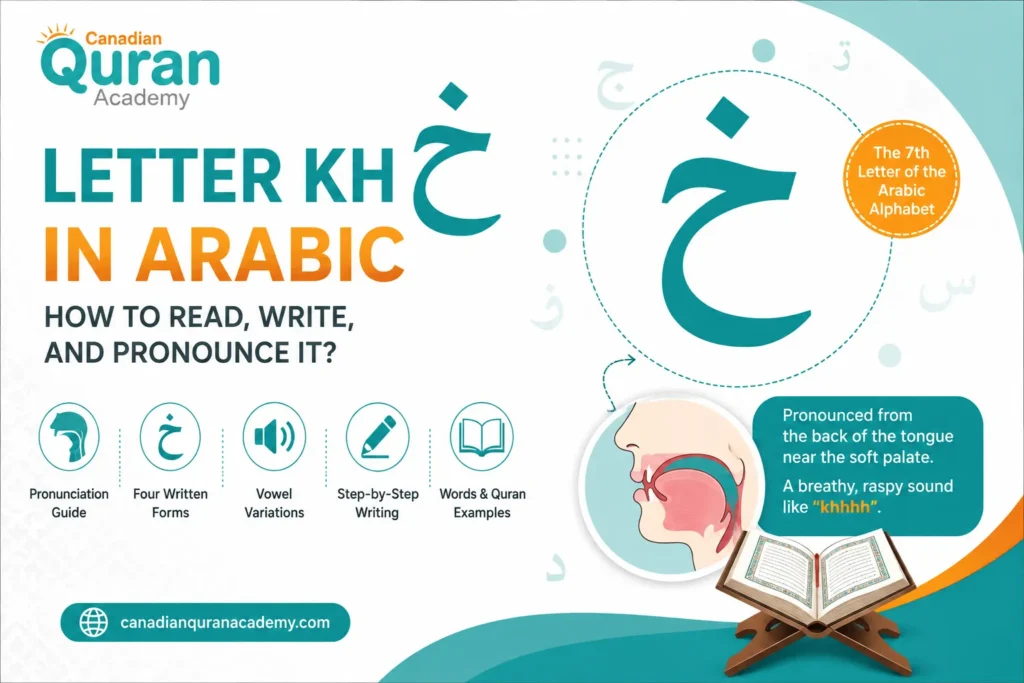
If you’ve started learning the Arabic alphabet, you’ve probably noticed one letter that doesn’t have a real match in English: the letter Kh (خ). At Canadian Quran Academy, this is one of the first sounds new students ask about, because it comes from a place in the mouth that English speakers simply never use on purpose.
خ – Letter Kh in arabic, written خ, is the seventh letter of the alphabet. It produces a rough, breathy sound from the back of the tongue, close to sounds you’d hear in the Scottish word “loch” or the German word “Bach.” Once you understand where it comes from and how it’s shaped on the page, it becomes one of the easier letters to spot and pronounce with confidence.
This guide walks you through everything you need to know about خ: its sound, its four written forms, how it behaves with different vowels, how to write it by hand, and where it shows up in real words and in the Quran.
Whether you’re a beginner, a parent teaching a child, or a student preparing for Quranic recitation, this article gives you a complete, practical foundation.
What You’ll Learn in This Article
- How the letter Kh (خ) is pronounced and where the sound comes from
- The four written forms of خ and how to recognize each one
- How خ changes sound with fatha, damma, kasra, and sukoon
- Step-by-step instructions for writing خ correctly
- Common words and Quranic examples that use خ
- Mistakes beginners make with خ, and how to correct them
What Is the Letter Kh (خ) in Arabic?
خ – Letter Kh in arabic is a consonant in the Arabic alphabet that produces a raspy, throat-based sound with no equivalent letter in English. It sits in the seventh position of the alphabet, right after Ha (ح) and before Dal (د).
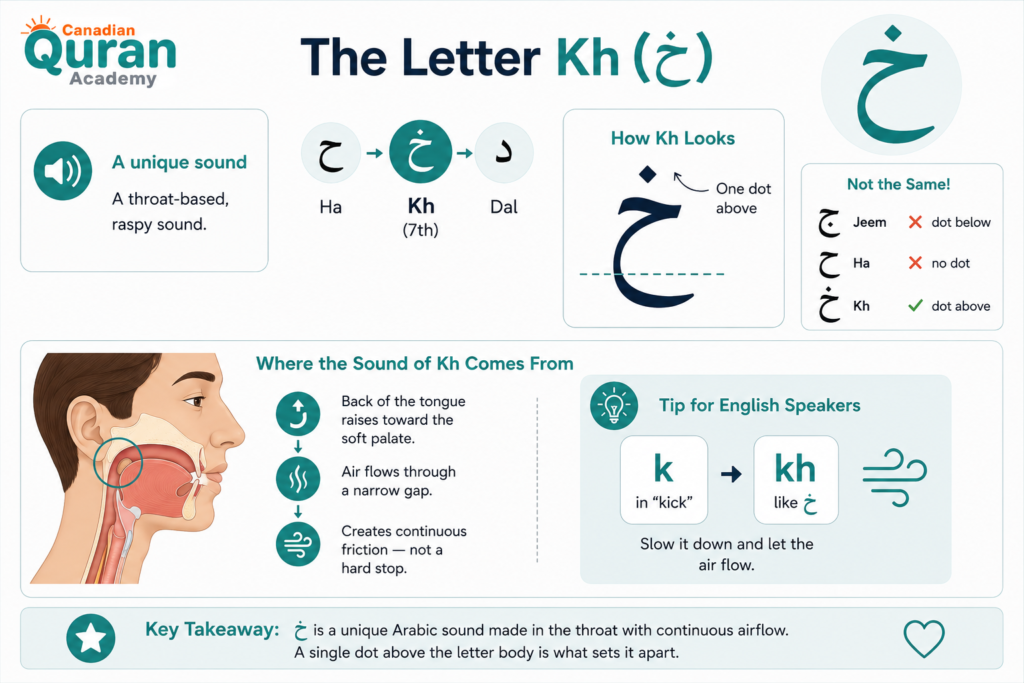
Visually, خ is a curved stroke that dips slightly below the writing line, topped with a single dot. That one dot above the letter body is what separates خ from its two closest relatives, Jeem (ج) and Ha (ح) — all three share almost the same base shape, and the dot’s position is the only thing that tells them apart.
Where The Sound Of Kh Comes From?
The sound of خ is produced by raising the back of the tongue toward the soft palate — the fleshy area at the back of the roof of your mouth — and pushing air through the narrow gap that’s left. This creates continuous friction rather than a hard stop, which is why you can actually hold the sound out loud: “khhhhh.”
A useful trick for English speakers: say the “k” in “kick,” but instead of releasing it with a burst, slow it down and let air leak through instead of snapping the closure shut. That slower, breathier version is very close to خ.
How Kh Fits Among Arabic’s Throat Letters?
Arabic groups several letters by where they’re produced in the mouth and throat.
خ, ح, and ج are often taught together because they share the same base shape but come from three different zones: ج (Jeem) is produced in the middle of the mouth, خ (Kh) further back at the soft palate, and ح (Ha) deep in the throat itself.
Practicing them in that order — ح, then خ, then ج — helps you feel the physical difference rather than just hearing it.
At Canadian Quran Academy, this letter grouping is one of the first pronunciation drills our instructors use with new students, precisely because feeling the difference in your mouth locks it in faster than repetition alone.
If you want a teacher to walk you through this sound live rather than piecing it together from text, our Arabic Course for Beginners is built for exactly this stage.
Read also: The Arabic Letter S (Seen س) – Pronunciation, Shapes, And Words To Practice
Read Also: Why Learn Arabic In Canada?
The Four Forms Of The Letter Kh In Arabic
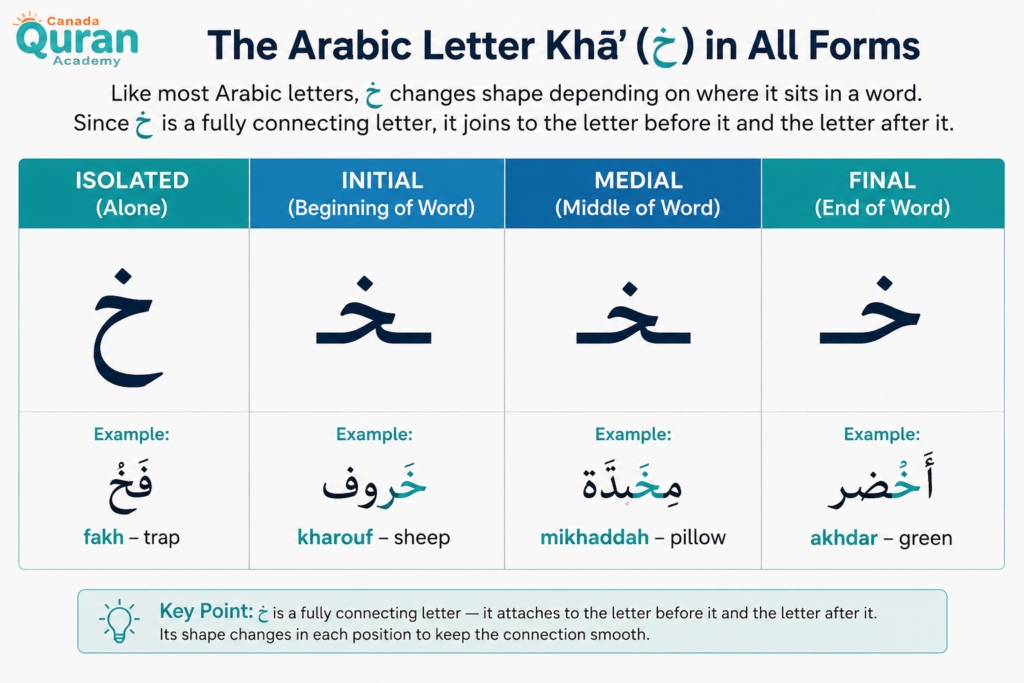
Like most Arabic letters, خ changes shape depending on where it sits in a word. Recognizing all four forms is essential, because the letter looks noticeably different at the start of a word compared to the middle.
A bridge worth remembering before going further: خ is a fully connecting letter. It joins to the letter before it and the letter after it, so its shape adjusts to make that connection smooth.
Kh at the Beginning of a Word
In the initial position, خ keeps its curved body and dot above, but drops the tail it would otherwise have, extending a connecting stroke to the left instead.
Example: خَروف (kharouf – sheep)
Kh in the Middle and End of a Word
In the middle of a word, خ compresses into a small, angular shape connected on both sides — this is often the hardest form for beginners to spot, since the letter shrinks down while the dot above stays in exactly the same relative position.
Examples: مِخَدَّة (mikhaddah – pillow), أخضر (akhdar – green)
At the end of a word, خ regains its full curved tail because there’s no following letter to connect to.
Example: فَخ (fakh – trap)
Read also: Arabic Punctuation In The Quran – The Complete Guide
How Kh Sounds With Each Vowel (Harakat)?
The consonant sound of خ stays the same, but the short vowel mark placed above or below it changes how the syllable is pronounced. This is one of the most practical things to master early, since it directly affects how you read real words.
1. Kh With Fatha, Damma, and Kasra
With fatha ( َ ), خ is read as “kha” — a short “a” sound, as in خَروف (kharouf – sheep) or خَبز (khabz – bread).
With damma ( ُ ), خ is read as “khu” — a short “u” sound, as in خُبز (khubz – bread) or خُردة (khurdah – junk).
With kasra ( ِ ), خ is read as “khi” — a short “i” sound, as in خِيار (khiyaar – cucumber) or خِزانة (khizanah – closet).
Read Also: How To Learn Arabic For Quran In Canada?
2. Kh With Sukoon and Shadda
With sukoon ( ْ ), خ carries no vowel at all — you produce the friction sound and stop cleanly, without adding any trailing vowel. This appears often in words like مَخْرَج (makhraj – articulation point, a term you’ll hear frequently in Tajweed lessons) and أَخْ (akh – brother).
With shadda, خ is doubled — you hold the friction sound noticeably longer before moving into the vowel that follows.
A quick note for anyone reading with long vowels: خ + Alif produces “khaa,” as in خَاتَم (khaatam – ring/seal). This combination appears in one of the most theologically significant phrases in the Quran, خَاتَم النَّبِيِّين (Khaatam al-Nabiyyeen – Seal of the Prophets), found in Surah Al-Ahzab (33:40).
Getting comfortable with all five vowel combinations is exactly the kind of foundational skill covered step by step in our Online Arabic Course, where students move from isolated letters to full words under a teacher’s correction rather than guessing at pronunciation alone.
Read also: The Arabic Letter K (ك) – Pronunciation, Shapes, And Meaning Explained
Live Class in Action
Watch how our instructors interact with students in real-time, focusing on interactive methods.
Start Your Quranic Journey in Canada
Join our vibrant community and learn with expert tutors through our flexible online platform.
Claim Your Free TrialHow to Write the Letter Kh Step by Step?
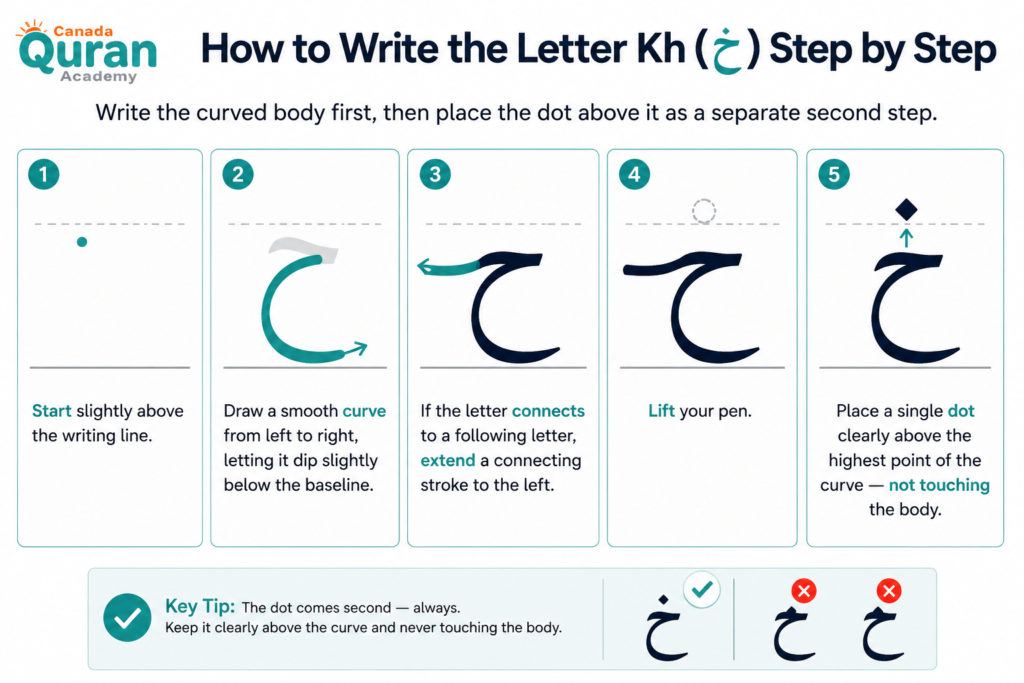
Writing خ correctly comes down to two separate actions done in the right order: draw the curved body first, then place the dot above it as a deliberate second step. Rushing the dot is the single most common cause of sloppy or misread خ.
Stroke Order for Writing Kh
Follow these five steps in order every time you practice, rather than trying to draw the whole letter in one continuous motion. Separating the curve from the dot is what keeps خ legible, especially while your hand is still building muscle memory for the shape.
- Start slightly above the writing line.
- Draw a smooth curve from left to right, letting it dip slightly below the baseline.
- If the letter connects to a following letter, extend a connecting stroke to the left.
- Lift your pen.
- Place a single dot clearly above the highest point of the curve — not touching the body.
Common Handwriting Mistakes
Beginners often place the dot too close to the letter body, which can make خ look like it has no dot at all from a distance, or they rush through the dot while still moving the pen and place it off-center.
Practicing the habit of pausing after the curve, then adding the dot as its own action, fixes this quickly.
Handwriting practice is one area where live correction from a teacher makes a real difference — a worksheet alone can’t tell you that your dot is drifting. Our Arabic Grammar Course includes structured letter-writing practice with feedback, which is especially useful for younger learners still building pen control.
Read also: Quran Verses About Ramadan In Arabic And English
Kh in Everyday Arabic and Quranic Words
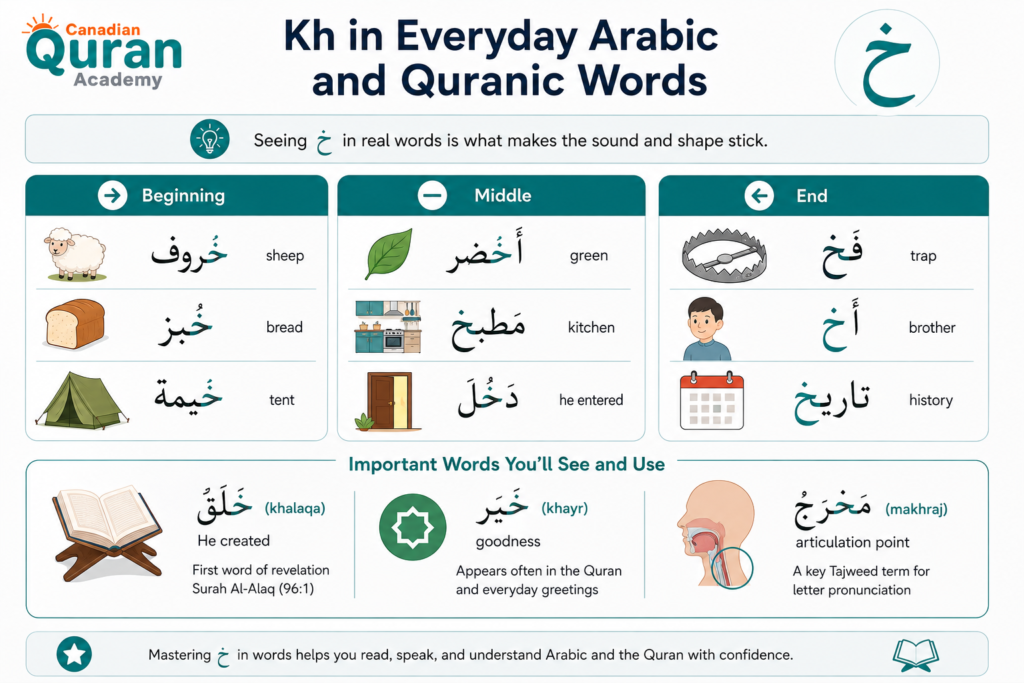
Seeing خ in real vocabulary — not just isolated letters — is what makes the sound and shape stick.
| Position | Arabic Word | Meaning |
| Beginning | خَروف / خُبز / خَيمة | sheep / bread / tent |
| Middle | أَخضر / مَطبخ / دَخَلَ | green / kitchen / he entered |
| End | فَخ / أَخ / تاريخ | trap / brother / history |
خ also appears in words carrying real theological weight. In the Quran, خَلَقَ (khalaqa – “He created”) is the very first verb of divine revelation, opening Surah Al-Alaq (96:1): “Recite in the name of your Lord who created.”
The word خَيْر (khayr – goodness) appears throughout the Quran and in everyday Islamic greetings, and مَخْرَج (makhraj – articulation point) is itself a Tajweed term you’ll use constantly once you begin studying letter pronunciation more formally.
For students working specifically toward accurate Quranic recitation, our Quranic Arabic Course covers letters like خ inside the context of Tajweed rules — including the requirement that its airflow stay continuous rather than stopping short, a detail that affects recitation accuracy far more than most beginners expect.
Common Mistakes When Learning Kh And How To Fix Them
Most errors with خ trace back to one of two things: mixing it up with a letter that looks or sounds similar, or letting the sound stop short instead of flowing continuously. Here are the four mistakes Canadian Quran Academy instructors see most often, and the specific fix for each.
1. Confusing Kh (خ) with Ha (ح)
Both can sound “throaty” to a new learner, but ح has no dot and is produced from deep in the throat with no tongue involvement, while خ has a dot above and is produced by the back of the tongue against the soft palate. If your خ sounds identical to your ح, the fix is physical: raise the back of your tongue instead of just exhaling from the throat.
2. Turning Kh into a hard “k”
This happens when the tongue fully closes against the soft palate and releases in a burst, the way English “k” works.
خ should never fully close — the air keeps flowing the entire time you produce it. You should be able to hold the sound out loud for several seconds without it cutting off.
3. Placing the dot below or inside the curve
That’s not a small stylistic choice — it turns خ into ج (Jeem), a completely different letter with a different sound. Always double-check that the dot sits above the body.
4. Missing Kh in the middle of a word
Because the medial form is compressed and small, learners sometimes skip over it while reading. Train your eye to scan for the dot first; if a small mid-word shape has a dot above it, it’s خ regardless of how compact it looks.
Read also: Quranic Verses About Parents in Arabic
Practice Exercises for the Letter Kh
Reading about خ is one thing — spotting it, writing it, and saying it under a bit of time pressure is what actually makes it stick.
The five short drills below move you through recognition, writing, and pronunciation in order, the same sequence our instructors at Canadian Quran Academy use with new students before moving on to full words.
- Circle the letter خ in these words: خروف — أخضر — مخدة — فخ — خبز
- Fill in the missing letter:
- __روف (sheep)
- ف__ (trap)
- م__دة (pillow)
- Read aloud, focusing on continuous airflow, not a hard stop:
خَبز — خِيار — خَرُوف — فَخ
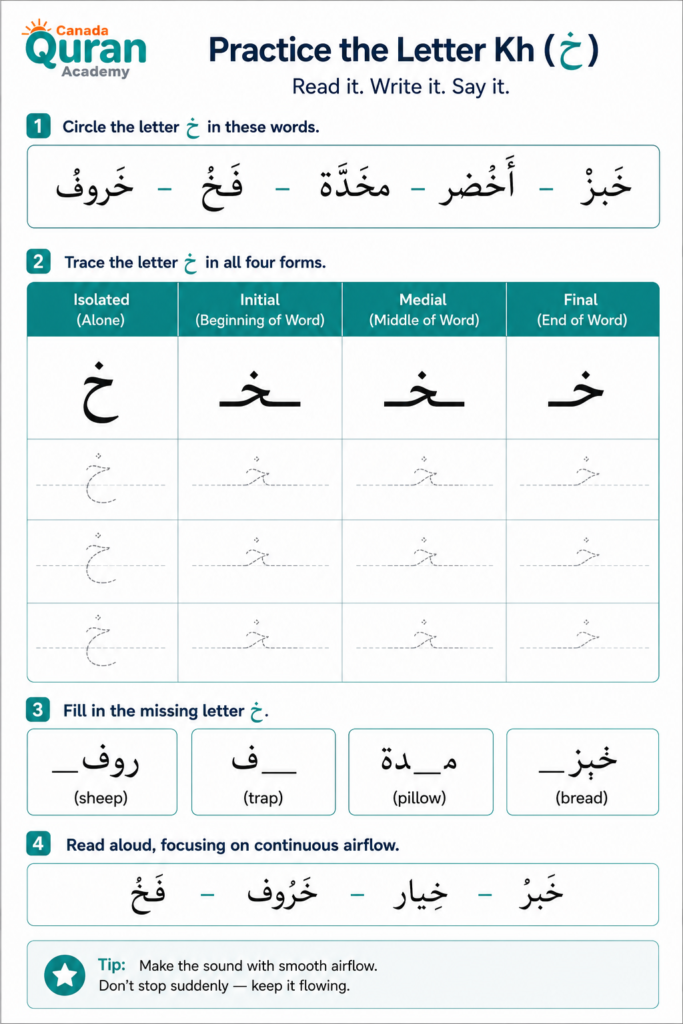
Repeat these drills daily for a week and the dot-check habit — scan above the curve first — becomes automatic.
Experience Our Classrooms
Don’t just take our word for it—take a look inside! Watch the videos below to experience our engaging teaching methods and vibrant online classrooms firsthand.
Start Your Quranic Journey in Canada
Join our vibrant community and learn with expert tutors through our flexible online platform.
Claim Your Free TrialStart Learning Arabic Letters the Right Way
Reading about a sound only gets you so far. The letter خ, like every Arabic letter with a subtle articulation point, is genuinely easier to correct in real time with a teacher listening to you than to self-diagnose from a screen.
At Canadian Quran Academy, our instructors work with students of every level — from children just starting the alphabet to adults preparing for confident Quranic recitation — correcting pronunciation letter by letter rather than leaving you to guess.

Whether you’re starting from zero or refining letters like خ before moving into full Tajweed study, there’s a course built for where you are: our Classical Arabic Course and Advanced Arabic Course both build directly on the letter-level foundation this article covers, and our Modern Standard Arabic Course is the right fit if your goal is everyday spoken and written Arabic rather than Quranic study specifically.
Stop guessing at pronunciation from articles and videos alone. Book a free trial class with Canadian Quran Academy and get direct, live correction on letters like خ from a qualified instructor — the fastest way to move from recognizing the letter to using it with real confidence.
Our Arabic Courses:
- Online Arabic Academy
- Online Arabic Course
- Classical Arabic Course
- Arabic Course for Beginners
- Advanced Arabic Course
- Quranic Arabic Course
- Arabic Grammar Course
- Modern Standard Arabic Course
- Arabic Conversation / Speaking Course
- Intensive Arabic Course
- Online Arabic Classes for Kids
- Arabic Classes for Adults
- Arabic Classes for Ladies

Start Your Quranic Journey in Canada
Join our vibrant community and learn with expert tutors through our flexible online platform.
Claim Your Free TrialConclusion
خ – Letter Kh in arabic is one of the more distinctive sounds in the Arabic alphabet — a back-of-tongue friction sound with no direct English equivalent, written as a curved stroke with a single dot above it.
Once you can reliably tell it apart from ح and ج, write all four of its forms, and read it correctly with each short vowel, you’ve mastered one of the genuinely challenging letters in Arabic.
From common words like خَروف (sheep) and مَطبخ (kitchen) to Quranically significant terms like خَلَقَ (He created) and خَيْر (goodness), خ shows up constantly in everyday reading.
Regular practice with the exercises above, paired with guided correction from an instructor at Canadian Quran Academy, is what turns this letter from a stumbling point into one you read and pronounce without a second thought.

Frequently Asked Questions About the Letter Kh in Arabic
These are the questions students at Canadian Quran Academy ask most often about the letter خ, along with a few points this guide touched on but worth restating clearly.
1. What does the letter Kh (خ) sound like in Arabic?
خ – Letter Kh in arabic sounds like a rough, breathy friction produced at the back of the tongue, close to the “ch” in the Scottish word “loch” or the German word “Bach.” It has no direct equivalent in English, which is why it’s usually one of the first sounds a new Arabic learner needs live correction on.
2. How is Kh (خ) different from Ha (ح)?
Kh (خ) is produced by the back of the tongue against the soft palate and carries a dot above the letter, while Ha (ح) is produced deep in the throat with no tongue involvement and has no dot at all. If the two sound identical when you say them, you’re likely producing both from the throat instead of engaging the tongue for خ.
3. How many forms does the letter Kh have?
خ – Letter Kh has four forms: isolated, initial, medial, and final. The dot above the letter body stays in every single form; only the curve and tail change depending on whether the letter connects to a preceding or following letter.
4. Can Kh (خ) be confused with Jeem (ج)?
Yes, because خ and ج share the same base curved shape. The only difference is dot placement: خ has its dot above the curve, while ج has its dot below or inside it. Placing the dot in the wrong spot turns one letter into the other.
5. What are some common words that use the letter Kh?
Common examples include خَروف (kharouf – sheep), خُبز (khubz – bread), مَطبخ (matbakh – kitchen), أخضر (akhdar – green), and أَخ (akh – brother). In the Quran, خَلَقَ (khalaqa – “He created”) and خَيْر (khayr – goodness) are especially frequent.
6. Is the letter Kh important for Quran recitation?
Yes. Kh (خ) requires continuous, unbroken airflow (a Tajweed characteristic called Rakhawah) rather than a hard stop, and mispronouncing it as a hard “k” is one of the most common recitation errors among beginners. Getting this letter right early makes later Tajweed rules significantly easier to apply correctly.






Leave a Reply