 Arabic
Your child can name every dinosaur in English but goes quiet when Grandma video-calls in Arabic. Sound familiar? The right Arabic books for kids can change that, one bedtime story at a time.
The hard part is choosing. Shelves are full of alphabet books, bilingual titles, workbooks and Islamic stories, and not all of them suit your child’s age, level or home language.
At The Canadian Quran Academy, our teachers help Canadian families match books with live lessons so that reading at home sticks. This guide brings that experience together for you.
Below are six types of books, what to look for in each one, how to read them together, and free websites, apps and videos that add to your reading time.
1. Alphabet Arabic Books For Kids Ages 3 To 6
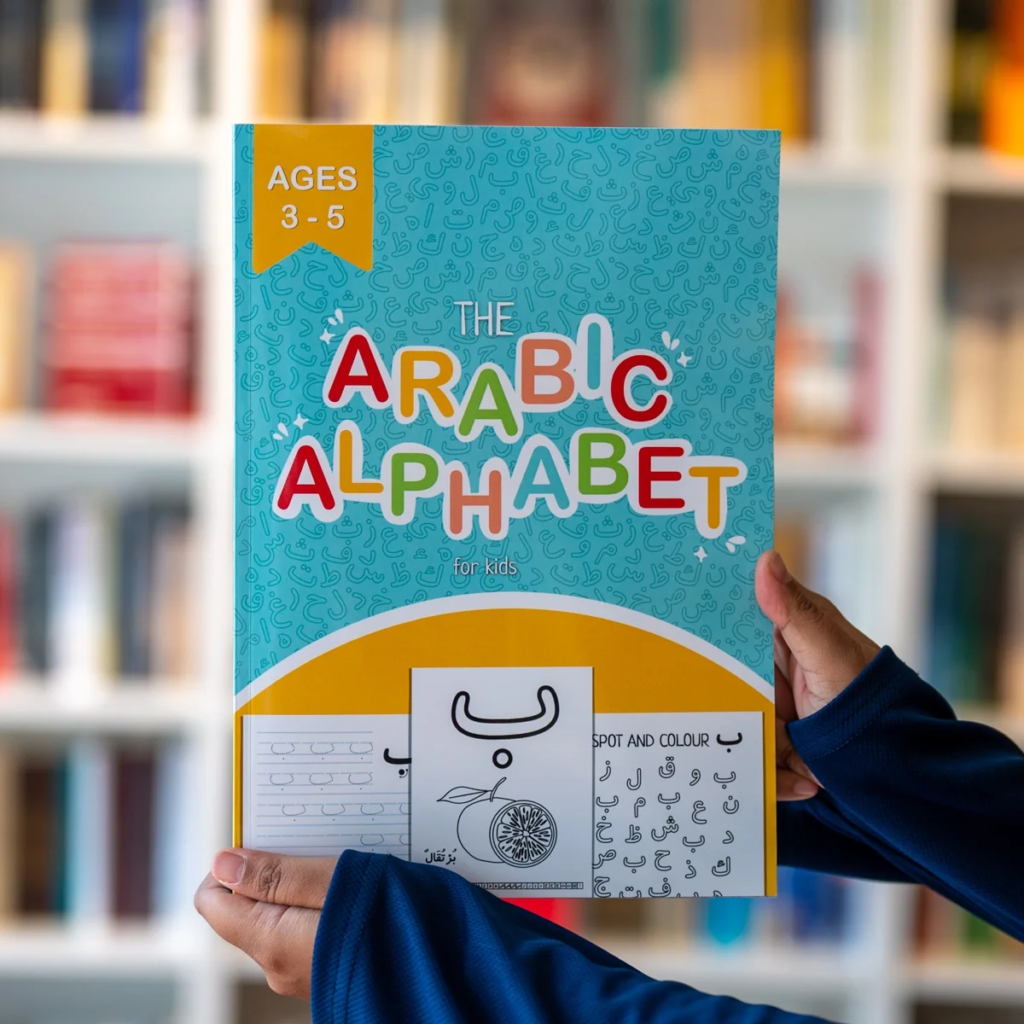
Alphabet Arabic books for kids are the natural first step. Children can’t read words until they know all 28 letters and the shapes each letter takes. Here is how to choose them and use them well.
What A Good Arabic Alphabet Book Includes
A good alphabet book gives each letter its own page. It shows one large letter, a clear picture and a simple word that starts with that sound, such as أرنب (rabbit) or باب (door).
Look for books that also show each letter’s beginning, middle and end forms. Arabic letters change shape when they connect, and children who see every form early make fewer reading mistakes later.
Thick board pages suit toddlers, and preschoolers enjoy lift-the-flap or touch-and-feel books. For a closer look at the first letter, read our guide Letter A (أ) In Arabic – The Complete Guide To Alif.
How To Read Alphabet Books With Your Child
Keep sessions short, about five to ten minutes. Point to the letter, say its sound and ask your child to repeat it before you turn the page.
Introduce three or four new letters a week and review the old ones every day. For children under six, playful repetition works better than long sittings.
Turn the pages into a game. Ask your child to find the letter on cereal boxes, street signs or the masjid noticeboard. Spotting letters in real life makes them feel useful.
Getting Teacher Support For Tricky Letters
Many parents find that books alone stop working at the hard letters, such as ع, ح and ق. Correct pronunciation is difficult to model without training.
Guided practice helps here. The Canadian Quran Academy offers Arabic Lessons for Kindergarten in Canada, where young learners trace letters, sing sounds and practise online with a patient teacher.
Bring your child’s alphabet book to class and let the teacher build on it. Children love seeing “their” book in lessons, and you get tips on reading it correctly at home.
2. Arabic Picture Storybooks For Early Readers
Once the letters feel familiar, picture storybooks take your child from single words to real sentences. They build vocabulary quickly and give children a reason to want to read.
Why Picture Books Build Arabic Vocabulary Quickly
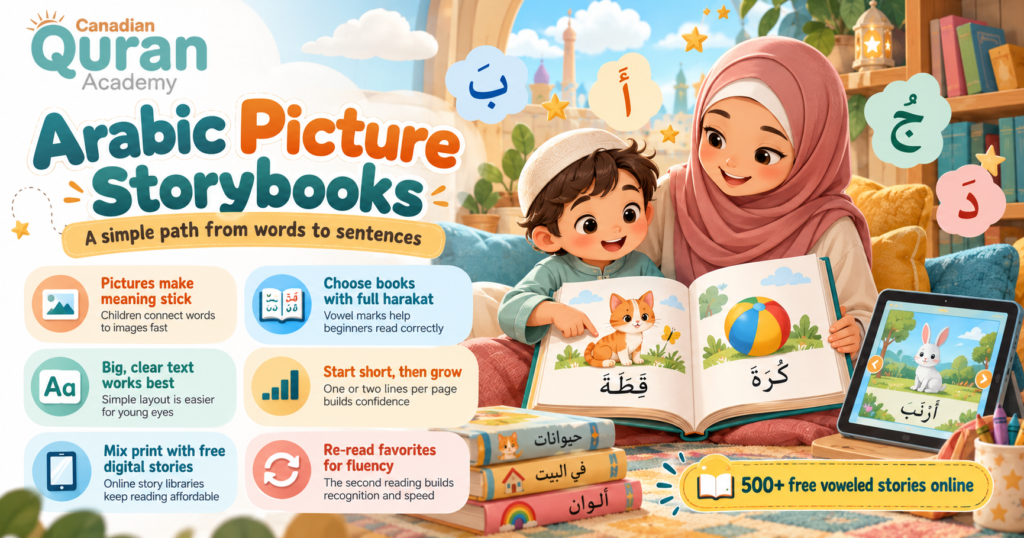
The pictures do the translating. When a child sees a cat beside the word قطة, the meaning sticks without any English explanation. Stories also repeat key words naturally. A short book about a lost ball might use كرة ten times, so your child gets repetition without the boredom of flashcards.
Choose subjects your child already loves, like animals, family, food or school. A familiar topic takes less effort, so your child can focus on the Arabic itself.
Choosing Stories With Full Harakat
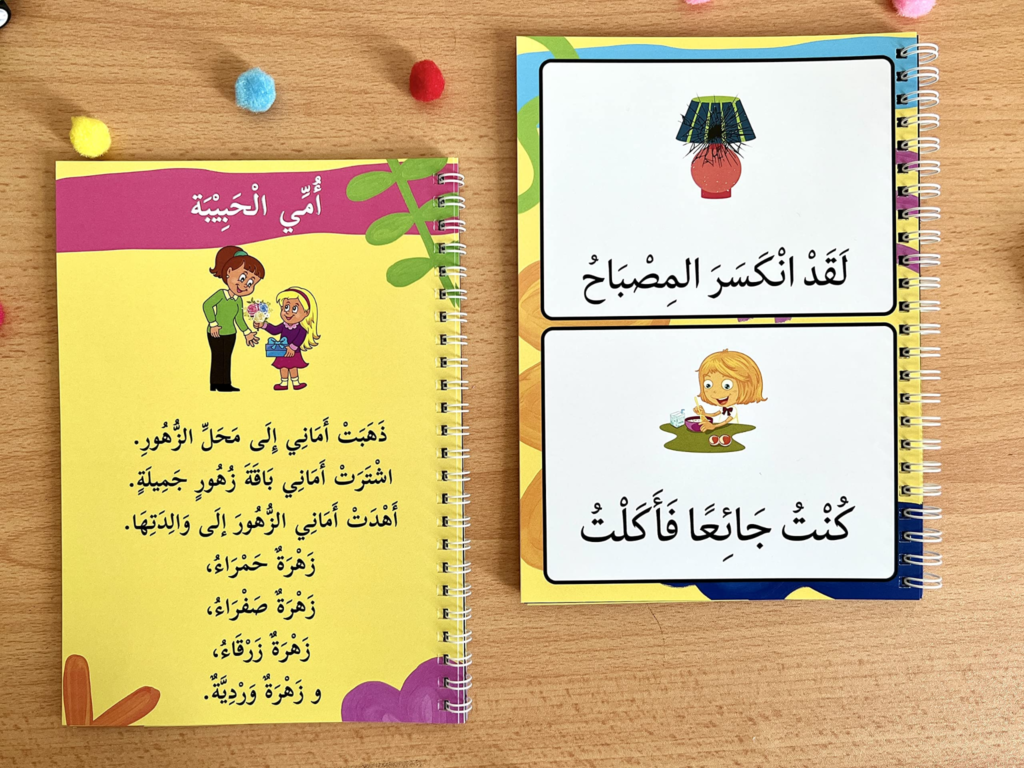
For beginners, choose books with full harakat, the small vowel marks above and below the letters. Without them, new readers have to guess how a word sounds.
Check the font as well. Large, clear script with plenty of spacing is much easier for young eyes than decorative or tightly packed text.
Start with short sentences, one or two lines per page. As your child gains confidence, move on to books with longer paragraphs and fewer pictures.
Free Arabic Storybooks You Can Read Online
Building a home library can get expensive, so mix printed books with free digital ones. You can browse more than 500 voweled stories, sorted by reading level, in StoryWeaver’s free Arabic story collection.
Read one free story on a tablet each evening, then read it again the next day. Fluency grows on the second reading, because your child starts recognizing words instead of sounding them out.
Keep a short list of your child’s favourite titles. Over time, these free Arabic books for kids become a reading log that shows clear progress.
Read also: Quran Verses About Life in Arabic: Meaning, Context, and Guidance
Live Class in Action
Watch how our instructors interact with students in real-time, focusing on interactive methods.
Start Your Quranic Journey in Canada
Join our vibrant community and learn with expert tutors through our flexible online platform.
Claim Your Free Trial3. Bilingual Arabic-English Books For Kids In Canadian Homes
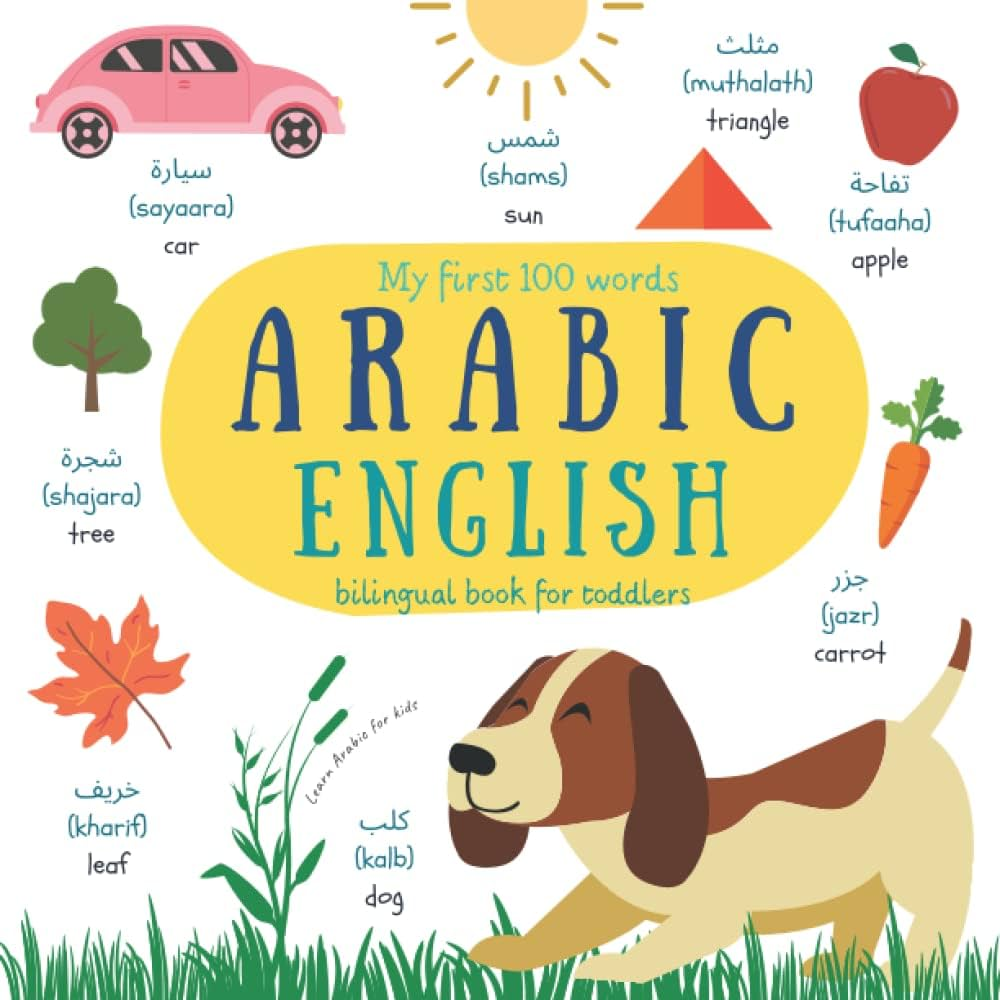
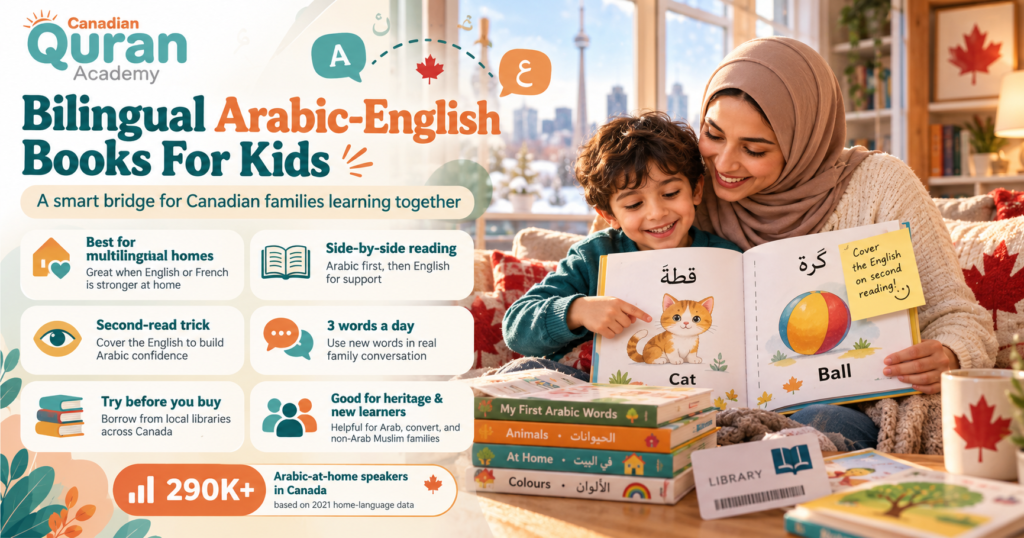
Bilingual books print Arabic and English side by side. They’re a good choice for Canadian families where English or French is the stronger language at home.
Which Families Benefit Most From Bilingual Books
More and more Canadian homes use Arabic. About 290,000 people spoke it mainly at home in 2021, according to Statistics Canada’s overview of home languages.
Many of these children understand Arabic but read mostly in English. Bilingual books meet them at their level, and they let parents who are still learning Arabic read along confidently.
They also help converts and non-Arab Muslim families, where parents want their children to read Arabic but can’t yet model the language themselves.
How To Use Side-By-Side Text Without Leaning On English
On the second reading, cover the English with a sticky note. Your child then has to rely on the pictures and their memory, which strengthens the Arabic.
Read the Arabic line first, every time. If you start with English, children learn to treat the Arabic as optional and soon skip it.
Pick three new words from each book and use them during the day. To turn those words into real conversations, The Canadian Quran Academy offers an Arabic Conversation Course in Canada built around everyday dialogue.
Where To Borrow Bilingual Arabic Books In Canada
Before you buy, check your local public library. Many Canadian libraries have Arabic and bilingual children’s collections, and the Toronto Public Library shows how to browse them in its guide to children’s books in your language.
Borrowing lets you try different formats and levels at no cost. Once you know what your child enjoys, you can buy a few favourites to keep at home.
Not sure whether to choose Modern Standard Arabic or a dialect? Our article Which Arabic Should I Learn in Canada? explains the differences so you can pick books in the right variety.
Recommended reading: Quran Verses About Kindness in Arabic
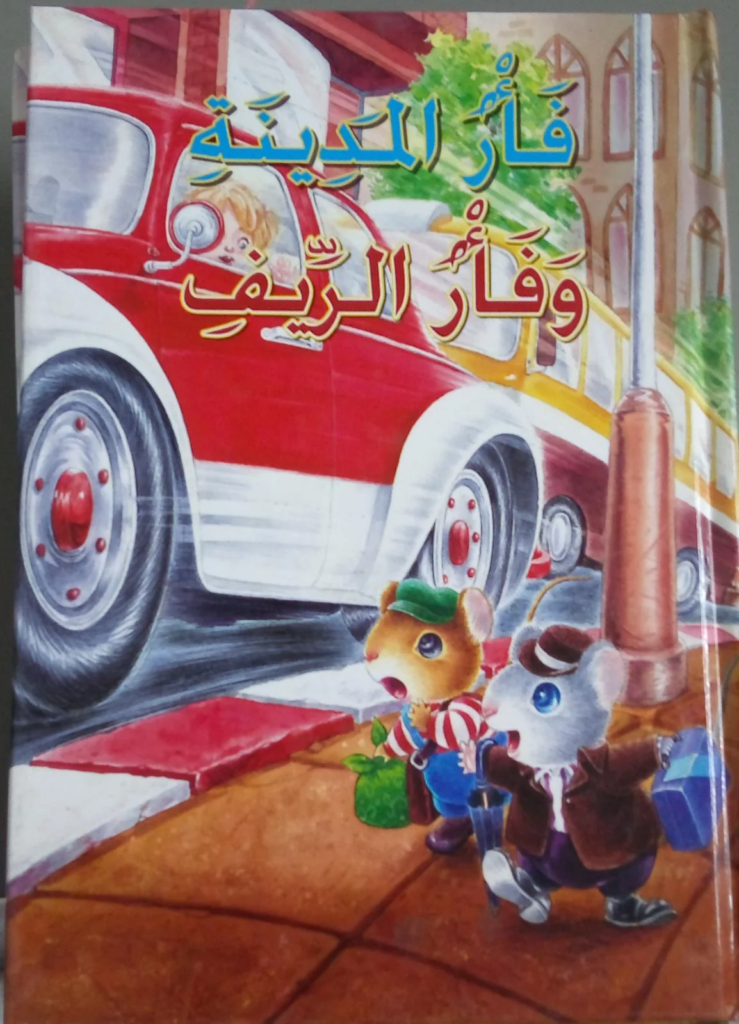
4. Leveled Arabic Readers And Classic Fables For Growing Readers
Leveled readers sort Arabic books for kids by difficulty, so your child always reads something challenging but manageable. Classic fables then give older readers richer language.
How Reading Levels Work In Arabic Books
Leveled series start with single words and short phrases. Each level adds longer sentences, new grammar and fewer pictures, along with a small, planned set of new words.
Early levels keep full harakat. Higher levels drop some vowel marks, which prepares children for the unvoweled text used in newspapers and adult books.
A useful rule: if your child struggles with more than five words on a page, the book is too hard. Go down one level and build fluency first.
Classic Arabic Fables For Confident Readers
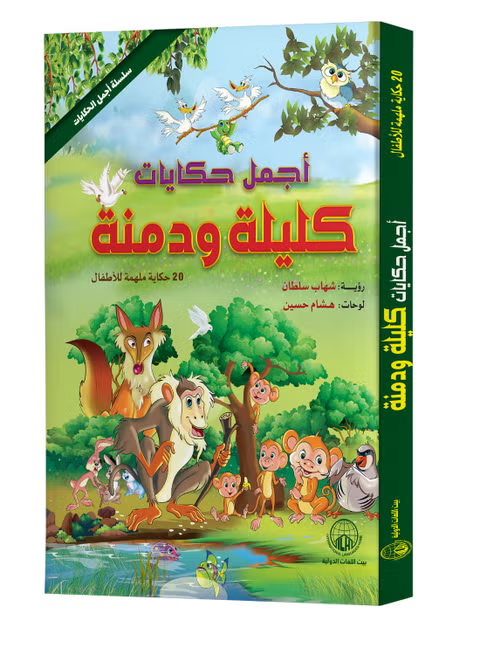
Children aged nine and up enjoy the animal fables of Kalila wa Dimna, which Ibn al-Muqaffa’ translated into Arabic in the eighth century. Many simplified children’s editions are available today.
You can show your child the original, too. The Library of Congress hosts an illustrated 1310 manuscript of Kalila and Dimna with 73 miniature paintings you can browse together.
These fables bring in richer Fusha vocabulary along with moral lessons. To understand that formal style, read our guide What Is Classical Arabic? A Complete Guide to Fusha and Quranic Study.
Pairing Leveled Readers With Structured Lessons
Leveled books work best alongside a curriculum that teaches grammar and vocabulary in the same order. Otherwise, children meet patterns at home that nobody has explained.
The Canadian Quran Academy’s Arabic Elementary School in Canada program follows a clear progression for primary-age learners, so the words taught in class match the words in their readers.
For older children ready for longer texts, the academy’s Arabic Intermediate School in Canada builds reading comprehension, grammar and writing, which makes Arabic chapter books much less intimidating.
Don’t miss: Quran Verses About Humanity in Arabic (With English Translation and Meaning)
5. Islamic And Quran Story Books In Arabic
Islamic story books combine reading practice with faith. They teach children about the prophets, good manners and worship while strengthening their Arabic.
Stories Of The Prophets And Islamic Manners Books
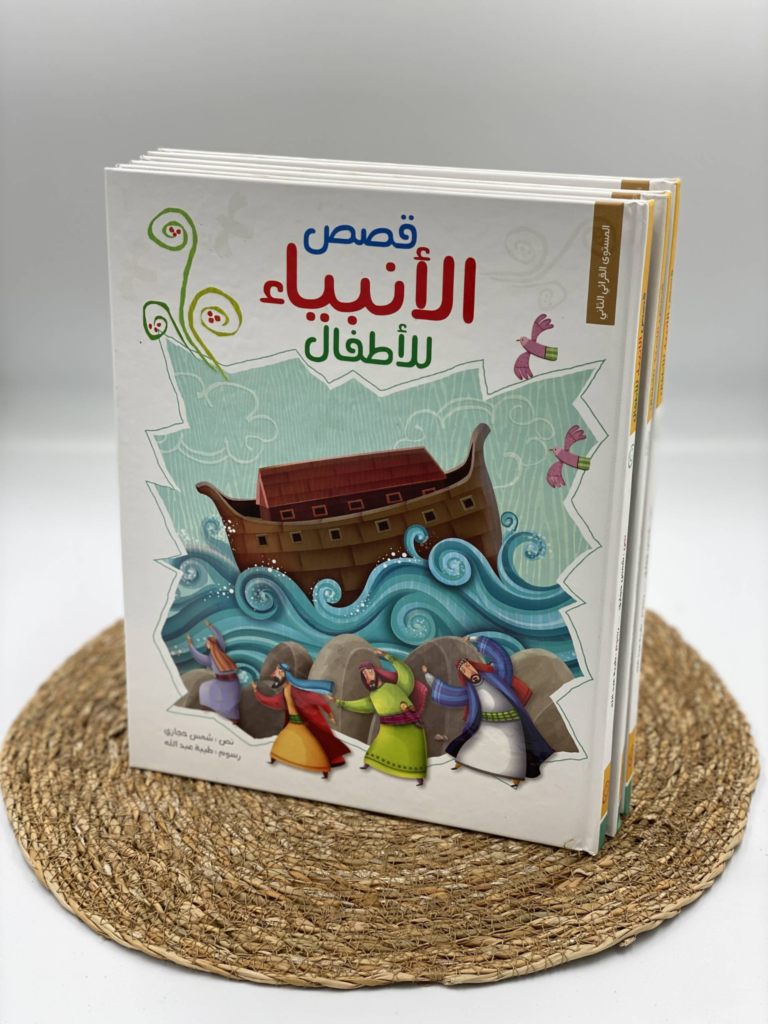
Stories of the prophets, such as Prophet Yunus and the whale or Prophet Nuh and the ark, are favourites because children already know what happens. A familiar story lets them focus on the Arabic words.
Manners books cover everyday topics such as saying Bismillah, honesty, kindness to parents and sharing. Their short sentences and repeated phrases are ideal for early readers.
Check that the content is accurate and suitable for your child’s age. Avoid books that invent details about the prophets, and ask a qualified teacher if you’re unsure about a title.
How Arabic Story Books Help Kids Understand The Quran
Reading Arabic stories builds the vocabulary children will later meet in the Quran. Allah Almighty says:
“إِنَّآ أَنزَلۡنَٰهُ قُرۡءَٰنًا عَرَبِيّٗا لَّعَلَّكُمۡ تَعۡقِلُونَ”
“Indeed, We have sent it down as an Arabic Quran so that you may understand.” — Surah Yusuf 12:2
This verse explains that the Quran was revealed in Arabic so its meanings could be understood. Every Arabic word your child learns brings them closer to understanding what they recite in salah.
Our article Quranic Verses About Arabic Language collects more verses on this topic.
Moving From Story Books To Quranic Arabic
Many words in children’s Islamic books, such as رحمة (mercy), صبر (patience) and جنة (paradise), appear throughout the Quran. Point them out when your child hears them in recitation.
For children ready to go further, The Canadian Quran Academy’s Quranic Arabic Course in Canada teaches the vocabulary and grammar of the Quran step by step.
Make story time part of your family routine, for example after Maghrib or before bed. Reading at the same time every day matters more than reading for a long time.
6. Arabic Activity Books And Workbooks For Writing Practice
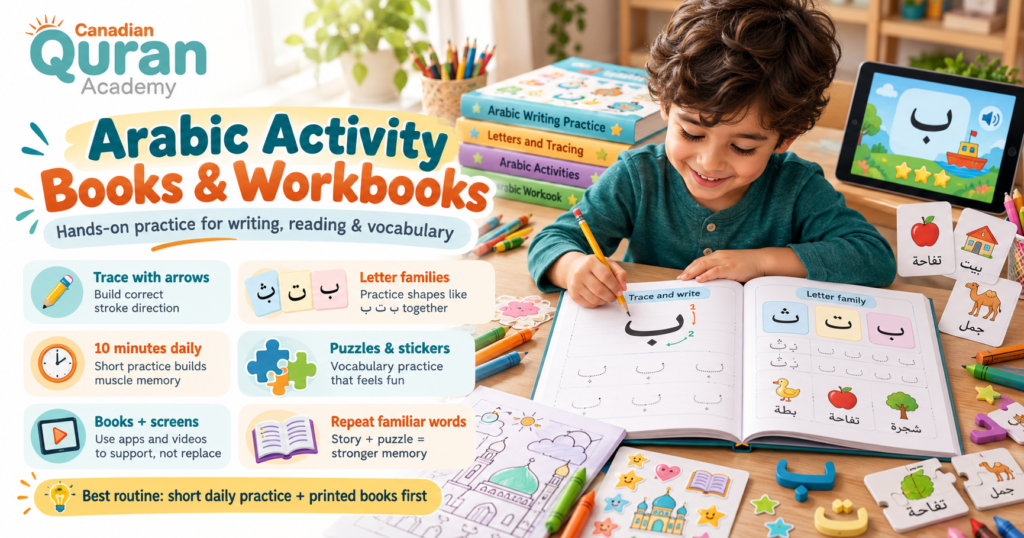
Activity books turn reading into hands-on practice. They keep active children engaged and build handwriting skills that reading alone can’t teach.
Tracing And Handwriting Workbooks
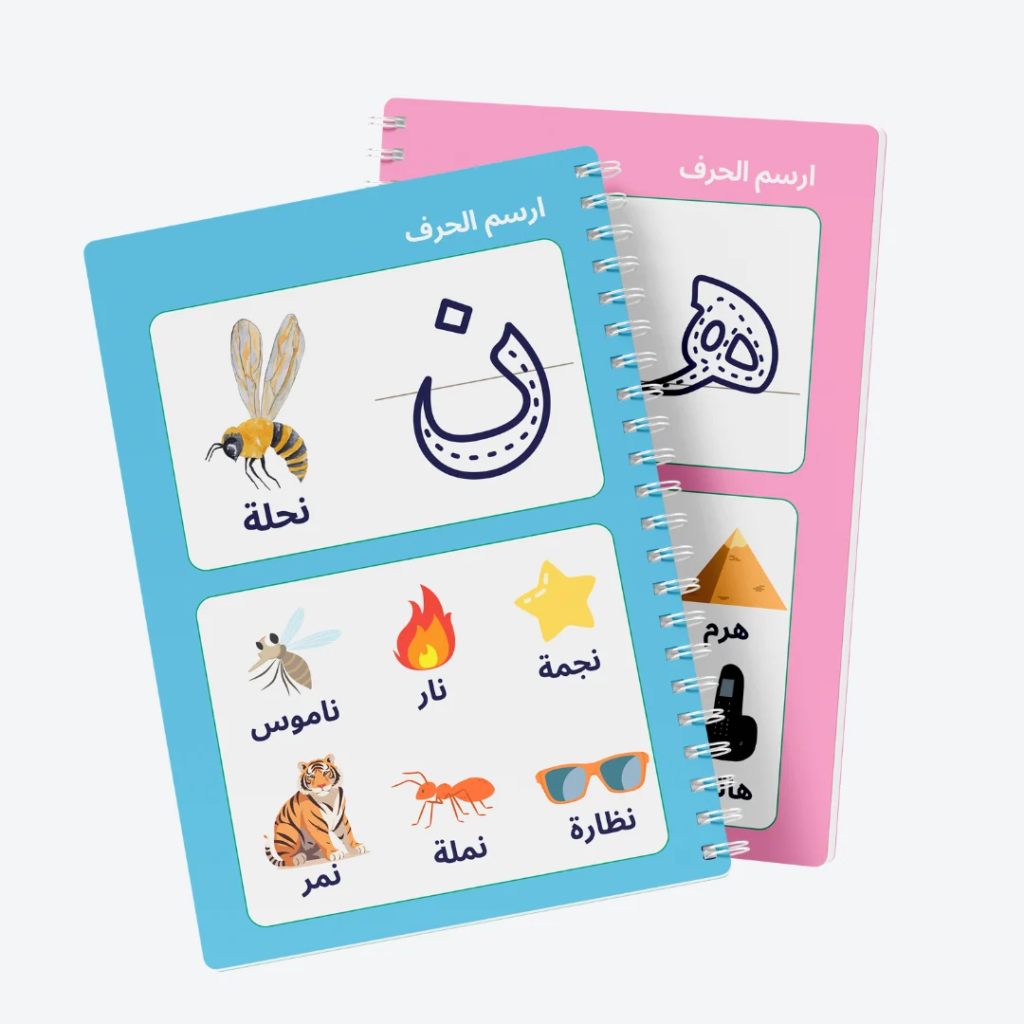
Good tracing workbooks use arrows to show stroke direction and start on the right side of the page, the way Arabic is written. The dotted guides fade gradually until children write on their own.
Practise letter families together, such as ب ت ث, which share one shape and differ only in their dots. Our guide The Arabic Letter Ba (ب) – Meaning, Shapes, and How to Pronounce It shows each form clearly.
Ten minutes of tracing a day beats an hour at the weekend. Short, regular practice builds the muscle memory that makes handwriting smooth.
Puzzle, Coloring, And Sticker Books
Word searches, matching puzzles, colouring pages and sticker scenes reinforce vocabulary from storybooks without feeling like homework.
Use them on car rides, in waiting rooms or during quiet time after school. These low-pressure Arabic books for kids keep the language around in moments that would otherwise go to screens.
Choose activity books that use the same words as your child’s current readers. When a word shows up in both a story and a puzzle, children remember it much more easily.
Free Apps And Videos To Support Your Child’s Books
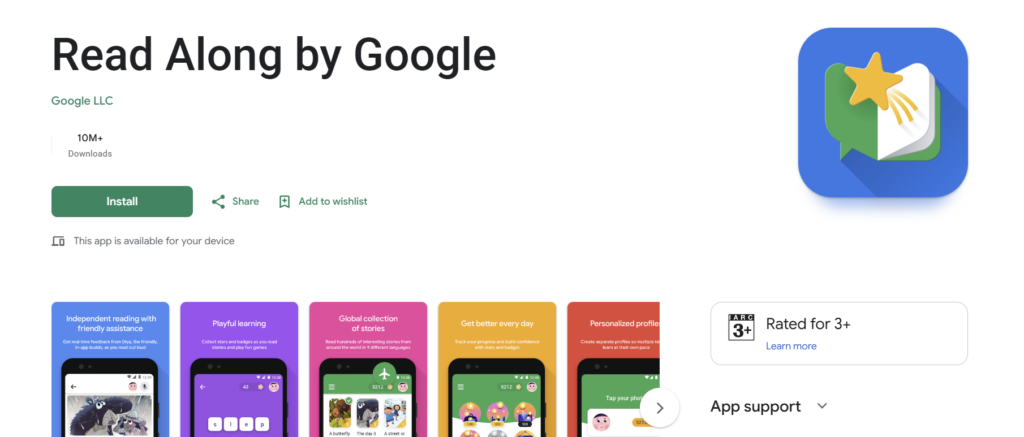
For hands-on reading practice, download Read Along by Google. This free Android app includes Arabic stories, and its built-in reading buddy listens as your child reads aloud. It helps with tricky words and rewards progress with stars. It has no ads or in-app purchases, and it works offline once downloaded.
For listening practice, the official Ahlan Simsim YouTube channel, from the creators of Sesame Street, has free Arabic episodes with friendly characters and clear everyday language.
Use screens to support books, not replace them. After ten minutes of an app or video, go back to a printed book. For more home-study ideas, see How to Learn Arabic on Your Own in Canada.
Help Your Child Read Arabic Confidently With The Canadian Quran Academy
Books give your child the words, but a teacher teaches them to say those words correctly. Even the best Arabic books for kids can’t correct a mispronounced ع or explain why a word changed its ending. The Canadian Quran Academy fills that gap.
Our Online Arabic Classes for Kids in Canada are designed for ages six to fourteen. Lessons use colourful flashcards, animated letter demonstrations and storytelling exercises that feel like the books your child already loves.
Every class is live and one-on-one, so the teacher hears your child read and corrects pronunciation on the spot. Our instructors are trained in teaching children and adjust their approach for a seven-year-old or a twelve-year-old.
Parents always know how things are going. You receive regular progress reports on vocabulary, reading and pronunciation. You can also share the books you use at home, so lessons and bedtime reading support each other.
The curriculum has clear milestones. Children typically learn to recognize the alphabet within about three months and know around two hundred common words within six months.
Class times fit Canadian time zones from Newfoundland to British Columbia and work around school schedules and family routines. Plans start at $18.99 per month, so expert guidance fits most family budgets.

Experience Our Classrooms
Don’t just take our word for it—take a look inside! Watch the videos below to experience our engaging teaching methods and vibrant online classrooms firsthand.
Start Your Quranic Journey in Canada
Join our vibrant community and learn with expert tutors through our flexible online platform.
Claim Your Free TrialGive Your Child A Live Arabic Reading Lesson This Week!
You have the book list. Now give your child a teacher who can help them actually read those pages.
Book a free trial class with The Canadian Quran Academy today. Bring your child’s favourite Arabic book and see how a live one-on-one lesson builds on what you read at home.
Our Arabic Courses:
- Arabic Classes for Adults
- Arabic Classes for Ladies
- Fusha Arabic Course
- Business Arabic Course
- Al-Azhar Arabic Course
- Madinah Arabic Course
- Learning Arabic for Non-Arabic Speakers
- Arabic Elementary School
- Arabic Intermediate School
- Arabic Lessons for Kindergarten
Choose a time that suits your family and let your child read their first Arabic words this week. It only takes one lesson to get started.
Start Your Quranic Journey in Canada
Join our vibrant community and learn with expert tutors through our flexible online platform.
Claim Your Free TrialConclusion
Start with alphabet books that show every letter form, then move to picture storybooks with full harakat. Use bilingual books to support English-dominant homes, and always read the Arabic line first. These early stages build the letters, sounds, and first words your child needs to read with confidence.
As your child grows, work up through leveled readers and classic fables like Kalila wa Dimna. Add Islamic and Quran story books for faith and vocabulary, and use activity books for writing practice. Free apps and videos can then support your reading time without replacing the printed page.
The best Arabic books for kids are the ones that match your child’s level and that you read together every day, even for ten minutes. When pronunciation or grammar gets tricky, a qualified teacher can make sure your child reads correctly. With the right books and steady support, Arabic can become a language your child reads, speaks, and loves.
Frequently Asked Questions
What Age Should Kids Start Reading Arabic Books?
Children can enjoy Arabic board and picture books from age two or three and start reading simple words around five or six. The Canadian Quran Academy’s kindergarten and kids’ programs support each stage with lessons matched to your child’s age.
Should I Choose Arabic Books With Harakat Or Without Them?
Choose books with full harakat for beginners, because the vowel marks show exactly how each word sounds. Teachers at The Canadian Quran Academy help children move to unvoweled text gradually once their reading is secure.
Are Bilingual Arabic-English Books Good For Learning?
Yes, especially in homes where English is stronger, as long as you read the Arabic first every time. The Canadian Quran Academy’s live classes then build the speaking confidence that bilingual books can’t provide alone.
How Many Minutes A Day Should My Child Read In Arabic?
For most young learners, ten to fifteen focused minutes a day is enough, and doing it every day matters more than doing it for longer. The Canadian Quran Academy’s 30-minute classes fit easily alongside this reading routine.
Can My Child Learn Arabic From Books Alone?
Books build vocabulary, but children need a teacher to correct pronunciation and explain grammar. The Canadian Quran Academy combines one-on-one online lessons with your home books, and you can start with a free trial.





Leave a Reply