 Quran
Quran
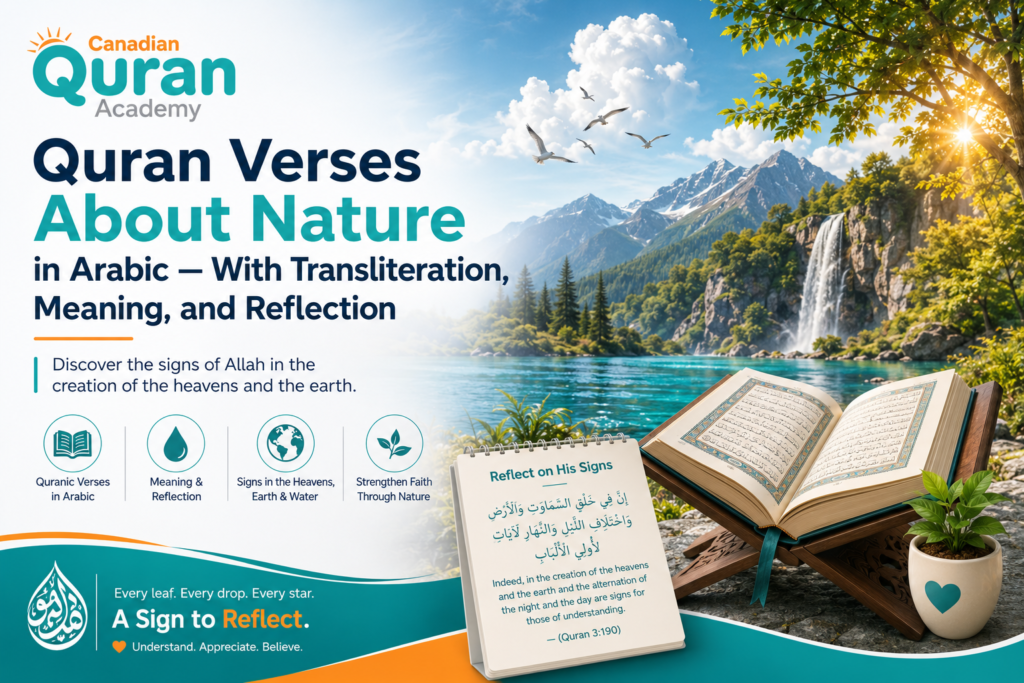
The Quran is not simply a book of commands and prohibitions. It is a book that repeatedly points your gaze outward — to the sky, the rain, the mountains, the birds, the seas — and asks you to think. Every natural phenomenon it describes carries the same Arabic word: آيَة (āyah) — a sign. The same word used for a Quranic verse is the word used for a natural wonder. That is not a coincidence; it is a theological statement.
This article gathers the most significant Quran verses about nature in Arabic, with full Arabic text (diacritical marks included), transliteration, English meaning, and a short reflection on what each verse actually communicates beyond the surface. Reading these in Arabic — even if your Arabic is limited — is worth the effort, because the precision of the original is what most translations flatten.
Why the Quran Uses Nature as a Proof?
Nature in the Quran is not scenery — it is argument. Every mountain, raindrop, and star is presented as evidence for something the reader is being asked to conclude on their own.
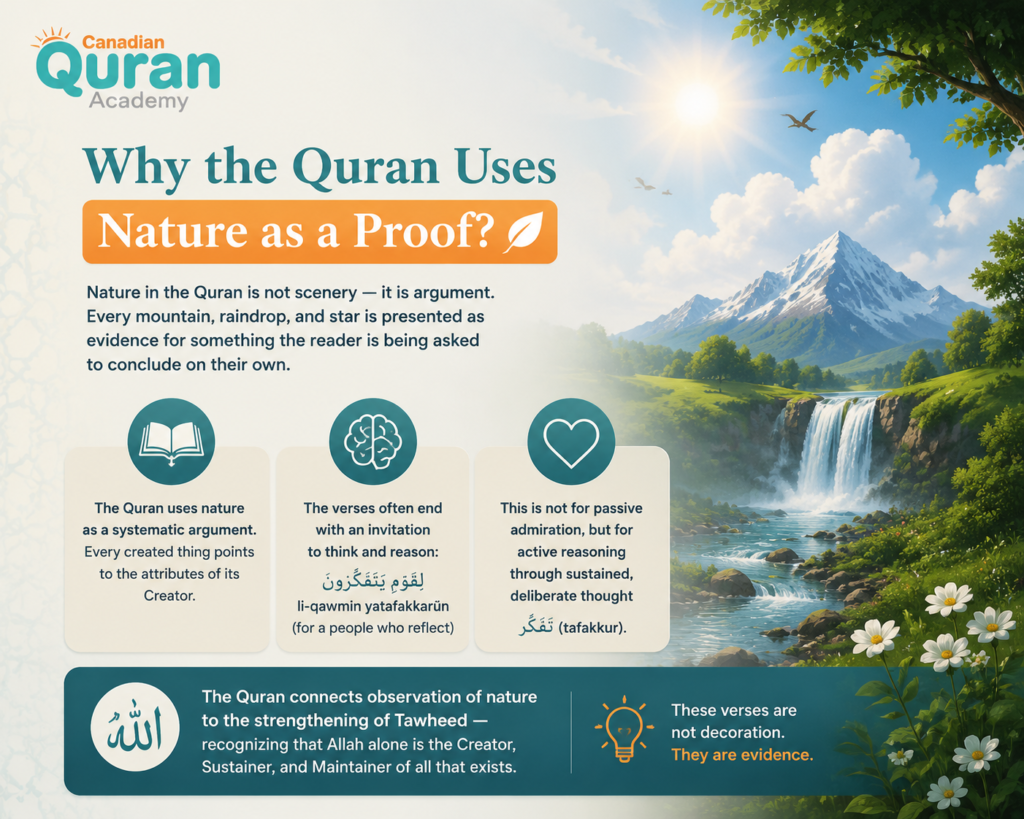
The Quran does not simply admire nature. It uses the natural world as a systematic argument — every created thing points to the attributes of its Creator. The pattern appears across dozens of surahs: a natural phenomenon is described, and then the verse closes with a phrase like li-qawmin yatafakkarūn (for a people who reflect) or li-qawmin yaʿqilūn (for a people who reason).
This closing formula is deliberate. Allah is not asking for passive admiration; He is inviting active reasoning. The word used for reflection — تَفَكُّر (tafakkur) — appears repeatedly and refers to sustained, deliberate thought, not a passing glance.
The Quran connects observation of nature directly to the strengthening of Tawheed — the recognition that Allah alone is the Creator, Sustainer, and Maintainer of all that exists. Understanding this purpose transforms how you read these verses: they are not decoration. They are evidence.
For students building this kind of engagement with Quranic meaning from the ground up, the Intensive Quran Course at Canadian Quran Academy is structured specifically to develop both recitation and comprehension together.
Accelerate Your Quran Learning with a FREE Intensive Trial Class

Quran Verses About the Heavens and the Earth
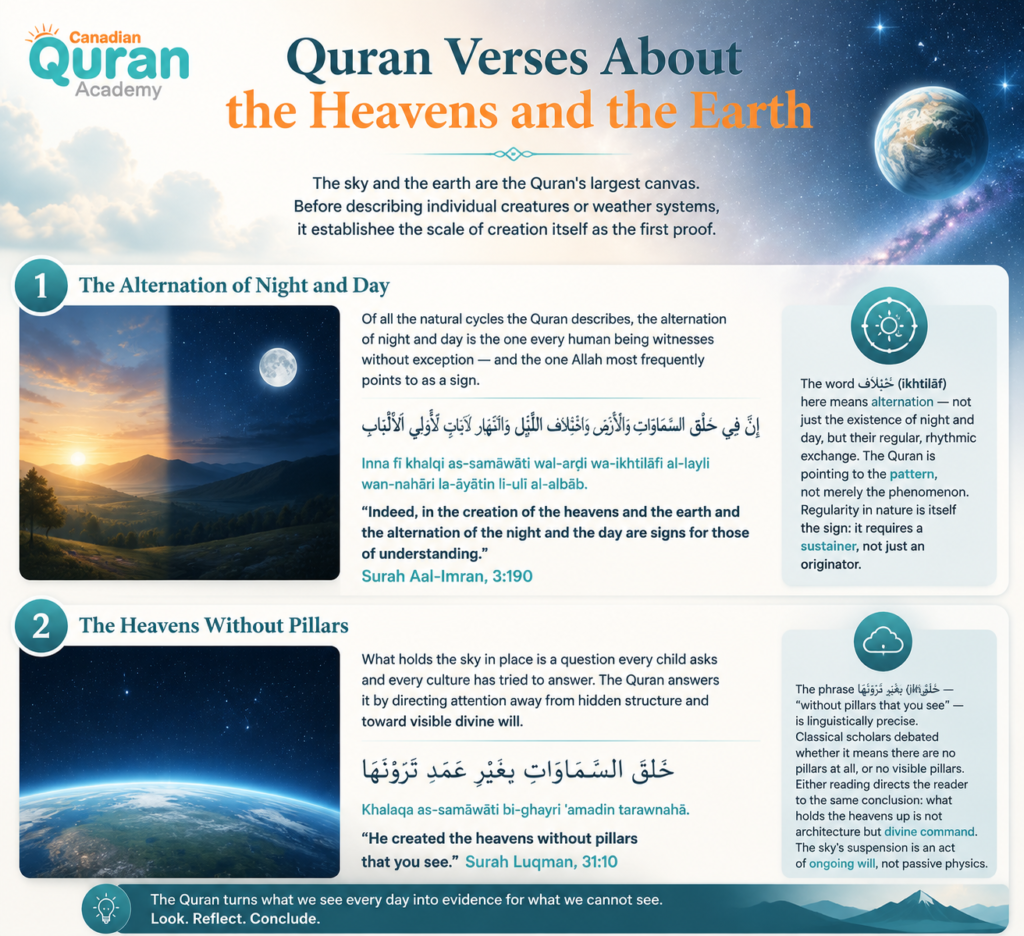
The sky and the earth are the Quran’s largest canvas. Before describing individual creatures or weather systems, it establishes the scale of creation itself as the first proof.
1. The Alternation of Night and Day
Of all the natural cycles the Quran describes, the alternation of night and day is the one every human being witnesses without exception — and the one Allah most frequently points to as a sign.
إِنَّ فِي خَلْقِ السَّمَاوَاتِ وَالْأَرْضِ وَاخْتِلَافِ اللَّيْلِ وَالنَّهَارِ لَآيَاتٍ لِّأُو۟لِي الْأَلْبَابِ
Inna fī khalqi as-samāwāti wal-arḍi wa-ikhtilāfi al-layli wan-nahāri la-āyātin li-ulī al-albāb.
“Indeed, in the creation of the heavens and the earth and the alternation of the night and the day are signs for those of understanding.” Surah Aal-Imran, 3:190
The word اخْتِلَاف (ikhtilāf) here means alternation — not just the existence of night and day, but their regular, rhythmic exchange. The Quran is pointing to the pattern, not merely the phenomenon. Regularity in nature is itself the sign: it requires a sustainer, not just an originator.
2. The Heavens Without Pillars
What holds the sky in place is a question every child asks and every culture has tried to answer. The Quran answers it by directing attention away from hidden structure and toward visible divine will.
خَلَقَ السَّمَاوَاتِ بِغَيْرِ عَمَدٍ تَرَوْنَهَا
Khalaqa as-samāwāti bi-ghayri ʿamadin tarawnahā.
“He created the heavens without pillars that you see.” Surah Luqman, 31:10
The phrase بِغَيْرِ عَمَدٍ تَرَوْنَهَا — “without pillars that you see” — is linguistically precise. Classical scholars debated whether it means there are no pillars at all, or no visible pillars. Either reading directs the reader to the same conclusion: what holds the heavens up is not architecture but divine command. The sky’s suspension is an act of ongoing will, not passive physics.
Read More: Quranic Verses on Trust in Allah in Arabic
Read also: Quran Verses About Nature in Arabic
Quran Verses About Rain and Water
Water is the Quran’s primary symbol for mercy, and its description of the water cycle is one of the most recurring natural themes across the entire scripture.
1. Rain After Despair
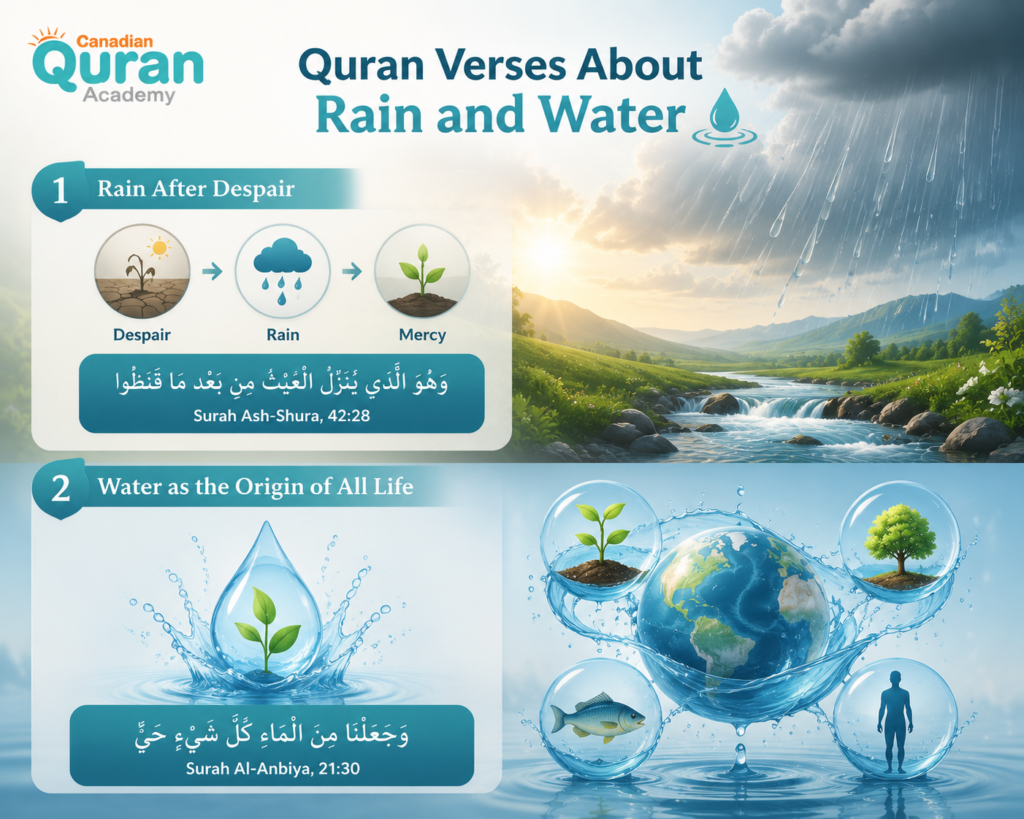
This verse does not describe rain at the height of abundance. It describes rain that arrives specifically when people have already given up — which is when its meaning as a mercy becomes impossible to miss.
وَهُوَ الَّذِي يُنَزِّلُ الْغَيْثَ مِن بَعْدِ مَا قَنَطُوا وَيَنشُرُ رَحْمَتَهُ وَهُوَ الْوَلِيُّ الْحَمِيدُ
Wa huwa alladhī yunazzilu al-ghaytha min baʿdi mā qanatū wa-yanshuru raḥmatahu, wa-huwa al-waliyyu al-ḥamīd.
“And He it is who sends down the rain after they had despaired and spreads His mercy. And He is the Protector, the Praiseworthy.” Surah Ash-Shura, 42:28
The word قَنَطُوا (qanatū — they despaired) is key. This verse does not describe rain in abundance; it describes rain that arrives specifically after hope has been abandoned. The theological point is that Allah’s mercy is not conditional on human optimism — it operates on His schedule, not ours.
2. Water as the Origin of All Life
Before modern biology had a name for cellular hydration, the Quran stated in a single sentence what science would later spend centuries confirming.
وَجَعَلْنَا مِنَ الْمَاءِ كُلَّ شَيْءٍ حَيٍّ
Wa jaʿalnā mina al-māʾi kulla shayʾin ḥayy.
“And We made from water every living thing.” Surah Al-Anbiya, 21:30
This verse was revealed fourteen centuries before modern biology confirmed that all cellular life depends on water for its basic functions. The Arabic كُلَّ شَيْءٍ حَيٍّ — “every living thing” — uses an absolute construction that leaves no exceptions. The Quran does not say “most” or “many.” It says all.
Read also: Quranic Verses on Cleanliness in Arabic
Quran Verses About Mountains
Mountains appear in the Quran in two very different roles: as anchors that stabilize the earth, and as objects that will one day be set in motion. Both descriptions carry the same point — their existence, and their fate, are entirely under divine command.
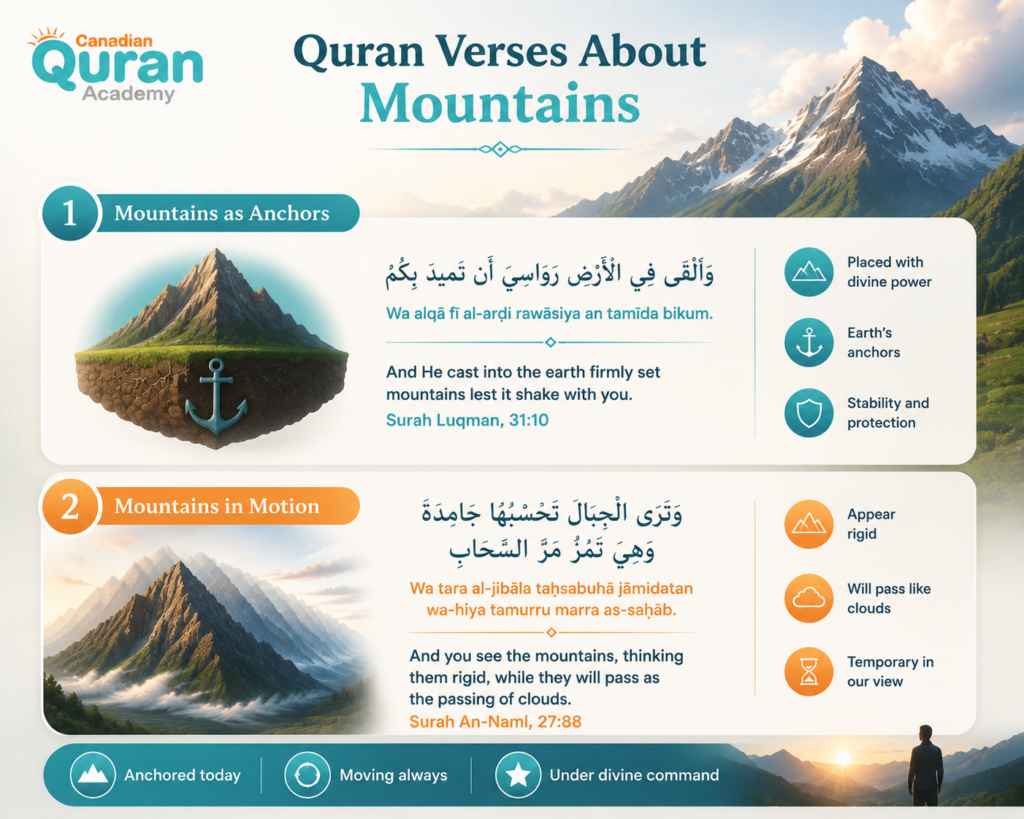
وَأَلْقَى فِي الْأَرْضِ رَوَاسِيَ أَن تَمِيدَ بِكُمْ
Wa alqā fī al-arḍi rawāsiya an tamīda bikum.
“And He cast into the earth firmly set mountains lest it shake with you.” Surah Luqman, 31:10
The verb أَلْقَى (alqā — He cast, threw) is striking. Mountains are described not as slowly formed geological structures but as something placed deliberately, with intention and force. The word رَوَاسِيَ (rawāsiya) comes from the root meaning to anchor — the same word used for a ship’s anchor. Mountains are the earth’s anchors.
وَتَرَى الْجِبَالَ تَحْسَبُهَا جَامِدَةً وَهِيَ تَمُرُّ مَرَّ السَّحَابِ
Wa tara al-jibāla taḥsabuhā jāmidatan wa-hiya tamurru marra as-saḥāb.
“And you see the mountains, thinking them rigid, while they will pass as the passing of clouds.” Surah An-Naml, 27:88
This verse, describing the Day of Judgment, is also linguistically remarkable in how it frames human perception: تَحْسَبُهَا — “you think them” — positions the apparent solidity of mountains as a cognitive error. What looks permanent is temporary. What appears fixed is moving on a timescale beyond human perception. Modern plate tectonics confirms that mountains move continuously, even if imperceptibly.
Experience Our Classrooms
Don’t just take our word for it—take a look inside! Watch the videos below to experience our engaging teaching methods and vibrant online classrooms firsthand.
Start Your Quranic Journey in Canada
Join our vibrant community and learn with expert tutors through our flexible online platform.
Claim Your Free TrialQuran Verses About Plants, Fruits, and the Earth’s Growth
The Quran returns to the image of the earth producing vegetation after rain more than almost any other natural image. Each time, it adds a detail the previous verse did not include.
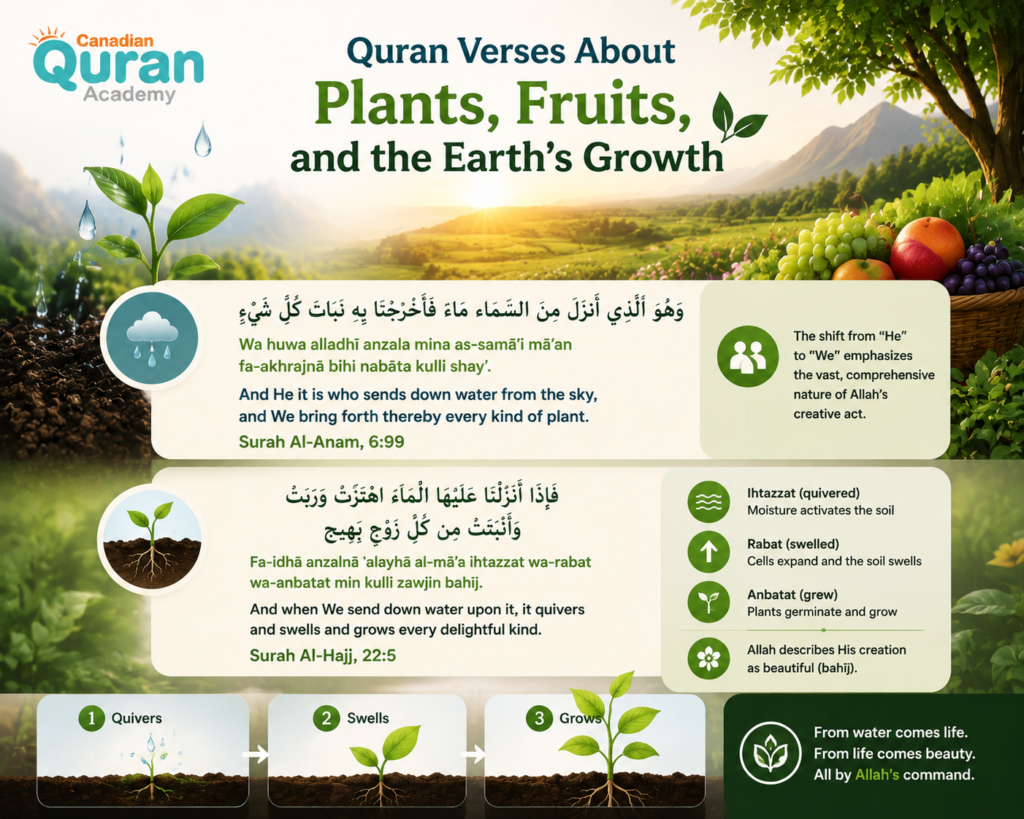
وَهُوَ الَّذِي أَنزَلَ مِنَ السَّمَاءِ مَاءً فَأَخْرَجْنَا بِهِ نَبَاتَ كُلِّ شَيْءٍ
Wa huwa alladhī anzala mina as-samāʾi māʾan fa-akhrajnā bihi nabāta kulli shayʾ.
“And He it is who sends down water from the sky, and We bring forth thereby every kind of plant.” Surah Al-Anam, 6:99
Notice the pronoun shift mid-verse — the verse begins with “He” and then switches to “We.” This grammatical shift, known in Arabic as iltifāt, is a rhetorical feature of the Quran that draws attention to a change in emphasis. The “We” highlights the comprehensive and multi-faceted nature of Allah’s creative act.
فَإِذَا أَنزَلْنَا عَلَيْهَا الْمَاءَ اهْتَزَّتْ وَرَبَتْ وَأَنبَتَتْ مِن كُلِّ زَوْجٍ بَهِيجٍ
Fa-idhā anzalnā ʿalayhā al-māʾa ihtazzat wa-rabat wa-anbatat min kulli zawjin bahīj.
“And when We send down water upon it, it quivers and swells and grows every delightful kind.” Surah Al-Hajj, 22:5
Three verbs in sequence: اهْتَزَّتْ (quivered), رَبَتْ (swelled), أَنبَتَتْ (grew). The Quran describes the biological response of soil to water in a three-stage process that modern botany recognizes — moisture activation, cell expansion, germination. The word بَهِيجٍ (bahīj — delightful, beautiful) is not a scientific term; it is an aesthetic one. Allah describes His own creation as beautiful.
For children beginning to connect Quranic words to the world around them, the Quran for Kids program at Canadian Quran Academy introduces these verses in an interactive, age-appropriate way that builds both recitation and meaning from the start.
Give Your Child the Gift of Quran Learning with a FREE Trial Class
Read More: Quranic Verses About Water in Arabic
Quran Verses About the Sun, Moon, and Stars
The celestial bodies appear in the Quran as instruments — tools created in service of human life and navigation, subjected to a command they cannot refuse.
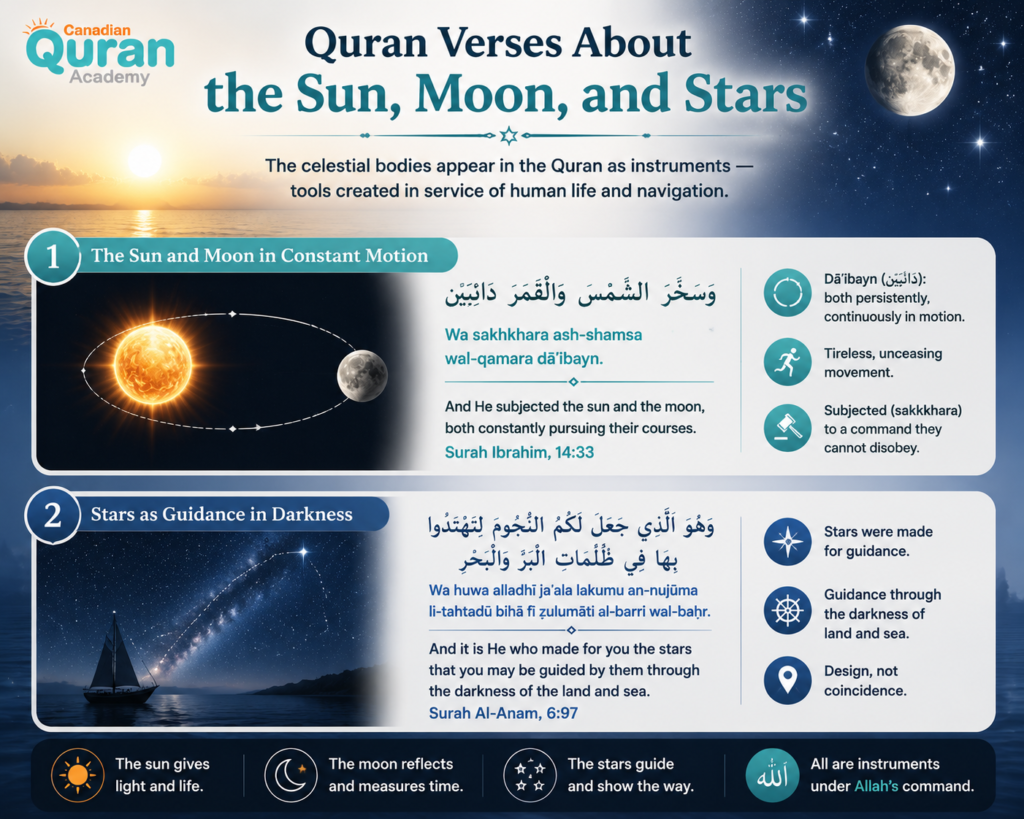
1. The Sun and Moon in Constant Motion
The Quran does not describe the sun and moon as objects hanging in the sky. It describes them as workers — tireless, continuous, and operating under a command they have no power to pause.
وَسَخَّرَ الشَّمْسَ وَالْقَمَرَ دَائِبَيْنِ
Wa sakhkhara ash-shamsa wal-qamara dāʾibayn.
“And He subjected the sun and the moon, both constantly pursuing their courses.” Surah Ibrahim, 14:33
دَائِبَيْنِ (dāʾibayn) is a dual form meaning “both persistently, continuously in motion.” The root carries the sense of tireless, unceasing labor. The Quran is not describing the sun and moon as static objects but as entities in perpetual, purposeful movement — subjected (sakhkhara) to a command they cannot disobey.
2. Stars as Guidance in Darkness
Stars existed long before compasses and GPS. The Quran describes their navigational function not as a lucky coincidence but as an explicit design — they were made for guidance, and the Arabic grammar says exactly that.
وَهُوَ الَّذِي جَعَلَ لَكُمُ النُّجُومَ لِتَهْتَدُوا بِهَا فِي ظُلُمَاتِ الْبَرِّ وَالْبَحْرِ
Wa huwa alladhī jaʿala lakumu an-nujūma li-tahtadū bihā fī ẓulumāti al-barri wal-baḥr.
“And it is He who made for you the stars that you may be guided by them through the darkness of the land and sea.” Surah Al-Anam, 6:97
لِتَهْتَدُوا — “so that you may be guided” — is a lam of purpose. The stars were created for navigation. This is the Quran asserting that the universe has instrumental purpose — things exist not randomly but in service of human benefit and, through that benefit, as proof of divine generosity.
Quran Verses About Birds, Animals, and Seas
Living creatures occupy a distinct category in the Quran’s argument from nature. Unlike mountains or rain, they move, act, and in some cases communicate — and the Quran uses each of these qualities as a separate angle of proof.
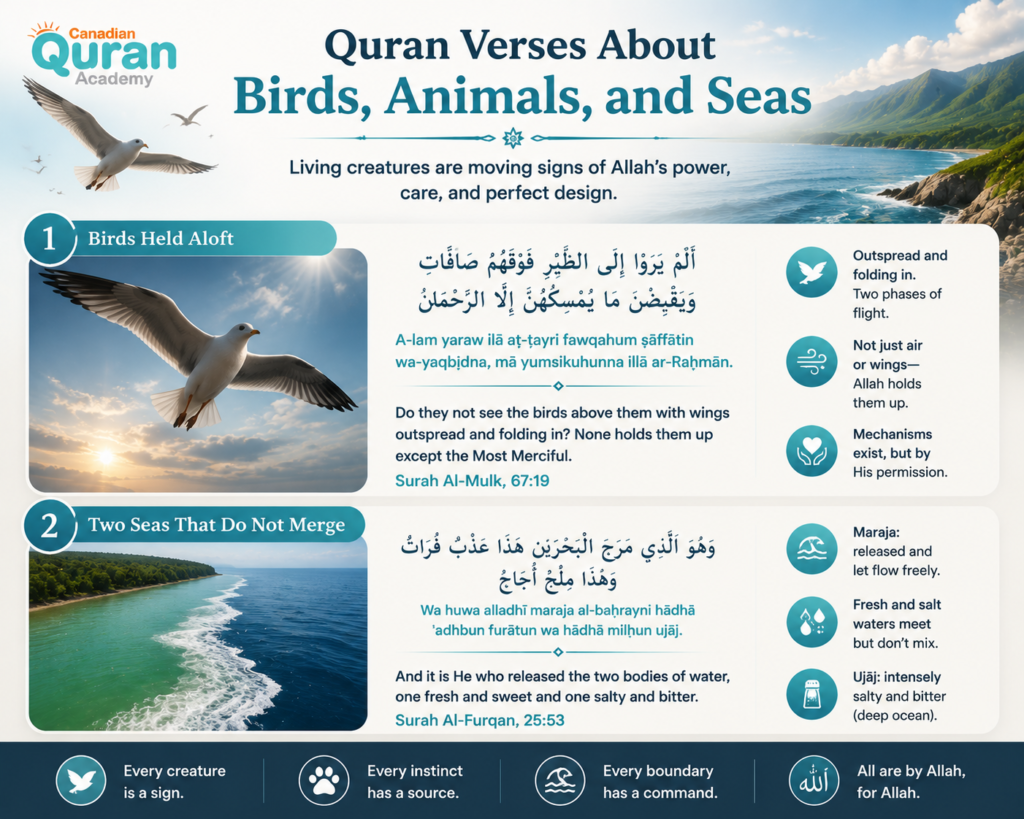
1. Birds Held Aloft
A bird in flight is one of the most ordinary sights in the natural world. The Quran asks you to look at it again — and tells you what you are actually seeing when you do.
أَلَمْ يَرَوْا إِلَى الطَّيْرِ فَوْقَهُمْ صَافَّاتٍ وَيَقْبِضْنَ مَا يُمْسِكُهُنَّ إِلَّا الرَّحْمَانُ
A-lam yaraw ilā aṭ-ṭayri fawqahum ṣāffātin wa-yaqbiḍna, mā yumsikuhunna illā ar-Raḥmān.
“Do they not see the birds above them with wings outspread and folding in? None holds them up except the Most Merciful.” Surah Al-Mulk, 67:19
صَافَّاتٍ وَيَقْبِضْنَ — “outspread and folding in” — describes the two phases of bird flight with aerodynamic precision: gliding with extended wings, then beating with folded ones. The Quran then says that what holds them up is not air pressure or wing design alone — those are mechanisms — but الرَّحْمَان Himself. The mechanisms are real; they operate under continuous divine permission.
2. Two Seas That Do Not Merge
Where a great river meets the ocean, fresh and salt water touch but do not immediately become one. The Quran describes this boundary not as a physical phenomenon but as a divine boundary set and maintained by command.
وَهُوَ الَّذِي مَرَجَ الْبَحْرَيْنِ هَذَا عَذْبٌ فُرَاتٌ وَهَذَا مِلْحٌ أُجَاجٌ
Wa huwa alladhī maraja al-baḥrayni hādhā ʿadhbun furātun wa hādhā milḥun ujāj.
“And it is He who released the two bodies of water, one fresh and sweet and one salty and bitter.” Surah Al-Furqan, 25:53
مَرَجَ (maraja) means to release or let flow freely. The verse describes haloclines — the physical boundary zones where fresh and salt water meet but do not fully mix, a phenomenon observed at river mouths and marine estuaries. The word أُجَاجٌ (ujāj — intensely bitter and salty) is specifically stronger than just “salty,” capturing the sharp taste of deep ocean water rather than brackish coastal water.
Students working through memorization who want these verses to become deeply embedded rather than phonetically stored benefit significantly from understanding their meaning. The Hifz program at Canadian Quran Academy builds memorization on comprehension — students who know what they are memorizing retain it far more reliably than those working from sound alone.
Start Your Quran Memorization Journey with a FREE Trial Class

Read More: Quranic Verses on Shukr in Arabic and English
Quran Verses About the Wind and Clouds
Wind and clouds are among the most dynamic natural systems the Quran describes — not as weather, but as instruments of a will that sets them in motion and directs where they go.
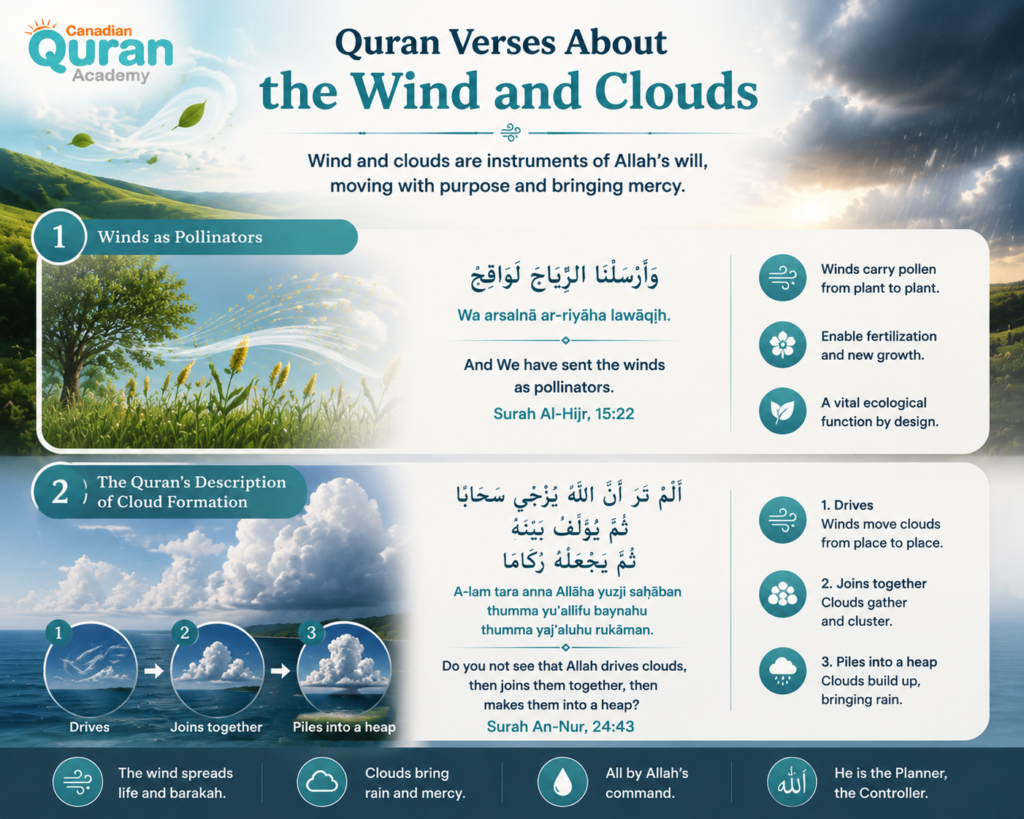
1. Winds as Pollinators
The wind’s role in plant reproduction is a biological fact. The Quran names it in a single Arabic word that most classical readers understood only partially — because the full meaning required a knowledge of botany they did not yet have.
وَأَرْسَلْنَا الرِّيَاحَ لَوَاقِحَ
Wa arsalnā ar-riyāḥa lawāqiḥ.
“And We have sent the winds as pollinators.” Surah Al-Hijr, 15:22
لَوَاقِحَ (lawāqiḥ) is the plural of lāqiḥ, a word that specifically means “one that causes fertilization.” In classical Arabic, this term was used for the act of a male animal fertilizing a female. Applied to wind, it is an explicit description of wind pollination — a biological process not understood in its mechanics until the modern era. The Quran uses a single word to capture a complex ecological function.
2. The Quran’s Description of Cloud Formation
Cloud formation is not a random process. The Quran describes it in three stages — movement, clustering, accumulation — matching the sequence that modern meteorology has since named and measured.
أَلَمْ تَرَ أَنَّ اللَّهَ يُزْجِي سَحَابًا ثُمَّ يُؤَلِّفُ بَيْنَهُ ثُمَّ يَجْعَلُهُ رُكَامًا
A-lam tara anna Allāha yuzjī saḥāban thumma yuʾallifu baynahu thumma yajʿaluhu rukāman.
“Do you not see that Allah drives clouds, then joins them together, then makes them into a heap?” Surah An-Nur, 24:43
Three stages: يُزْجِي (drives), يُؤَلِّفُ (joins together), يَجْعَلُهُ رُكَامًا (piles into a heap). Meteorologists describe cloud formation in precisely these phases — advection moves air masses, convergence causes clouds to cluster, and convective uplift builds cumulonimbus towers that produce heavy rain. The Quran describes the mechanism without the terminology.
Live Class in Action
Watch how our instructors interact with students in real-time, focusing on interactive methods.
Start Your Quranic Journey in Canada
Join our vibrant community and learn with expert tutors through our flexible online platform.
Claim Your Free TrialRead More: Quranic Verses About Parents in Arabic
Explore Quranic Verses About Nature with Canadian Quran Academy
The Quran invites us to look at the natural world with reflection, revealing signs of Allah’s wisdom, power, and mercy in every aspect of creation. Reading these verses in their original Arabic allows you to appreciate the precision, beauty, and depth of meaning that translations alone cannot fully convey.
At Canadian Quran Academy, our qualified teachers help students of all ages build a strong foundation in Quran reading, Tajweed, and Quranic Arabic through personalized online classes. As your understanding grows, verses about the heavens, mountains, rain, plants, and every sign of Allah’s creation become more meaningful and inspiring.
Start learning with the Canadian Quran Academy today and discover the beauty of the Quran in its original Arabic.
Our Quran Courses
- Quran Online Academy
- Quran Recitation Classes
- Quran Reading Classes
- Online Quran Classes for Kids
- Quran Classes for Adults
- Quran Classes for Female
- Learn Quran Course for Beginners
- Quran Memorization (Hifz) Course
- Hifz Classes for Adults
- Quran Memorization and Hifz Course for Kids
Start Your Quranic Journey in Canada
Join our vibrant community and learn with expert tutors through our flexible online platform.
Claim Your Free TrialConclusion
The Quran verses about nature in Arabic span the entire scope of creation — from the structure of the heavens to the biology of bees, from the precision of rainfall to the flight mechanics of birds. What unifies them is a single consistent argument: every natural system, process, and creature is a sign (āyah) pointing to its Creator. The Arabic word for a Quranic verse and the word for a natural sign are the same — and that identity is the Quran’s deepest statement about the relationship between scripture and creation.
Reading these verses in Arabic, rather than only in translation, reveals a layer of meaning that English cannot fully carry. A single word like لَوَاقِحَ contains what English needs four words to say. A grammatical shift mid-verse signals a change in theological emphasis. A closing formula like li-qawmin yatafakkarūn is a direct invitation — directed at you, individually — to think.
Frequently Asked Questions
The Quran invites believers to observe the natural world with reflection, recognizing every aspect of creation as a sign of Allah’s wisdom and power. Below are answers to some of the most frequently asked questions about nature in the Quran.
What does the Quran say about the beauty of nature?
The Quran consistently presents nature as a system of signs (āyāt) pointing to Allah’s power, wisdom, and mercy. Verses across dozens of surahs describe the heavens, rain, mountains, plants, animals, and seas — not as decoration but as evidence. The Arabic word آيَة means both “a Quranic verse” and “a natural sign,” reflecting the Quran’s view that creation and revelation are parallel proofs of the same Creator.
Which Quran verse describes all life coming from water?
Surah Al-Anbiya, 21:30 states وَجَعَلْنَا مِنَ الْمَاءِ كُلَّ شَيْءٍ حَيٍّ — “And We made from water every living thing.” The Arabic construction uses an absolute form (كُلَّ شَيْءٍ — every thing) with no exception. This verse was revealed centuries before modern biology confirmed that all cellular life depends on water as its primary medium.
Why does the Quran close many nature verses with “for people who reflect”?
The closing formulas — لِقَوْمٍ يَتَفَكَّرُونَ (for people who reflect), لِقَوْمٍ يَعْقِلُونَ (for people who reason), لِقَوْمٍ يُؤْمِنُونَ (for people who believe) — are deliberate conditions. The Quran is not addressing passive observers; it is addressing those who engage their minds and faith when they look at creation. Observation without reflection yields no sign. It is the reasoning that converts a natural phenomenon into recognition of Allah.
Is it better to read Quran verses about nature in Arabic or in English?
Reading in both is ideal — English for understanding the meaning, Arabic for engaging the linguistic precision. Many Quranic nature terms carry meanings that English phrases approximate but cannot equal: رَوَاسِيَ (firmly anchored mountains), لَوَاقِحَ (fertilizing winds), دَائِبَيْنِ (both ceaselessly in motion). Learning even basic Quranic Arabic opens access to these layers that translation necessarily flattens.
How can children learn these nature verses effectively?
Connecting verses to things children can see — the rain, birds, the sky, fruit — makes them immediately memorable. The Quran for Kids program at Canadian Quran Academy links recitation to the world around the child so that learning becomes experiential rather than abstract. Short verses like 21:30 and 67:19 are particularly suited to early memorization because they are brief, visually concrete, and immediately verifiable by looking outside.
What is the significance of the word āyah referring to both a verse and a natural sign?
آيَة (āyah) means “sign” or “proof.” The Quran uses this same word for its own verses and for natural phenomena. This linguistic identity is theological: the Quran is stating that revealed scripture and the created world are parallel forms of evidence for the same truth. Reading a verse and observing nature are, at a fundamental level, the same act of receiving a sign from Allah.






Leave a Reply